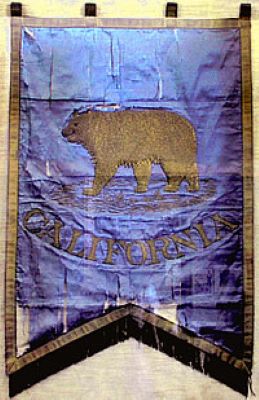
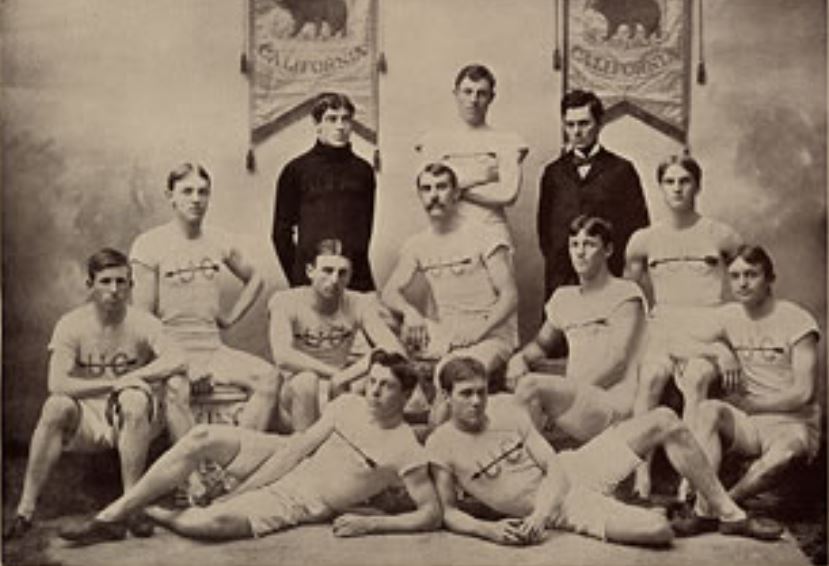
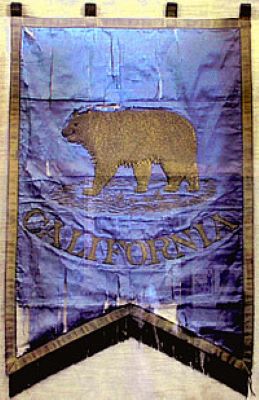
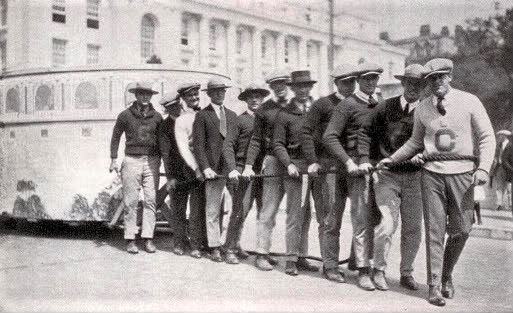
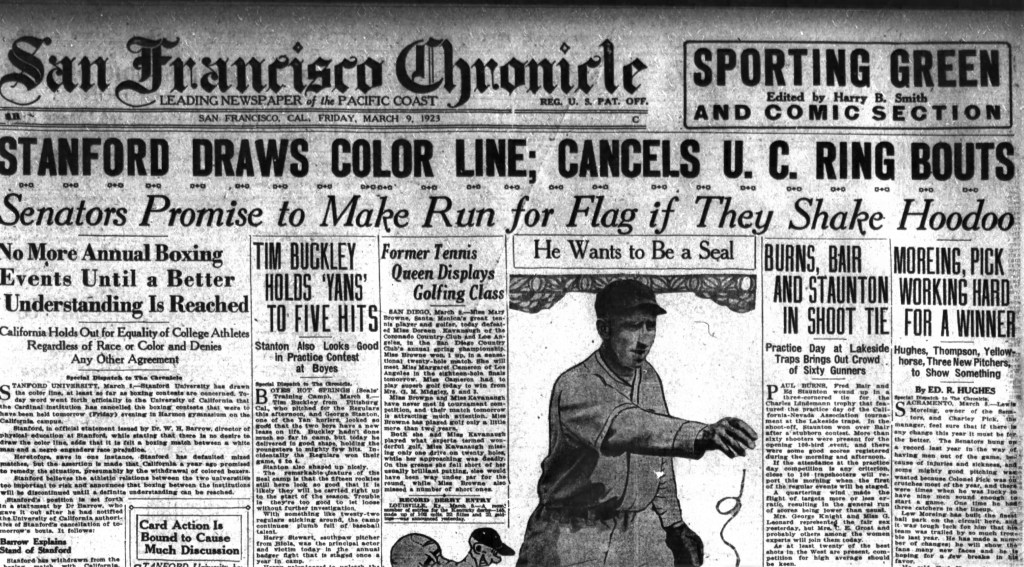
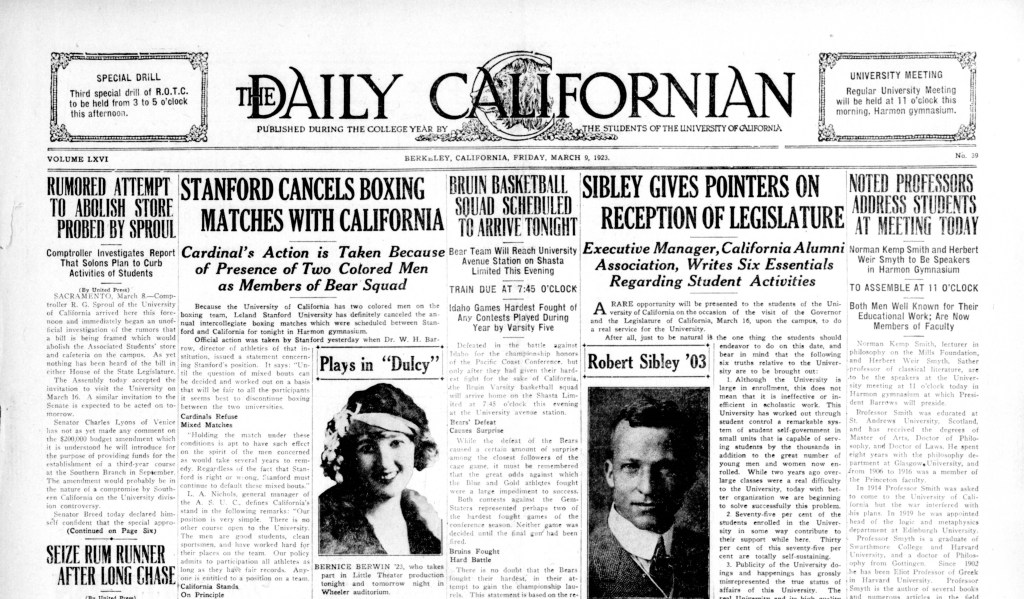
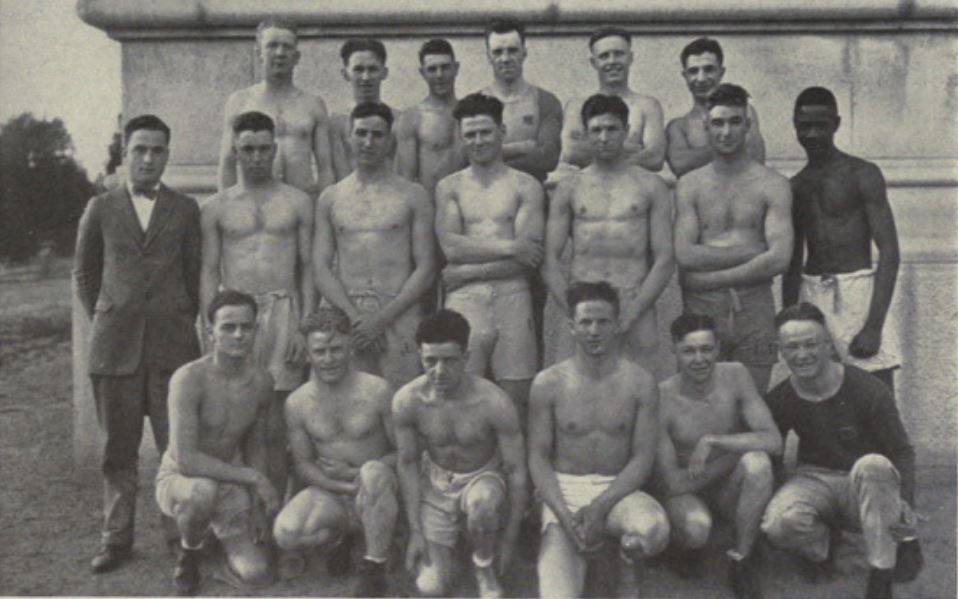
On May 2, 1895, eleven members of the California Track and Field team boarded a train at the Berkeley station on Shattuck Avenue and departed for the east coast to take on some of the great powerhouses of American track. No western team had ever traveled so far or competed against the highly regarded eastern schools, or against any eastern school at all. Indeed, none of California’s athletic teams had ever even traveled outside their home state before. The team carried with them two blue banners, each with a gold colored bear embroidered on it, along with the word “California,” also in gold. When the California team left Berkeley, the papers referred to them by their established nickname, “the Blue and Gold.” By the time they returned, after having shocked the east with their athletic prowess, the team – and the entire University – had become “the Golden Bears.”
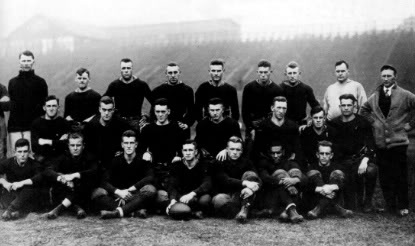
The 1895 Cal Track and Field Team. Standing in back: Theodore Barnes, Louis T. Merwin, Arthur North (manager). Seated: Philip Bradley, Chester Woolsey, William C. Patterson, Fred W. Koch, Robert Edgren, Ernest Dyer, James Scoggins. In front: Harry Beal Torrey, Melville Dozier.The Golden Bear banners they carried east with them are in the back.
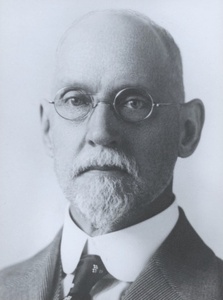
In the 1890s, Track and Field was one of the major college sports, second only to football and more or less tied with baseball in popularity and importance. The idea of an east coast trip by the California team had been percolating around the Berkeley campus since at least 1893. In 1894, the idea was brought before the students – who at that time both funded and controlled the athletics programs – by team captain Fred Koch and the faculty advisor, George C. Edwards. Edwards was a member of the Class of 1873, the University’s first graduating class, and a math professor. Cal’s track stadium, Edwards Stadium, would later be named in his honor.
The students present when the eastern tour was proposed voted unanimously in its favor. Professor Edwards and students Koch, H. H. Lang, M. Anthony and Arthur W. North were given sole charge of organizing the trip. They held a mass meeting of students, and according the the Blue and Gold Yearbook report, within 20 minutes, the students had put up over $1,000, a large sum at the time and almost one-third of what would turn out to be the total cost of the trip. The Committee selected eleven athletes to make the trip and began arranging for training for the team and continued raising funds. Telegrams were dispatched to eastern schools and team manager Arthur North set off by train to talk to the schools about organizing competitions. He returned to Berkeley with commitments from Princeton, the University of Pennsylvania, Union College in Schenectady, New York, the Chicago Athletic Association and the Denver Athletic Club. More competitions would be added, even while the team was traveling in the east.
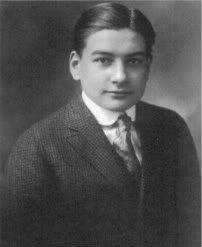
There was great excitement when the team left Berkeley on May 2, 1895. Students and faculty had donated from their own pockets to fund the trip and they took a proprietary interest in the fate of the team. One of the athletes, Robert Edgren, was a standout in the hammer throw. He was also an aspiring writer, having been hired by William Randolph Hearst as a part time journalist for the San Francisco Examiner just a few months earlier. Hearst directed Edgren to write dispatches back to the paper regarding every development on the trip. Accordingly, Edgren spent many of his evenings during the trip writing articles about the contests which had taken place and his assessments of the upcoming meets and teams, and taking them down to the local Western Union office to oversee their dispatch by telegraph. Bay Area readers followed his reports and the team’s progress assiduously.
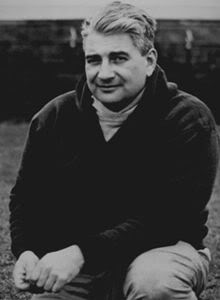
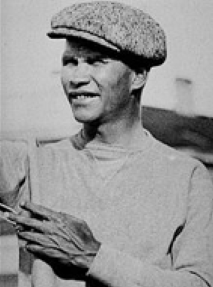
Robert Edgren
On the trip, the athletes tried to stay fit by getting off the train and running at every station where it stopped and by doing gymnastic exercises on the train itself. The Bay Area boys, used to the cool weather of a Berkeley summer, were shocked by the heat. Temperatures for most of the trip were in excess of 90 degrees, with the high humidity found in the East and Midwest. At least two players suffered so much from the heat that they were uncertain if they would be able to compete. The fatigued team arrived in Princeton, New Jersey at 3:00 a.m. on May 8, having spent six days crossing the country, with only two days to rest and recover before the meet.
The consensus in the East was that the Californians did stand much chance of beating a strong Princeton team. They were widely underrated, since the easterners knew almost nothing about western teams, and tended to look down on them on principle. The rules for the Princeton meet were also unfavorable for the Blue and Gold. Princeton insisted that points would be awarded for both first place and second place finishers. Since the Californians were only traveling with eleven athletes, in comparison to the 28 competitors for Princeton, the Blue and Gold would be at a distinct disadvantage. Several athletes had to compete in what were not their regular events. And in at least one case, pole vault, the Californians had to default, as they did not have a pole vaulter among their group.
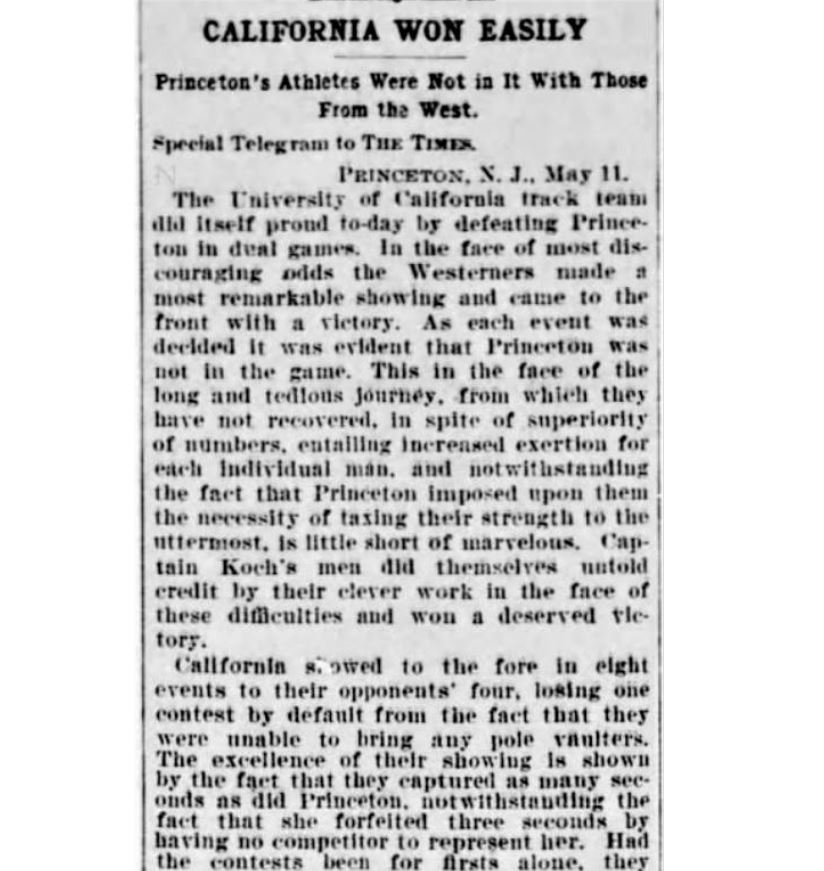
Despite all their disadvantages, the Cal team performed magnificently. They won eight of the twelve events (including the forfeit in pole vault). They also scored second place in six of the twelve events, despite having to forfeit second place points in three events, because they lacked sufficient athletes to compete. The easterners were stunned. The Philadelphia Times reported:
“The University of California track team did itself proud today by defeating Princeton in dual games. In the face of the most discouraging odds, the Westerners made a most remarkable showing and came to the front with a victory.”
Thus the upstart team from the West, despite all their disadvantages, pulled off a huge win in the first athletic competition ever held been any teams from the west and the east. When news of this victory reached home by telegraph, followed by Robert Edgren’s reports in the Examiner, there was unbridled joy in Berkeley and throughout the Bay. A week later the team took on one of the best teams in the country, the University of Pennsylvania. They put on another great showing, but were trailing going into the final event, the 440. This was not Fred Koch’s best event, but he somehow pulled off a win, ending the meet in a 7-7 tie. Unfortunately, runner Melville Dozier suffered a strained tendon during the Pennsylvania meet, further limiting the number of California competitors.
Nevertheless, the Blue and Gold would compete in six more meets during their seven-week tour of the country. This included a 59-39 blowout of Union College in Schenectady, New York and, on the trip home, both a 55-43 victory at the University of Illinois, and a massive 62-22 win in Denver over what was billed as “all of Colorado.” They also won a large, multi-team meet in Chicago, outscoring Michigan, Wisconsin and several others, despite again being severely outnumbered in competitors against several other schools. As Robert Edgren reported to the Examiner:
“Today, the athletic team of the University of California scored the most decisive and glorious victory of its brilliant career. . . . The teams from the other colleges far outnumbered the one from the Pacific Coast. Wisconsin sent twenty-eight men. Michigan entered twenty and other colleges were represented by teams equally strong in numbers.”
Edgren added, “tonight the California boys own the town, and everywhere we hear their college yells, invariably ending with a whoop of ‘California! California!'” The team received a silver trophy and was proclaimed, “Western Champions.”
The final contest in Denver included perhaps the most surprising moments of the entire trip, when a group of Stanford supporters showed up to cheer the California team on. The Examiner reported: “A group of nine Stanford students howled themselves hoarse whenever a U.C. came in front. And they kept the U.C. yell booming throughout the whole afternoon.” Robert Edgren expressed, “our thanks to our friendly rivals.”
By the time the trip ended, three California athletes held new American records: James Scoggins in the 100 yards, Ernest Dyer in the 120 yard hurdle, and Robert Edgren in the hammer throw. Edgren noted in the Examiner that the team was headed home with their Golden Bear banners, “covered with glory, to be put up in our college library never to be taken out until a U.C. again crosses the continent to battle for its alma mater.”
The team was due back in home on June 27, and the Bay Area began planning a celebration. They were met by hundreds of people at the Oakland train station and escorted to the Olympic Club in San Francisco by ferry, including a torchlight parade in San Francisco led by Cal students, followed by a grand banquet. When they arrived at the station, Cal English Professor Charles Mills Gayley took special notice of the Golden Bear banners, leading him to write a song entitled, “The Golden Bear,” with lyrics referencing to “Our silent, sturdy Golden Bear.” The song became an instant hit in Berkeley and, together with the track and field team’s spectacular triumphs and their Golden Bear banners, it gave birth to a new nickname for the University.
As for hammer thrower and Examiner reporter Robert Edgren, he went on to become Cal’s very first Olympian, competing in both discus and shot put in Athens in 1906. (For the only time in history there was an interim Olympics in 1906, coming between the St. Louis games in 1904 and the London games of 1908.) Edgren went on to become a very highly regarded professional sportswriter.
And it is because Robert Edgren and the rest of the glorious 1895 Cal Track and Field team that I am able to end this story by saying:
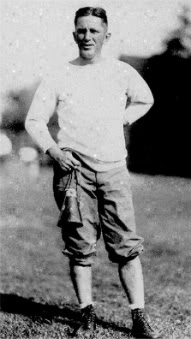
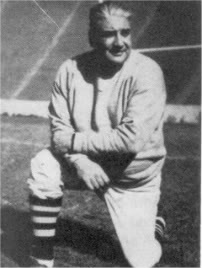
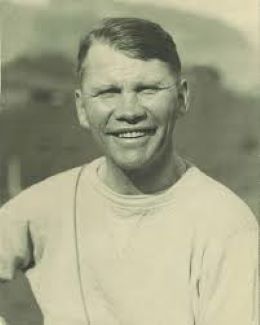
Who is the only person who ever coached teams to both the Rose Bowl and the Final Four? The University of California’s Clarence “Nibs” Price. Nibs Price took over as Cal’s football head coach in 1926, after the death of Andy Smith. In his five years as head coach, he had three tremendous seasons and took the Bears to the 1929 Rose Bowl — where they were involved in one of the most famous (or infamous) plays in football history. And at the same time Price was coaching the football team, he was also the basketball head coach, ultimately winning more games than any coach in California basketball history, and earning a trip to the Final Four in 1946.
Coach Clarence “Nibs” Price
Clarence M. “Nibs” Price was born in San Diego in 1890. In 1910 he was admitted to the University of California in Berkeley where, despite his short stature and slight build, he earned a varsity letter in rugby as well as baseball. He would have liked to have played football as well, but this was the era when American football had been replaced by rugby at Cal. After graduating in 1914, Price returned home to San Diego, where he became the football coach at his alma mater, San Diego High School, until he joined the Army Air Corps to serve in World War I.
Price was discharged from the service in Seattle in December 1918. On his way home to San Diego, he stopped off for a visit in Berkeley, where he met the new California head coach, Andy Smith. Smith was looking for an experienced football coach to take over the Bears’ freshman team. There was not a lot of talent to choose from, because most west coast high schools had given up American football in the early 1900s, as a result of the extreme violence, injuries, and even deaths resulting from the sport. California itself had only returned to playing football in 1915. But San Diego High was one of the few schools which had never stopped playing the game. Smith thought Price would be good for Cal, both as an experienced football coach and as someone who might be able to convince the talented players at San Diego High and other football schools to come to Cal. Price jumped at the chance to return to Berkeley, and was hired as an assistant coach on the spot. He would remain a Cal coach for the next 35 years.
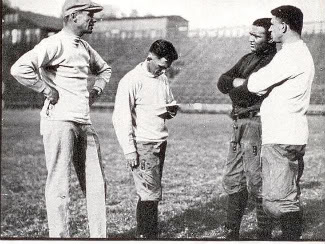
The Cal coaching staff in 1922: Head Coach Andy Smith, Nibs Price,Walter Gordon, and Albert Rosenthal, at California Field
Hiring Nibs Price was one of the smartest decisions Andy Smith ever made, because Price turned out to be a great recruiter. He convinced several of the best players he had coached in San Diego to come to Cal, among them Stan Barnes and Harold “Brick” Mueller, two of the greatest ever to play at Cal. Price was also on good terms with coaches and players from other southern California high schools, against whom he had competed. He was able to use those personal ties to recruit Archie Nisbet, Don Nichols, Bill Bell and others to play for him on the Bears’ 1919 freshman team. The following year, it was these Nibs Price recruits who became the heart of California’s “Wonder Teams.”
The Wonder Team set college football ablaze in 1920, with a perfect 9-0-0 record, including a dominating 28-0 win over Ohio State in the Rose Bowl. The team was undefeated again in 1921, and then again in 1922, establishing California as one of the great football powers in the nation. So great was the Wonder Team’s success, that Cal built a spectacular new stadium to hold the enormous crowds clamoring for tickets.
Even after the first group of Wonder Team players graduated, the Bears continued to have great success under Andy Smith and his staff, completing two more undefeated seasons in 1923 and 1924. Things dropped off in 1925, with a decline in talent. The Bears went 6-3, suffering their first losses in six years. Still, Cal fans had unwavering faith that Andy Smith would return the Bears to glory within a year or two. But it was not to be. While on a visit to Philadelphia in January 1926, the 42-year-old Smith contracted pneumonia and died suddenly.
Andy Smith had stated several times that he thought Nibs Price was his natural successor as Cal’s head coach, and Price was duly elevated to that position in March 1926. Following the incomparable Andy Smith, especially in light of his sudden and shocking death, was an almost impossible task. To make things even more difficult for Price, he had also been named as Cal’s head basketball coach the previous year, and would now be responsible for coaching both teams.
The 1926 football season was not a promising start for Price’s Bears. The team had lost all its best players to graduation and it would probably have been a “re-building” year even if Andy Smith were still the head coach. Added to that, Smith’s death had cast a pall over the team, the fans, and the season. The Bears’ record was 3-6 — Cal’s first losing season in American football since 1897. (The Bears did have a losing season in 1906, during the period when rugby had replaced football.) The season ended with a dismal 41-6 loss to undefeated Stanford. But despite the team’s problems in 1926, Nibs Price had the full support of his team and of Cal fans, who recognized what a difficult task he had. In fact, Cal set an all-time attendance record that year, with 417,000 fans showing up at California Memorial Stadium to watch the Bears.
The fans’ confidence in Price was rewarded. The 1927 team, made up of now-experienced upperclassmen and a group of excellent sophomores newly elevated from the freshman team, made a much stronger showing. The season started with a 14-6 win over Santa Clara sparked by the surprising passing of unknown sophomore Benny Lom. The next week the Bears handed Nevada a resounding 54-0 defeat. Lom’s passing was the key again to Cal’s upset of St. Mary’s, and a 16-0 defeat of Oregon. The Bears were 5-0 going into the game against heavily favored USC in Los Angeles. The Trojans pulled out a 13-0 win, but the press called it one of the hardest-fought contests in memory. The Bears also lost to Stanford, but the 13-6 score was at least nowhere near as embarrassing as the prior year’s rout. Cal finished the season with a rare inter-sectional game against Pennsylvania, which was also highly favored. Price called plays which were very wide-open by the standards of the day, including a 40-yard pass from Benny Lom to Jim Dougery, resulting in a touchdown. Late in the game, Price called for a real razzle-dazzle play, with Paul Clymer throwing a pass to Paul Perrin, who then lateraled to Lee Eisen, who ran 42 yards for another touchdown. The stunning 27-13 Cal victory ended a successful 7-3 season that showed the Bears were back.
Benny Lom, the star of Cal’s 1927-1929 football teams.
1928 would prove to be one of the most memorable seasons in Cal football history. Although the offense was a bit suspect, Price had a defense that was almost impenetrable. The Bears began the season with wins against Santa Clara, St. Mary’s, and Washington State, before facing a big test in the high-scoring USC team. A capacity crowd of more than 81,000 in Berkeley saw the Bears and the Trojans battle to a 0-0 tie. The star of the game was once again Benny Lom — but this time because of his outstanding punting! It was the first time USC had been shut out under head coach Howard Jones, and the Bears were pleased with their effort.
The 1928 Bears were 6-1-1 going into the Big Game against another very high-scoring team. Once again the Cal defense came up strong, the big play being an interception and 75-yard run-back by Steve Bancroft for a Cal touchdown. The Bears were leading 13-7 late in the game, when disaster struck. With seconds left in the game, Stanford had the ball on Cal’s 24. Stanford quarterback Bill Simkin threw a bad pass, which Cal’s Irv Phillips could easily have intercepted. But Phillips thought it was fourth down, and just batted the ball down. On the next play, Stanford scored a touchdown to make the score 13-13. But the snap for the extra point was slow, giving Cal’s Frank Fitz time to smash through the Indians’ line and block the kick. The game ended in a tie. While this was certainly not as satisfying as a win, it was enough to send the 6-1-2 Bears to the Rose Bowl on New Year’s Day.
The 1929 Rose Bowl between California and Georgia Tech turned out to be one of the most talked-about football games of all time. Once again, Cal’s defense was outstanding. And statistically, the Bears were ahead in every category, leading George Tech in: first downs 11-5; rushing yards 204-166; and passing yards 67-23. The only place Georgia Tech prevailed was the final score: 8-7. It was in this game, of course, that Cal’s Roy Riegels picked up a Georgia Tech fumble and started running toward the end zone. But Riegels had become confused and turned around, and he began running toward the wrong end zone. Teammate Benny Lom chased Riegels down the field, shouting at him to turn around, but he could not be heard over the roar of the crowd. Lom finally caught Riegels and tackled him on the Bears’ one-yard line.
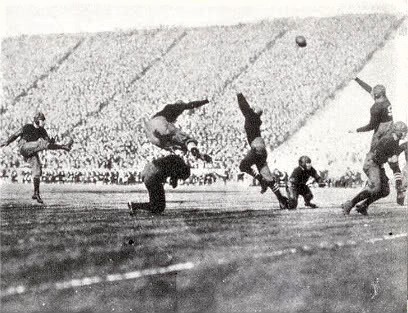
Although California had the ball first-and-ten on their own one-yard-line, the stunned Nibs Price ordered a punt on the next play. Calling a punt on first down was a fairly extraordinary thing to do, and Price’s call has remained highly controversial ever since. He was concerned that the Bears had been so demoralized by the Riegels play, they might easily give up a safety on the one-yard line. And the Cal defense was so outstanding that he was confident they would not give up a score if they could just get a little room from a punt. But Price’s decision to punt only piled disaster onto disaster. The punt was blocked and rolled out of the end zone for a Georgia Tech safety — the very thing Price had been trying to avoid. And that safety that would turn out to be the margin of victory for Georgia Tech.
Roy Riegels was in a state of shock. Price did not want to remove him from the game, (he would not be allowed to come back in until after the half under the rules of the day), because he believed it would be a terrible blow to team morale. But he could not determine whether Riegels was injured or merely stunned by what had happened. So he took Riegels out and the young man sat on the bench trying to hold back tears as his teammates attempted to comfort him.
At halftime, Coach Price had to decide what to do with the devastated Riegels in the second half, as the young man sat sobbing in the corner of the locker room. Shortly before half-time ended, Price announced, “Men, the same team that played in the first half will start the second.” As the players started to run back onto the field, Riegels remained sitting where he was. When Price again told him he was going to start the second half, Riegels said, “Coach, I can’t do it to save my life. I’ve ruined you, I’ve ruined the University of California, I’ve ruined myself. I couldn’t face that crowd in the stadium to save my life.” Price put his hand on Riegels’ shoulder and said, “Roy, get up and go on back; the game is only half over.” And Riegels went out and played and played an outstanding second half.
Unfortunately, Cal was not able to pull out the win, and Riegels become known forever as “Wrong Way Riegels.” However, Price’s vote of confidence in Riegels would pay off the following year, when he was elected captain by his teammates and named a first team All-American. And for the rest of his life, Roy Riegels made a point of sending letters to high school and college athletes who had made blunders which cost their teams a game, offering comfort, and letting them know that making such a mistake was not the end of the world.
Cal Center, Roy Riegels.
Despite the great disappointment of the Rose Bowl loss on January 1, the 1929 football season would be Nibs Price’s best. The highlight of the year was once again the USC game. And that game once again showed off Price’s willingness to take risks, when he called a fake punt from Cal’s own 15 yard line. Punter Benny Lom pulled the ball down and cut around the Trojan defender, who was blocked by Rusty Gill. Lom then dodged right between two more USC defenders, and ran 85 yards for the touchdown. A couple of series later, Roy Riegels blocked a Trojan punt through the end zone for a Cal safety. The final score was California 15, USC 7. Once again, the victory was won despite mediocre offense (USC out-gained the Bears 252 to 192, and the Bears punted 13 times), because of outstanding defense and Price’s gamble on special teams.
Cal’s Rusty Gill throws the block that will spring ball carrier Benny Lom for a 85-yard touchdown on a fake punt in the 1929 Cal-USC game.
Although Cal ended the 1929 season with a 7-1-1 record, it was not entirely satisfying, because the one loss once again came against Stanford. A victory, or even a tie in the Big Game would have sent the Bears back to the Rose Bowl. But as it was, California, Stanford, and USC ended the season tied for the conference championship. In light of the Bears’ 21-6 loss in the Big Game, University President William Campbell withdrew Cal from consideration for the 1930 Rose Bowl, and USC was given the bid.
The Bears had a Rose Bowl and a combined 20-6-3 record over the 1927-1929 seasons under Price. But virtually all of their great players graduated at the end of the 1929 season, including Benny Lom and first team All Americans Roy Riegels and Bert Schwarz. Even worse, 1930 began with a very bad omen when Stanford students disguised as reporters stole the Axe and spirited it away to Palo Alto.
The 1930 Golden Bears started the season a mediocre 3-3. And then thing got much worse. USC decided to take revenge for their loss the previous year and utterly demolished the Bears, 74-0, running up 734 yards of total offense. 95 years later, this game remains the worst loss in California history. An unfavorable editorial in The Daily Californian stirred up a media frenzy about the students trying to have Nibs Price fired. In fact, most students and fans still supported the coach, who had just completed three successful seasons. It was even reported in the papers that a prominent supporter of Coach Price had said, “Let’s face it, fellows. We were beaten 74-0 by the best professional football team in the country.” The president of USC expressed outrage at this comment and threatened to break off all relations with the University of California, until Cal’s president, Robert Gordon Sproul, intervened to smooth things over.
But the debacle against USC had definitely had consequences for the Bears. The next week, only 3,000 fans showed up at Memorial Stadium to watch Cal defeat a weak Nevada team 8-0. And the seemingly dispirited Bears were then crushed 41-0 by Stanford. The Bears’ record on the season was only 4-5, but Nibs Price resigned as head coach two days after the Big Game.
Nibs Price’s career record as Cal’s head coach was 27-17-3. Three of his five seasons were highly successful, and he took the Bears to the 1929 Rose Bowl. His less-than-stellar rookie year can be attributed to the shock of Andy Smith’s death, and the graduation of many of the Bears’ best players. The loss of key players was also a big factor in the unsuccessful 1930 season, although the blow-outs by USC and Stanford were embarrassing. Yet there is no reason to think that Price could not have turned the team around if he had remained as head coach. He had a good group of new recruits coming in for 1931 and, in fact, the 1931 team would go 8-2, including a 6-0 victory over Stanford.
It was entirely Price’s decision to resign as head coach. But he was by no means done at his beloved alma mater. Price actually remained on the football staff as an assistant under the new head coach, Bill Ingram, and under Ingram’s successors, including Stub Allison and Pappy Waldorf, coaching defensive backs and punters. Under Waldorf, he became the Bears’ head scout. Price’s football knowledge and recruiting abilities remained an important part of the Cal program for another 24 years. As a result, Nibs Price coached for seven of California’s eight Rose Bowl teams: in 1921 and 1922 as an assistant to Andy Smith, in 1929 as Cal’s head coach, in 1938 as an assistant to Stub Allison, and in 1949, 1950, and 1951 as an assistant to Pappy Waldorf.
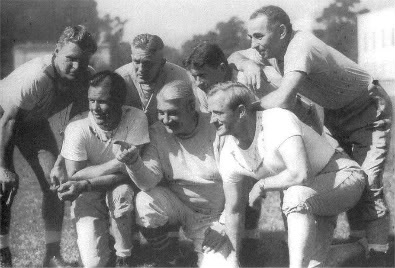
Nibs Price, who began his Cal football coaching career as an assistant on Andy Smith’s staff, ended it as an assistant to Pappy Waldorf. Pictured here is Waldorf’s first coaching staff. Back row: Eggs Manske, Nibs Price, Hal Grant, Wes Fry. Front row: Zeb Chaney, Pappy Waldorf, Bob Tessier.
In the meantime, Price had also been serving as Cal Men’s Basketball’s head coach since 1924. Basketball was considered a minor sport in these years, and it was not unusual for college coaches to double up on sports. And in basketball, Price had spectacular success. There was considerable doubt when he was made head coach, because he had virtually no background in the sport, but he led the Bears to three straight Pacific Coast Conference championships in his first three seasons, 1924-1927, compiling a 42-4 record. The Bears won the Pacific Coast Conference title again in the 1928-1929 season, at the same time Price was leading Cal Football to the Rose Bowl.
Price served as Cal’s Men’s Basketball head coach for an astonishing 30 seasons, from 1924 to 1954, during which time the team won eleven conference championships. The 1926-1927 team went 17-0. The NCAA Tournament did not exist until 1939, and there was no other national playoff or championship tournament before then. However, the 1926-1927 Golden Bears have been retrospectively named as that year’s National Champion by the Premo-Porretta Power Poll.
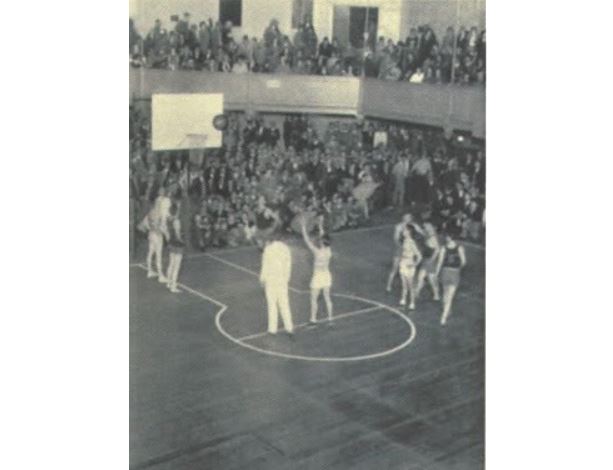
The 1926-1927 Golden Bears playing a non-conference game at the sold-out old Harmon Gymnasium (now the site of Dwinelle Hall). The old gym’s capacity was 1,400 fans.
In 1946, Price led the Bears to the Final Four, following a 30-5 season and another first place finish in the Pacific Coast Conference. They were eliminated in the National semi-final by Oklahoma A&M (now Oklahoma State), which went on to win the National Championship. Price’s career record as Cal’s basketball coach was 449-294, and his 449 career wins remains the Cal record. When he finally retired in 1954, it was Price who urged the University to hire the University of San Francisco’s basketball coach, Pete Newell, to succeed him. He remained an avid follower of Cal sports, offering advice and support to his successors.
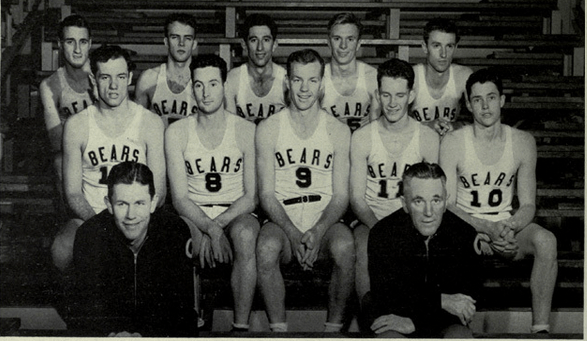
Cal’s 1946 Final Four team. Nibs Price is at front right.
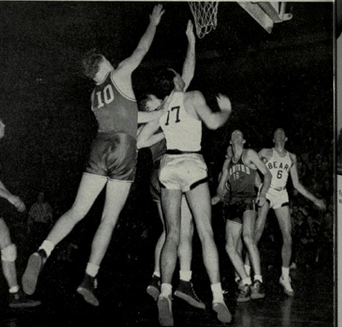
The Golden Bears in action in their final game of the 1945-1946 regular season, an 88-46 thrashing of Stanford.
Nibs Price had a truly remarkable career at Cal, as a student, a rugby and baseball player, and a football and basketball coach, spanning a period of more than 40 years. Coaching teams to both the Rose Bowl and the Final Four and winning conference champions in both football and basketball in the same year are feats that it is safe to say will never be equaled, given the modern landscape of college athletics.
Lynn O. “Pappy” Waldorf was the most beloved football coach in Cal history: beloved by his players, by the fans, and even by the Bears’ opponents. He was a great coach. A career record of 157-89-19, and a 67-32-4 record at California, are evidence of this. So are three straight Rose Bowl appearances and back-to-back 10-win seasons for only the second time in Cal history. And so is his history of turning around losing football programs everywhere he went, from Oklahoma City University to the University of California, and of winning conference championships at all five schools where he was the head coach. But there was something more than this that made people love him. Something more, even, than his 7-1-2 record in the Big Game. There was something so special about Pappy Waldorf that 55 years after he retired from coaching, and 30 years after his death, his former players, men in their 70s and 80s who still called themselves “Pappy’s Boys,” gathered regularly to remember and honor him. He was not just a great coach, he was a good man.
Pappy Waldorf
Lynn Waldorf was born on October 3, 1902 in Clifton Springs, New York. His father, Ernest, was a well-connected Methodist minister, who later became a bishop. The family moved to Cleveland, where Lynn grew up. He followed his father to Syracuse University where, although he was considered too short to play football, he made the varsity squad, and was named an All American twice. At Syracuse, he also met Louise McKay, whom he married in 1925 in what, by all accounts turned out to be an extraordinarily happy marriage.
Lynn Waldorf’s HIgh School graduation photo.
Waldorf graduated from Syracuse with degrees in sociology and psychology, and set about looking for work. His father, Bishop Waldorf, contacted the president of Oklahoma City University, a Methodist school, about getting his son a teaching job. Instead, the younger Waldorf was offered the substantial salary of $4,000 to take on the jobs of football, basketball, and track coach, and athletic director. Lynn took the job, and took charge of the 1-7 Goldbugs. Only 14 players turned up for the first practice, and Waldorf had to find additional players — his starting team would eventually include six players who had not even played high school football. But, by focusing on fundamentals of blocking and tackling, Waldorf was able to lead the Goldbugs to a 4-6 record, the best in school history. Two years later, in 1927, the Goldbugs were 8-1-2, and tied for the conference championship.
In 1928, Waldorf went to the University of Kansas as an assistant, before being hired as the head coach of Oklahoma A&M (now Oklahoma State) the following year. In five years at Oklahoma A&M, Waldorf’s record was 34-10-7. He won three conference championships, and never lost to arch-rival Oklahoma. In 1934 he was hired as the head coach of Kansas State. In his single season there, he won the Big Six conference title — the first time Kansas State had ever won the championship, and the only time it would do so until 2003.
Waldorf was a very hot property by now, and the next year he was wooed away to Evanston, Illinois by Northwestern University. Waldorf recognized that his players were not outstanding, and would probably not win many games. So he decided on a limited focus. He later explained, “When you’re faced with one of those years when your material is only fair and you’re not going to win many games, put your eggs in one basket. Pick a tough team and lay for it. Knock if off, and you’ve got yourself a season. . . . I chose Notre Dame.” Waldorf’s “secret weapon” against Notre Dame was a brand new strategy – changing defensive formations on each play. It worked. Notre Dame was completely confused by the changes on defense by Northwestern, and the Wildcats pulled off a startling 14-7 upset. When the coaches went out that night for a drink to celebrate, the bartender, noticing Waldorf nursing a single drink all night long, started calling him “Pappy.” His assistants picked up on it, and the nickname stuck. Northwestern finished the season 4-3-1, and Pappy Waldorf won the first-ever National Coach of the Year Award.
The next year, 1936, was even better. Waldorf developed a new formation, an unbalanced line which he called the “Cockeyed Formation,” and which is now recognized as the first slot formation. It allowed four receivers to head down field, instead of the usual two. Waldorf debuted the new formation against Ohio State, leading to a Northwestern victory. The Wildcats ended the season 7-1, and won the Big-10 Championship. At the end of the season, Waldorf was invited to the East-West Shrine game in the Bay Area as the Big-10s “observer.” The Waldorfs fell in love with northern California, and Pappy decided that if a job came open there in the future, he would accept it. But in the meantime, Waldorf continued his success in Evanston. His 49 career wins at Northwestern remain the most in school history.
While Pappy Waldorf was enjoying success at Northwestern, things were not going well in Berkeley. The Bears had won the Rose Bowl and a National Championship under Stub Allison in 1937, but the 1940s had been a disaster. Allison had not adjusted to the changes in the game in the early 1940s, and World War II had made it difficult to even field a team. In 1944, Allison resigned and was replaced by Lawrence Shaw. Shaw was, in turn, replaced by Frank Wickhorst for the 1946 season, in which the Bears went 2-7. Worse, Wickhorst lost the support of his team. 42 of the 44 varsity players signed a petition calling for his firing. The students were equally upset, to the point that during the embarrassing 1946 Big Game loss, they began tearing up the seats and passing them down onto the field.
Cal athletics had a unique organizational structure. Since 1904, management of the athletic department had been in the hands of the Associated Students of the University of California (ASUC), whose Executive Committee had the power to hire and fire coaches. Two weeks after the 1946 Big Game they did just that, firing Wickhorst and two of his assistants. The actions of the ASUC shocked the college football establishment. The University of California was condemned for allowing students to exercise that kind of control over coaches, and it was widely predicted that no respected coach would be willing to come to Cal under such circumstances.
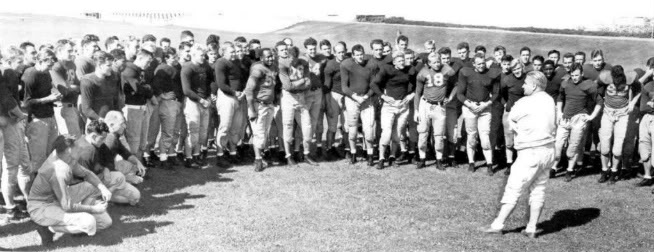
University president Robert Gordon Sproul stepped in to limit the damage by creating the position of Athletic Director, with the power to hire and fire coaches. The job was given to Cal’s highly respected track coach, Brutus Hamilton. Hamilton offered the head coach job to Fritz Crisler at Michigan, who turned it down. Then, at a meeting of the American Football Coaches Association in January 1947, Hamilton mentioned the Cal coaching job to Pappy Waldorf. Waldorf, remembering his fondness for northern California, immediately expressed interest. To the shock of the college football world, Pappy Waldorf accepted the job as the California’s head coach in February 1947. At a press conference at the Claremont Hotel, Waldorf proclaimed that he had come to Berkeley, “to awaken a sleeping giant.”
Pappy Waldorf meets with the 1947 Golden Bears at their first practice.
Despite Waldorf’s history of success, the California football program had been so troubled that his arrival was greeted skeptically. San Francisco Examiner sports columnist Prescott Sullivan summed it up:
“Big, meaty Lynn O. “Pappy” Waldorf is the new head coach at the University of California. We realize there is nothing particularly distinctive about that. California’s always getting a new football coach. Waldorf is the fourth the school has had in as many years. We hope Waldorf is a man of independent means. The job over there in Berkeley ain’t too steady.“
But Waldorf quickly won over the players, the fans, and even the reporters. Waldorf was a great story-teller, and he would host cocktail parties for the press where he told stories and recited some of his seemingly endless store of limericks, while puffing on a cigar and sipping bourbon. He could talk about Plato and Shakespeare, debate the details of Civil War battles, and discuss the football theories of his friend Amos Alonzo Stagg, with equal enthusiasm. The press was charmed.
At the first team practice, 255 students showed up to try out. Since the rule allowing free substitution of players, which had been implemented during the war, remained in effect, there were plenty of opportunities. Many of those who showed up had no football experience, but Pappy did not discourage them, as he wanted to create an atmosphere of enthusiasm. When one student lined up at quarterback under a tackle, Waldorf just said, “That cow’s dry, son. Move over.” Then the student lined up behind a guard. “That one’s dry, too. Keep movin’ over,” Pappy told him. Team manager Sedge Thompson said, “He didn’t show any sign of being mad or disgusted that entire spring.” He set about learning the names of all 255 potential players, developed carefully organized practice schedules, and required every player to carry a notebook, which the coaches inspected to ensure the recruits were taking proper notes. Waldorf focused on careful drills, with every detail of each player’s performance critiqued by the coaches.
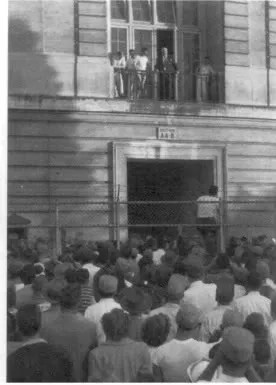
Waldorf’s attention to detail paid off. The very first play from scrimmage by the Bears under Waldorf was a 39-yard touchdown run by halfback George Fong against Santa Clara, and the Bears went on to a 33-7 win. Thousands of fans gathered under the north balcony of Memorial Stadium chanting, “We want Pappy!” Waldorf went onto the balcony with team captain Rod Franz, and thus began the tradition of Pappy Waldorf’s post-game balcony addresses to the fans.
Pappy Waldorf and Cal team members address fans from the north balcony of Memorial Stadium.
The next week, California faced a much bigger challenge in a great Navy team. 83,000 fans showed up — the biggest crowd in the history of Memorial Stadium. When Cal took the lead right before the half with a touchdown on a scramble by quarterback Bob Celeri, the crowd’s reaction registered on the campus’ seismograph. The Bears led 14-7 with minutes to go in the game, when Navy went on a drive. But an interception by unknown sophomore Jackie Jensen sealed the Bears’ victory. This was only the beginning. The next week the Bears beat highly regarded St. Mary’s 45-6, rushing for 432 yards in the process. The week after, they traveled to Madison, where they walloped Wisconsin 48-7, in a game that featured both a 22-yard touchdown run and a 23-yard touchdown pass by Jensen.
Going into the Big Game, the Bears were 8-1, with only a loss to #11 USC marring their record. After a 60-14 drubbing of Montana the week before the Big Game, Jackie Jensen told the fans from the north balcony, “We’re sorry the score went so high today.” After a pause he added, “But we don’t care how high it goes next week!” The crowd, starved for their first Big Game victory since 1941, went wild. The Indians made the game closer than expected, but the Bears emerged with a 21-18 win. In his first season in Berkeley, Pappy Waldorf had turned a 2-7 team into a 9-1, nationally recognized, power. 1948 would be even better.
Jackie Jensen, with one of his 27 carries in the 1948 USC game.
The Bears were prohibitive favorites in the Big Game. A win would guarantee the Rose Bowl for the first time since 1938, and tickets were impossible to obtain. But once again, Stanford proved to be a bigger challenge than expected. The Bears scored a touchdown on their first drive. But the Stanford defense stepped up and kept the Bears from scoring again. In the third quarter, the Indians scored a touchdown, but Cal’s Jim “Truck” Cullom blocked the extra point. The Bears held on for a 7-6 win, an undefeated 10-0 regular season, and the Rose Bowl.
The Bears faced Pappy’s old team, Northwestern, in Pasadena on January 1, 1949. With the game tied 7-7 in the second quarter, Northwestern went on a drive to the Cal goal line. But Cal’s Norm Pressley grabbed the arms of Northwestern ball carrier, Art Murakowki, from behind, causing a fumble, which the Bears recovered in the end zone for a touch back. Except that the referee called it a touchdown. Looking at photographs after the game, the press was unanimous that Murakowski had fumbled before he reached the end zone, but the infamous “phantom touchdown” stood.
Art Murakowki’s “Phantom Touchdown” in the 1949 Rose Bowl
The Bears took a 14-13 lead in the third quarter, but then Jackie Jensen went down with a foot injury. With Jensen out, the Bears were not able to score again. A late Northwestern touchdown gave them a 20-14 win, and left Cal fans complaining about the “Phantom Touchdown” for years.
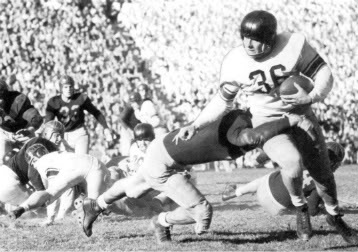
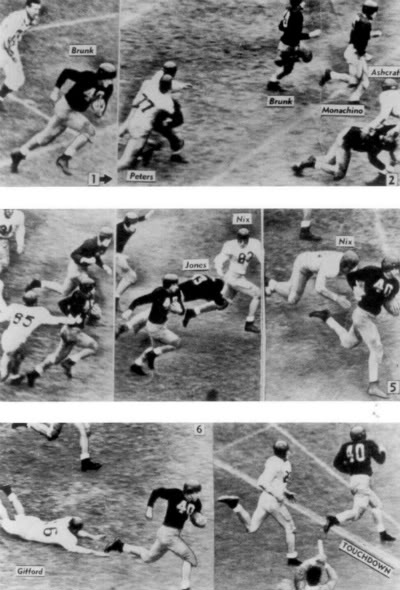
The Rose Bowl loss was all the more discouraging to Cal fans, because the Bears were losing many of their best players. Most notably, Jackie Jensen, with Pappy Waldorf’s encouragement, decided to leave school a year early to accept an offer to play professional baseball. (He would become the first person ever to play in the Rose Bowl, the World Series and the All-Star game). Nevertheless, Waldorf’s 1949 Golden Bears remained strong. They were 4-0 heading into another big showdown with USC, in what would be the Bears’ first televised game. USC took a 10-7 lead in the fourth quarter on a Frank Gifford field goal. But on the ensuing kick-off, Cal’s Frank Brunk fielded the ball in the end zone and, with extraordinary blocking from his teammates, ran it back for a 102-yard touchdown. The last USC player with a shot at him was Frank Gifford, who is seen in the photographs face down on the turf, having missed the tackle. Because the game was televised, Brunk’s run became legendary. California ended up with a 16-10 victory.
Frank Brunk’s famous 102-yard touchdown run in the 1949 USC game.
Once again the Bears were undefeated heading into the Big Game. But this year, Stanford would prove no obstacle. California won the game easily, 33-14, out-rushing the Indians 390-167. After a second-straight 10-0 regular season, and ranked #1, the Bears headed back to the Rose Bowl. Once again, however, the Bears were frustrated in Pasadena. They faced a talented Ohio State team, and were fortunate to have a 14-14 tie late in the fourth quarter. But with two minutes left, a bad snap caused Bob Celeri to shank a punt, giving the Buckeyes the ball on the California 13-yard-line. Ohio State kicked a field goal for a 17-14 win. The Bears ended the year ranked #3.
1950 was expected to be a rebuilding year. But Pappy had brought in another unknown who would turn into a star almost overnight, running back Johnny Olszewski. While Jackie Jensen had been quick and light on his feet, Johnny O was fast but amazingly powerful. Running backs coach Wes Fry said of Olszewski, “He’s the most elusive player you’ll ever see . . . but he’s also equipped with an additional weapon. If there’s no place else to go, he’ll take on the other guy, and he usually doesn’t come off second best.”
Johnny Olszewski
The 1950 Golden Bears didn’t miss a beat. They began the season with convincing wins against Santa Clara, Oregon, and Pennsylvania, before facing USC. The Trojans had sent Sam Barry, a long-time friend of Pappy’s, to the Santa Clara game to scout the Bears. Barry had given Waldorf a USC tie in 1947, which Pappy wore for luck during every game. On his way to the Santa Clara game, Barry suffered a fatal heart attack. Although there was an informal conference rule against using game film for scouting, Pappy Waldorf sent the film of the Cal-Santa Clara game to USC’s head coach, Jeff Cravath, with a note saying, “I deeply regret your loss and that Sam was unable to scout Cal for you. He was a good friend and his work should not be left unfinished. I hope you can make do with the enclosed film.” For once, a good deed did go unpunished. Cal beat USC,13-7.
For the third straight year, the Bears headed into the Big Game undefeated. This time Stanford was finally able to pull off something of an upset, holding the Bears to a 7-7 tie. The star of the game for Cal was Les Richter (who in 2011 became the first Cal Bear to enter the NFL Hall of Fame). Richter stopped one Stanford drive by intercepting the ball at the two-yard line, and stopped another with a 15-yard sack, preserving the tie.
Cal’s first NFL Hall of Famer, Les Richter.
This left California 9-0-1 on the season, and headed to its third consecutive Rose Bowl. Alas, it was another disappointment for the Bears. Cal dominated the first half, out-gaining Michigan 192-65 yards. But the Bears only managed to score 6 points. Late in the fourth quarter, Michigan took a 7-6 lead. Then, when Cal’s desperation fourth down play at the end of the game failed, Michigan took over deep in Cal territory and scored again, for a 14-6 final score. Always dignified, Pappy Waldorf once again went to his opponents’ locker room to offer congratulations. Said Waldorf’s assistant, Paul Christopoulos, “I learned from Pappy Waldorf how to lose with dignity. It is a virtue that many among us sorely lack.”
The 1951 team dropped off a bit because of injuries to key players, including a knee injury to Olszewski, suffered against USC. After Johnny O went down on his first carry, the USC tackler, Pat Cannamela, appeared to deliberately give his right leg an extra twist as he lay on the ground, leading to a near-brawl, both on the field and in the stands. Cal Athletic Director Brutus Hamilton and faculty representative Glenn Seaborg protested to the conference to no avail. Years later, Seaborg wrote that it was clear that Cannamela had deliberately injured Olszewski, and complained, “The only satisfaction I got was an evasive non-apology from USC Coach Jess Hill.” Although Olszewski returned for the 1952 season, he was never the same player again. Thus, although the Bears began the 1951 season 4-0 and ranked #1, by the time the Big Game rolled around they were 7-2 and ranked #19. It was Stanford, undefeated and ranked #3, that had visions of a national championship. But the Bears pulled off a stirring 20-7 upset to ruin Stanford’s dreams, and, incidentally, to finish the season 8-2. After five seasons, Pappy Waldorf’s regular season record at California was an astonishing 46-3-1.
The 1952 Bears had lost several All America players, and Johnny O had not returned to form. A bright spot was outstanding quarterback Paul Larsen. And the Big Game was a 26-0 triumph, featuring a Larsen run for a touchdown, a 37-yard interception return for a touchdown by Lloyd Torchio (whose son would be the unexpected hero of the 1980 Big Game), and a fine performance by Johnny Olszewski, who gained 122 yards on 25 carries in his last game as a Golden Bear. California ended the year 7-3. But it would be Pappy’s last winning season.
In 1953, the NCAA abandoned the free-substitution rule that had been in place since World War II, and required all players to play both offense and defense. This radical change in the game destroyed the system Pappy Waldorf had carefully crafted over the previous decade for developing offensive and defensive specialists. This rule change, along with the graduation of 29 varsity players, had severe consequences. The Bears went 4-4-2 in 1953 and 5-5 in 1954. Things got even worse in 1955, when the Bears had their first losing season since 1946, ending with a 2-7-1 record and, worse yet, Pappy’s first-ever loss to Stanford.
During the summer of 1956, California became embroiled in the Ronnie Knox scandal. Knox was a highly regarded quarterback recruit from southern California, with a domineering step-father, who seemed to be cashing in on Ronnie’s talents. Ronnie Knox decided to go to Cal in 1953, after members of a Cal booster club led him to believe he could be paid to write sports articles for the Berkeley Gazette, and would be receive $500 a year in “pocket money” for selling game tickets. When the University learned of these promises, they put an end to them, and after playing a year with the freshman squad, Knox transferred to UCLA, where he got into further trouble. Although Waldorf was unaware of the actions of the booster club with regard to Knox, a subsequent investigation revealed that he had approved the creation of a booster fund to make payments to players in emergencies. This was permissible under NCAA and conference rules, but Waldorf had not sought the approval of the University president. As a result, Berkeley Chancellor Clark Kerr issued a formal reprimand to Waldorf, and Pappy issued a formal apology.
The Knox affair led to a wider investigation of conference booster clubs, which resulted in harsh penalties to UCLA, USC, and Washington, and lesser penalties to California. Although UCLA came in for the harshest penalties of all, including three years of probation, the UCLA chancellor offered no reprimand to head coach Red Sanders, and Sanders made no apology.
After this difficult summer, the 1956 season was equally difficult, with the Bears having a 2-7 record going into the Big Game against heavily-favored Stanford. The Bears were down to their third-string quarterback for the game, having lost the first two to injuries. The Big Game would be in the hands of an obscure sophomore named Joe Kapp.
Sophomore quarterback Joe Kapp
During the season, Waldorf decided that the time had come for him to retire. He made the announcement a few days before the Big Game. The Cal band showed up that night at Pappy’s home on Grizzly Peak in full uniform to serenade him. Pappy told the band members, “This is one of the finest compliments ever paid me. It is a grand gesture. Your band is the epitome of the University of California.”
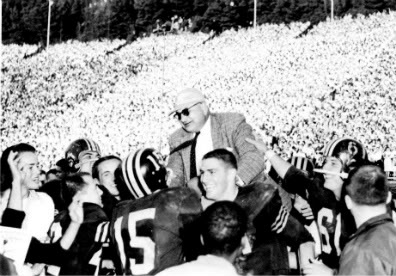
In storybook fashion, the 14-point underdog Bears pulled off one of the biggest upsets ever in the Big Game. The team came onto the field inspired, building up leads of 14-0 and 20-6, before holding on for a 20-18 win. Joe Kapp was the star, rushing for 106 yards on 18 carries. After the game, the team carried Pappy off the field on their shoulders, and Pappy made his final appearance on the north balcony of Memorial Stadium to tell an emotional crowd of 18,000 listening fans, “I love you, and I always will.”
Pappy Waldorf is carried off the field by his players after the 1956 Big Game
A few years after his retirement from Cal, Waldorf was contacted by the San Francisco 49ers to see if he would scout for them. He became the 49ers director of college scouting for the next 12 years. Pappy’s friendships with coaches and athletic directors around the country gave him an access that other NFL scouts could only envy. In fact, when he was in Ohio, he stayed at the home of his friend, Ohio State coach Woody Hayes. In New York, he always stayed at the home of former USC player, NFL player and, later, broadcaster, Frank Gifford.
Pappy finally retired from the 49ers in 1972, at the age of 70. But he continued to support his beloved Cal Bears. In 1980, he was asked by the California head coach, Roger Theder, to address the team before the Big Game. The Bears had had a terrible season. They had a 2-8 record, and were 15-point underdogs to a Stanford team led by sophomore quarterback John Elway. Pappy told the players,”The Big Game is college football in its purest form. There is nothing else like it.” His talk seemed to inspire the team. Led by back-up quarterback J Torchio, son of Pappy’s player Lloyd Torchio, the Bears went on a 80-yard touchdown drive on their first possession, built up a 21-7 halftime lead, and hung on for a gutsy 28-23 upset. Pappy was elated. It turned out to be his last Big Game, as he passed away on August 15, 1981.
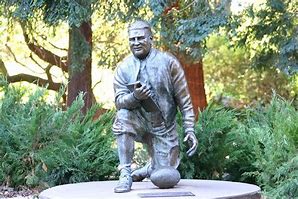
Pappy’s former players formed a group called “Pappy’s Boys” in tribute to their coach, and they remained in regular contact for decades. It was Pappy’s Boys who led the drive to place a monument in tribute to the man they so admired in Faculty Glade on the Berkeley campus in 1994, ensuring that he would be remembered by future generations of California students.
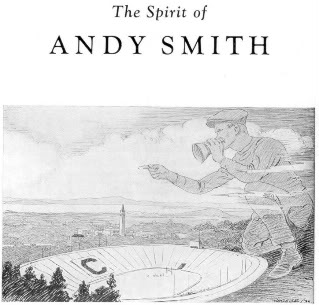
Andy Smith’s accomplishments at Cal are, quite simply, beyond compare. In 10 seasons at California, he compiled a 74-16-7 record, won five Pacific Coast Conference championships and four consecutive national championships, and took the Bears to two Rose Bowls. He also led Cal to an astonishing five straight undefeated seasons. In the Wonder-filled 1920 season, Smith’s Bears outscored their opponents by a combined score of 510-14. He also had a 6-1-1 record against Stanford, including Cal’s two biggest Big Game blow-outs of all-time. Had it not been for Smith’s death at the age of only 42, it is almost impossible to imagine what he might have accomplished. As it is, Andy Smith is, beyond question, not only the greatest football coach in the history of the University of California, but one of the greatest in the history of football.
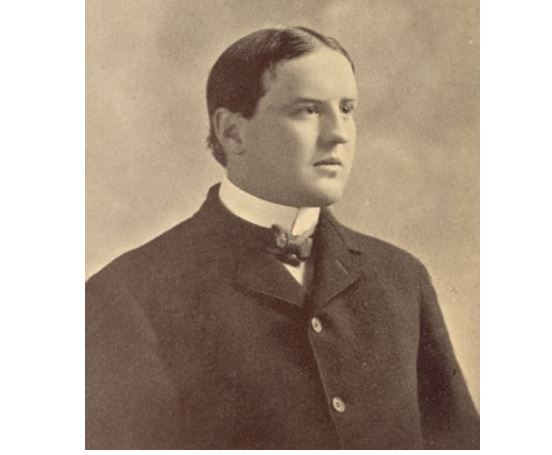
Andrew Latham Smith, Head Coach of the University of California 1916-1925
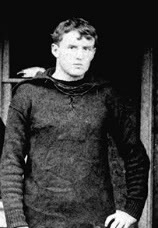
Andrew Latham Smith was born on September 10, 1883, in Dubois, Pennsylvania. Dubois was just a few miles from Penn State, where Andy Smith enrolled as a freshman in 1901, joining the football team as a fullback. Although Smith had a slight build, he was a natural at football, and proved himself to be a fearless, smash-mouth player. He played so well in Penn State’s 1902 game against the University of Pennsylvania that the Penn coach asked him to transfer. Penn was the more prestigious program, and Smith was immediately interested. Under the virtually non-existent recruiting rules of the time, Smith began working out with Penn players the following week, and transferred for the 1903 season. He was named a first team All American in 1904, his senior year.
Andy Smith graduated from Penn with a degree in chemistry, and planned to go into the iron business. But the country was in a nation-wide building slump, and the iron firms were not hiring. He took a job in real estate, which he did not enjoy, and was considering looking for work in advertising or finance, when his alma mater asked if he would be interested in coaching the 1905 freshman team. He jumped at the chance to stay with football. The next year he was promoted to the Varsity backfield coach and in 1909 he became the head coach. In four years as Penn’s head coach, he led the Quakers to a 30-10-3 record. Then, in 1913, he was lured away by a big contract offer from Purdue, where in three seasons as head coach, he compiled a 12-6-3 record.
During this time, the possibility of Andy Smith coaching at California would have seemed non-existent, because Cal did not even play American football. Because of the dangerous nature of the game, and the many severe injuries to college players, Cal, Stanford, and many other schools had switched to rugby in 1906. But after the 1914 season a dispute developed between California and Stanford over the eligibility of freshman players. After a series of increasingly acrimonious negotiations, the two schools severed their athletic agreements, and broke off all athletic competitions between them. This left California looking for a substitute rival, and it turned to the University of Washington. But there was a problem: Washington played American football. The rules of American football had been changed substantially since 1906, making the kind of severe injuries that had occurred in the early days of the sport less common. And so, just like that, Cal went back to playing American football in 1915.
This created another problem, however. California’s head coach, Jimmy Schaeffer, was a great rugby coach. He had led the Bears to a spectacular 65-11-8 record from 1909 to 1914. But Schaeffer knew almost nothing about American football. So he set off on a cross-country trip, seeking out college coaches to, in essence, ask them how to play the game of football. By the time Coach Schaeffer reached Chicago, his trip had made the newspapers. A bartender in Champaign, Illinois recognized Schaeffer from having seen his picture in the paper, and told him he really ought to talk to the coach at Purdue, a fellow named Andy Smith. According to the bartender, Smith stopped by from time to time, and was very friendly. Although Schaeffer had never heard of Andy Smith, he took the bartender’s advice and bought a train ticket for West Lafayette, Indiana.
When Smith and Schaeffer met, they spent several hours talking: Schaeffer discussing the California program, and Smith explaining the basics of coaching American football to Schaeffer. Smith was impressed with the possibilities at Cal, and Schaeffer was impressed by Smith. By the end of the evening, Schaeffer had offered Smith the California head coaching job starting the following season, 1916. And Andy Smith had accepted the offer. This, despite the fact that Schaeffer had no authority to offer the job to anybody!
Jimmy Schaeffer, California’s outstanding rugby coach from 1909 to 1915
Despite the inexperience of both coach and players with American football, Jimmy Schaeffer managed to pull off a surprisingly good 8-5 season in 1915, although it did include an embarrassing 72-0 loss to Washington. And Schaeffer was happy to turn the team over to Andy Smith for the 1916 season. In addition to being Andy Smith’s first season, 1916 would be the first year of the Pacific Coast Conference, which was formed on December 2, 1915, in an agreement between the University of California, the University of Oregon, the University of Washington, and Oregon Agricultural College (now Oregon State).
The Cal community got its first look at Andy Smith at a rally held before the 1916 season. Former Cal player Brick Morse recounted the scene in his 1937 book California Football History:
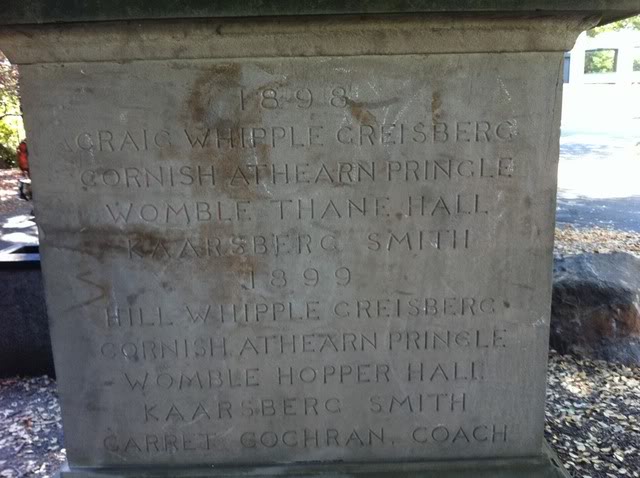
Several of us old football men attended to look him over. “I only want men on my team who come to college primarily to study,” was the opening statement. “Out upon him, he’s a long hair,” whispered one of my companions. . . . “Does he imagine this is a divinity school?” observed another. “Whoever heard of a football man coming to college to study?” . . . However, we listened further, got interested and moved up closer to get a better view. “Say, he’s no long hair, look at that mug,” quoth [Kangaroo] Pete Kaarsberg, who had begun to get interested. Smith continued, “There are four mental qualifications necessary for success — Aggressiveness, Obedience, Concentration and Determination. Add to this, Harmonious co-operation and you have the making of a real team. Sixty percent of the success of a football man or team is the spirit and fight that they put into their efforts.”
Andy Smith recognized that his team was still largely unfamiliar with the game of American football. He told the press that on the first day of practice he was greeted by “125 of the finest specimens of humanity that I have ever laid eyes upon. However, under a hasty investigation, I discovered that about all they knew about football was that the ball was spherical and that the game was played on a field 100 yards long and 50 yards wide. As far as knowledge of the game was concerned, I might as well have gone to Russia.” Smith put his players through very tough drills in preparation for the 1916 season. He scheduled daily practices from 4-7 p.m., using incandescent lamps to light the field, and painting the ball white so it could be seen more easily after sunset. Smith believed that nothing could substitute for repetitive drills. “It takes about two minutes to tell a man the proper form to use in tackling and blocking,” said Smith, “but it often takes two years to get him to do it instinctively and well.” Smith also believed that defense was the most important part of the game, “Defensive methods are much more difficult to acquire than offensive methods. And while it is easier to teach offense than defense, it is my opinion that there never was an offense in any one exclusive style of play that could not be stopped by the defense — if there is time enough to drill it into the man.”
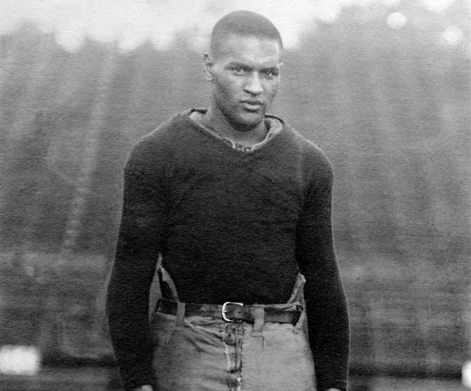
The 1916 season proved to be modestly successful, with Cal going 6-4-1, including a 27-0 win over USC and a 48-6 defeat of St. Mary’s, who were both also in the process of switching from rugby back to football. Although the players were still learning the fundamentals of the game, the Bears had a few stand-outs in halfbacks Roy Sharp and Carlton “Dummy” Wells, and most particularly in lineman Walter Gordon, the first African American to play at Cal. But the 1917 season proved to be an even bigger challenge, when the team was disrupted by the loss of a number of players to the World War I draft. The Bears were 5-5-1 in 1917 and 7-2 in 1918, the latter good enough to win the conference championship.
Andy Smith (top row, far left) with his 1917 team at California Field
1918 was notable for the return of the Big Game. Stanford finally decided to follow the rest of the west coast colleges and return to American football, and the two schools agreed to play a game on November 30. However, Stanford insisted that neither the final score nor any of the statistics be included in the official records. Accordingly, the Bears issued an “unofficial” whopping to Stanford in the first Big Game in four years. Even the lopsided final score of 67-0 and the seven touchdowns scored by Albert “Pesky” Sprott do not fully reflect the overwhelming nature of the California victory. That is better reflected by Stanford’s failure to complete a single pass and its net of -10 yards rushing. The season ended with Cal’s Walter Gordon becoming the first Golden Bear to be named an All American.
1919 was another good season, with the Bears going 6-2-1, including wins over USC and Stanford. But the real excitement that year came from the freshman team. Andy Smith had hired a new assistant in 1918, former Cal rugby player Clarence “Nibs” Price. Price, who had coached high school football in southern California before serving in World War I, had already been instrumental in encouraging Pesky Sprott, Stanley Barnes, Cort Majors, and several other outstanding players to attend Cal. Now he brought even more outstanding recruits to Berkeley, including Harold “Brick” Muller, Archie Nisbet, and Bill Bell, all of whom played on the 1919 freshman team. That team went 11-1 in 1919, with the only loss being a one-point heart-breaker against Nevada. And they pounded the Stanford freshmen 47-0. With this group of players now eligible for the Varsity team, it looked like 1920 would be a very good season for the Bears. It turned out, “very good” wouldn’t be the half of it.
Andy Smith believed that defense was the key to winning football games, and he described his football philosophy as “kick and wait for the breaks.” But he was not at all averse to creative offense. During the winter of 1919-20, he began considering some more wide-open offensive plays. While having dinner with his friend, Missouri coach Jimmy Phelan, Smith drew up a play involving a lateral to a player who had dropped far back and who would then throw a forward pass of 50 yards or more. Phelan did not think the play could succeed — unless Smith could get, “a man with a shotgun for an arm.” A smiling Smith told his friend, “I’ve got one.” His name was Brick Muller.
The 1920 season started with a solid victory 21-0 victory over the Olympic Club and a spectacular 88-0 defeat of the Mare Island Marines, who had soundly beaten the Bears the last time they had played. Then came the St. Mary’s game. Cal was a slight favorite, but the game was supposed to be the Bears’ first real test of the season. The Bears scored less than two minutes into the game on a four-play 80-yard drive. And it just got worse from there for the Gaels. The Bears led 37-0 at the end of the first quarter and 85-0 at halftime. Although Smith pulled his starters in an effort to prevent the rout from becoming worse, the demoralized St. Mary’s team could not stop the second-string Bears either. By the end of the third quarter, the score was 106-0. The final score would be 127-0. The 1920 St. Mary’s game remains the biggest blow-out in Cal history. Following the game, St. Mary’s canceled the rest of its season.
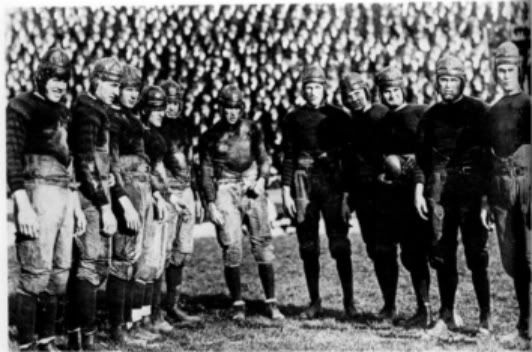
The starters on Andy Smith’s 1920 Wonder Team (from left): Brick Muller, Bob Berkey, Duke Morrison, Charley Erb, Pesky Sprott, Crip Toomey, Dan McMillan, Stan Barnes, Lee Cramer, George “Fat” Latham, and Cort Majors
The following week, Nevada finally managed to score against the Bears. (And my own great-uncle, Jack Heward, kicked the extra point for Nevada!) Despite the Bears’ 79-7 victory, Andy Smith was unhappy with the defense for allowing a touchdown, and he increased defensive drills the following week in preparation for the Utah game. The result: a 63-0 Cal win. After this game, former Cal player Brick Morse wrote in The San Francisco Chronicle that Andy Smith’s team was a “Wonder Team.” Smith was outraged, fearful that such hubris would motivate opponents and cause complacency among his players. He called Morse up to berate him, but Morse just laughed, telling Smith, “Why don’t you break down and admit it, Andy, for you know as well as I that it is a real Wonder Team.” Smith’s response: “They’re overrated.”
And it did seem the next week that perhaps Coach Smith’s concerns had been justified, as the Oregon Agricultural College Aggies (now Oregon State) gave the Bears their toughest game of the season in Corvallis. The Bears only managed a 17-7 win, although they out-gained the Aggies 191 yards to 47 yards. The next week the Bears faced undefeated Washington State in what was expected to be another tough game. But this time the Wonder Team lived up to its name, posting a 49-0 victory.
Then came the Big Game. Stanford had had a good season. Their record was 4-2, with their two losses coming in close games against the Olympic Club and USC. On game day, nearly 28,000 fans jammed into California Field, built to hold fewer than 25,000. It was the largest crowed ever to see the Bears play. The Stanford defense played well in the first half, keeping the score to 10-0 at halftime. But in the second half, the superior power and conditioning the the Bears wore them down, and the Bears began to score at will. The statistics tell the story: total yardage — California 382, Stanford 26; total first downs — California 18, Stanford 0. The final score, 38-0, made it the biggest “official” Big Game blow-out to date.
Ticket stub for the 1920 Big Game – the last Big Game played at California Field
The Bears’ 8-0 record earned them a berth in the Rose Bowl against Ohio State. Despite California’s spectacular season, in which they had outscored their opponents 482-14, the east coast media showed little respect for the Bears, and undefeated Ohio State was made an 8-to-5 favorite. But the interest of the west coast fans in the game was overwhelming. Although 10,000 seats were added to 31,000-seat Tournament Park, demand for tickets was triple capacity, and they were sold by scalpers for unprecedented sums. So great was the interest in the California-Ohio State game that the Rose Bowl Committee immediately began planning to build a new, much larger stadium, which would be called, simply, The Rose Bowl.
California scored on its first possession, and then stopped Ohio State on its only legitimate drive of the day, when Brick Muller recovered an Ohio State fumble on Cal’s 8-yard-line. In the second quarter, the Bears executed one of the most famous plays in Rose Bowl history. After a first down run, Archie Nisbet feigned injury, laying on the ground for a few moments while the Cal players appeared to be milling around. In fact, they were lining up for the next play. Center George “Fat” Latham took Brick Muller’s position at right end. Right halfback Pesky Sprott moved six yards behind the line, behind the right guard. Brick Muller stood 10 yards behind, and slightly to the right of, Sprott. Archie Nisbet unexpectedly rose from the ground, moved to the center spot and snapped the ball to Sprott, who turned and lateraled to Muller. At the same time, left end Brodie Stephens ran full speed down the field, but was ignored by the Ohio State secondary, who assumed that the ball could not be thrown that far. In fact, Ohio State defender Pete Stinchcomb yelled to Stephens, “Where do you think you’re going?” Much to Stinchcomb’s surprise, Brick Muller threw the ball 53 yards in the air to Stephens, who caught it for another Cal touchdown. It was the play Andy Smith had drawn up for his friend Jimmy Phelan before the season began — with the trickery of Nisbet’s feigned injury added in. After the game Stinchcomb was asked why he had not covered Stephens. He answered, “Frankly, I didn’t think anybody could throw the ball that far.”
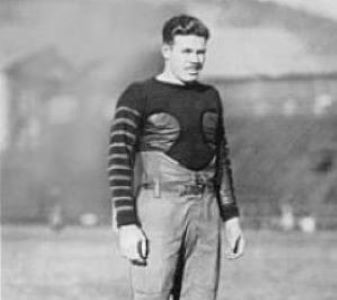
Harold “Brick” Muller – one of the greatest athletes ever to play at Cal
The final score of the game was 28-0. California ended the season 9-0-0, having outscored its opponents 510-14. And the Golden Bears were national champions. So traumatized was the Big 10 by Ohio State’s humiliating loss, that it refused to send another team to play in the Rose Bowl for 26 years. Andy Smith became a national football idol, with coaches all over the country trying to emulate his combination of conservative play with the occasional wildly radical call.
Smith himself remained utterly dedicated to his team. While he could be very gregarious, Smith also suffered from depression and was highly sensitive to criticism. And he was a heavy drinker. One of his players, Stan Barnes, recalled years later, “I never knew how much he drank. That is, I didn’t until after I graduated and became an assistant coach for a year. He drank quite a bit.” When he was not with his team or coaches, he could usually be found at the bar of the Berkeley Elks Club. In 1919 he married a young woman from Illinois, Bobbie Hollingshead. But after only a few months she tired of a husband who spent virtually no time at home, and filed for divorce.
Smith was tough on his players. Stan Barnes, who later became a federal appellate judge, recalled getting so frustrated at missing a tackle during practice that he pounded his fist on the ground and yelled that he was going to quit. Smith jerked Barnes to his feet and yelled, “Quit! No, you’re not going to quit. What you are going to do is get up and fight. Fight harder!” And Barnes did. At another practice, a promising player kept refusing to follow Smith’s instructions to hit the line head first, instead of turning around as he hit the line. “Why are you hitting the line with your ass?” Smith demanded. “You’ve got to dive in there head first.” When the player still did not follow Coach Smith’s instructions, Smith ordered him off the field, and chased the young man all the way back to the gym, trying to kick him in the offending rear end all the way. But Smith was equally loyal to his players. In addition to hiring Stan Barnes as an assistant, he took the extraordinary step of hiring former player Walter Gordon as an assistant in 1920, making Gordon the first African American ever hired to coach at a predominately white school.
The Cal coaching staff at California Field in 1922. From left: Smith, Clarence “Nibs” Price, Walter Gordon, and Albert Rosenthal.
The 1921 season was another extraordinary success. The Bears finished the season a perfect 9-0. And although the scores were not quite as overwhelming as the previous year, there were impressive wins of 51-6 over Nevada, 39-0 over Oregon, 38-7 over USC, 72-3 over Washington, and 42-7 over Stanford. In the Washington game, Jesse “Duke” Morrison rushed for five touchdowns — a single-game record that still stands at California. The Bears once again appeared in the Rose Bowl, this time against the obscure Washington & Jefferson College, a substitute for the Big 10 schools that now refused to come west to play California. A rainstorm of almost biblical proportions hit Pasadena the night before the game, and the field was little more than a mud pit, making all but the most conservative offensive plays impossible. Nevertheless, the heavily favored Bears were shocked to be held to a 0-0 tie.
The terrible field conditions at the 1922 Rose Bowl made scoring all but impossible for both teams.
Despite the unsatisfying Rose Bowl tie, the Bears were named national champions again for the 1921 season. And 1922 was more of the same. The 1922 Bears were a perfect 9-0, with six shutouts, including a 28-0 season finale against Stanford. Duke Morrison set scoring records for California that still stand: most points scored in a season (131) and most touchdowns in a season (18), while Dick Dunn set the still standing record for most touchdowns in a game (6) and most points scored in a game (36), in the Bears’ 61-13 drubbing of Nevada. Although the Bears were invited to their third consecutive Rose Bowl, California announced that it was not interested in participating in any more Rose Bowls, because of disputes with the Rose Bowl Committee. USC was invited in Cal’s place. Nevertheless, California was selected as the national champion for the third consecutive year.
After the end of the 1922 season, every member of the original Wonder Team had graduated. Their achievements were mind-boggling. In three years as Varsity players, the Wonder Team had compiled a 27-0-1 record, with only the muddy 1922 Rose Bowl tie marring their perfection. They had outscored their opponents 1220-81. California was expected to struggle the following year, and Andy Smith began receiving offers to coach at prestigious eastern universities. Cal took care of the second problem by signing Smith to a four-year contract extension, and Andy Smith took care of the first problem by continuing to win.
In fact, Smith never seriously contemplated leaving Berkeley. He loved the University and the city. He loved the campus, and could often be seen walking along Strawberry Creek. He had friends among the faculty, and among his drinking buddies at the Elks’ Club. And he took great pride both in his players, and in the knowledge that he had almost single-handedly brought west coast football respect from the rest of the nation. He said he was married to the University, and hoped it would be “till death do us part.”
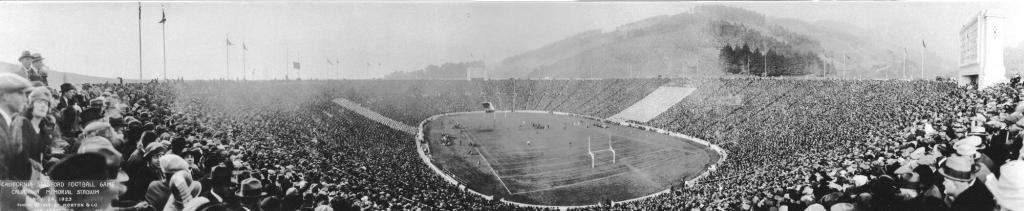
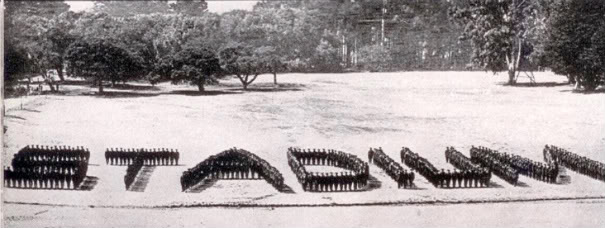
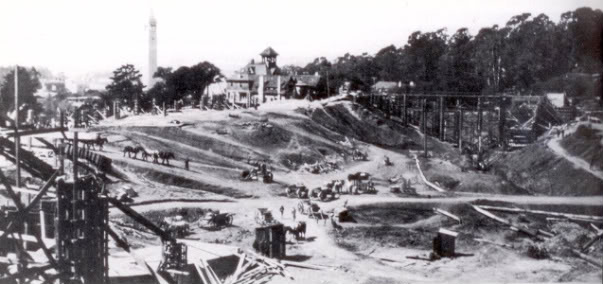
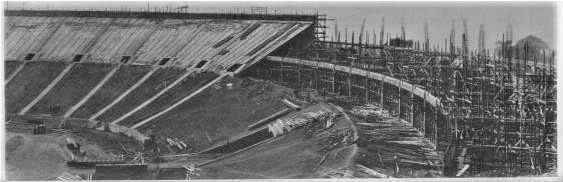
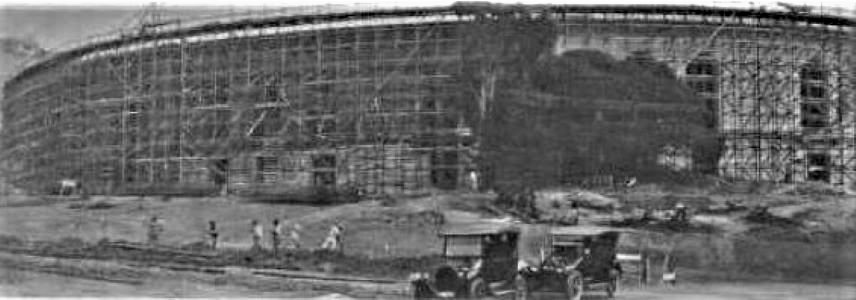
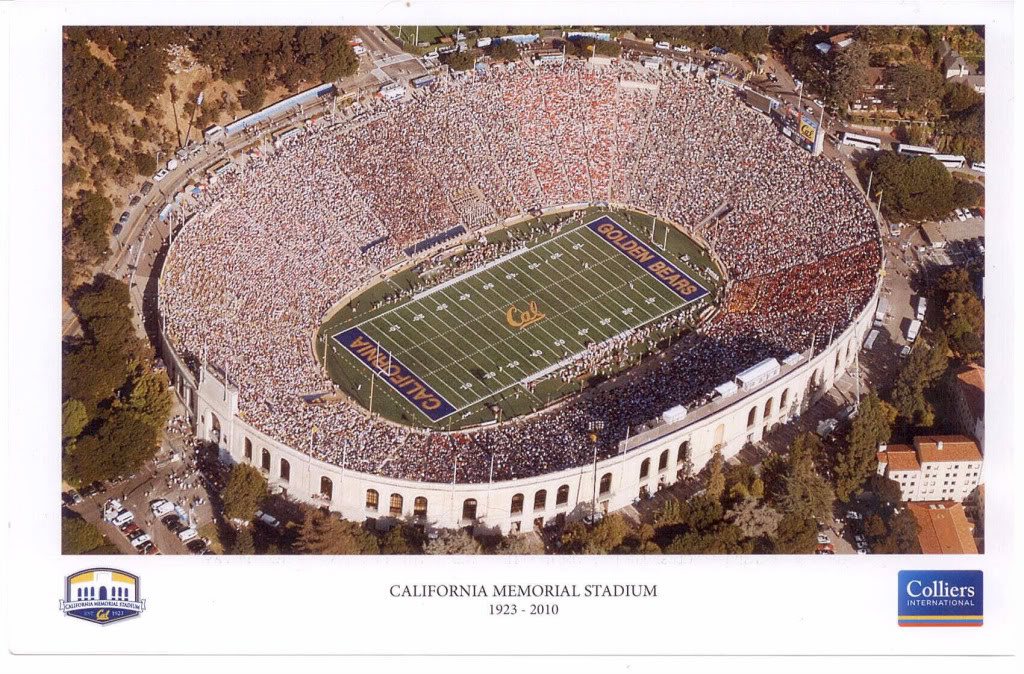
What’s more, the success of Smith’s Wonder Teams brought the money and the will to Berkeley to build an enormous new stadium. Demand for tickets far exceeded the 25,000 capacity of California Field, and rival Stanford had recently opened a 63,000 seat stadium. Two huge stadiums had also just opened in southern California, the Rose Bowl and the Los Angeles Coliseum. The Bears, unwilling to be left behind, began building 72,000-seat California Memorial Stadium in 1922, and it was ready for the 1923 Big Game. Fittingly, the new stadium became known as “the House that Andy Built.”
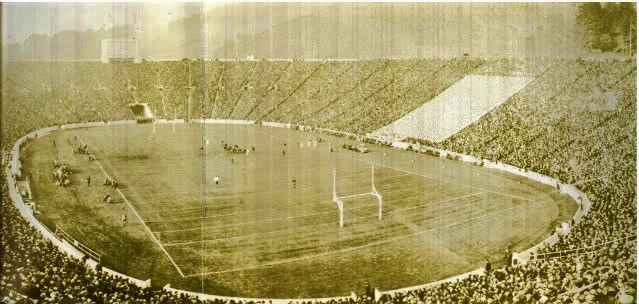
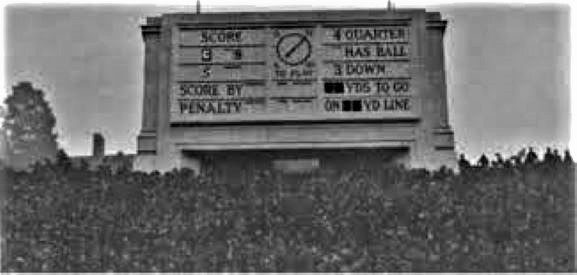
Despite the loss of seven starters from the 1922 team, including Muller and Morrison, the Bears did not slow down in 1923. Andy Smith said, “the knowledge of football never graduates.” Several players stepped up to fill the shoes of the original Wonder Team, notably center Edwin “Babe” Horrell, fullback Dick Dunn, and halfback Don Nichols, and the 1923 Golden Bears went 9-0-1. They shut out nine of their ten opponents, outscoring them by a total of 182-7. This was the Bears’ fourth consecutive undefeated season and fourth straight conference championship. California also won its fourth straight national championship. The season culminated in the first game ever played at Memorial Stadium, a 9-0 Big Game victory over Stanford, with well over 80,000 fans in attendance — thousands of them perched on a hill overlooking the sold-out stadium that would forever after be known as Tightwad Hill.
Opening day of California Memorial Stadium in 1923
1924 brought the Bears yet another undefeated season — their fifth straight. But that year Stanford was also a contender in the Pacific Coast Conference. Both teams were undefeated going into the 1924 Big Game at Berkeley. The game ended in a 20-20 tie, which sent Stanford to the Rose Bowl. In the extraordinary five seasons from 1920 to 1924, the Bears had a record of 44-0-4, had outscored their opponents 1564-146, and had shut out their opponents in 30 of the 48 games played. It was inevitable that this streak would end eventually, and 1925 saw the Bears return to earth. The graduation of Andy Smith’s second crop of great players had left the team weakened. Nevertheless, California managed a respectable 6-3 record, with all six wins coming by shutout. The fans were not discouraged, as it was universally assumed that Coach Smith would soon have California back at the top of the college football world.
After the season ended, Smith took a trip back east to watch the Penn-Cornell and Army-Navy games. While there, he contracted pneumonia. At first it did not not seem serious, but in the days before the existence of antibiotics, pneumonia posed a serious danger even to healthy young men. Smith’s years of heavy drinking may also have weakened his resistance to illness. On January 9, 1926, Andy Smith died in Philadelphia at the age of 42. He left no family. His only close relative was his brother Richard, whom Andy rarely saw. Richard Smith told reporters that his brother had, “centered all of his affections on the University of California and the boys he coached.”
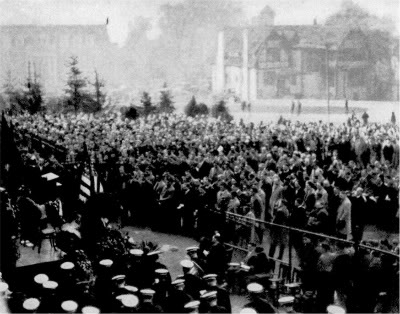
And the University returned the affection. The Berkeley campus was devastated by the news of Andy Smith’s sudden death. The 1925 team captain, Tut Imlay said, “We loved him. He made men. Andy is gone and we can’t understand why.” And Brick Muller said, “We idolized him, and he was intensely loyal to us. It was one big family with Andy coaching.”
Tributes poured in from other schools as well. UCLA’s coach Bill Spaulding praised Smith for his concern for academics. Slip Madigan of St. Mary’s added, “His characteristics were reflected by his players after they left the gridiron.” And Washington All American George Wilson said of Smith, “He was a man who could honestly be called a perfect sportsman.” Stanford’s coach, Pop Warner, said he was simply too overcome to comment on the death of his friend.
Andy Smith’s memorial service at the north entrance of Memorial Stadium on January 15, 1926
Tribute to Andy Smith in the 1926 Big Game program
The year after Andy Smith’s death, a granite bench was placed on the field at Memorial Stadium in his honor, engraved with his most famous advice to his players:
We do not want men who will lie down bravely to die but men who will fight valiantly to live — Winning is not everything, and it is far better to play the game squarely and lose than win at the sacrifice of an ideal.
In 1951, Andy Smith became one of the 54 original inductees into the College Football Hall of Fame. And in 1960, the Helms Athletic Foundation selected the 1920 Golden Bears as “the greatest college football team of all time.”
Garrett Cochran was only 22 years old when he was hired as head coach of the University of California football and baseball teams in 1898, and he only coached at Cal for two seasons. Despite his brief tenure, this young man earned the right to be considered Cal’s first great football coach by taking a team which had gone 0-3-2 in 1897, and which had not won a Big Game in seven attempts, and turning it into a nationally recognized power. Under Cochran, the Bears compiled a 15-1-3 record, and outscored their opponents 363-7. Even better, Cochran brought the Bears their first two victories over Stanford, by a combined score of 52-0. And California became the first western team to gain the respect of the eastern football elite, then still dominated by the “Big Three” of Princeton, Yale, and Harvard.
Garrett Cochran in 1896: All America end and captain of Princeton’s national champion football team
Garrett Cochran was born in Driftwood, Pennsylvania on August 26, 1876. He came from a wealthy and influential family, his father being a prominent financier and state senator. When Garry was nine, the Cochran family moved to Williamsport, Pennsylvania (which would become the birthplace of Little League baseball in 1939). In 1894, Garry entered Princeton University, where he joined the football and baseball teams. An outstanding athlete, Cochran made the varsity football team as a freshman, and immediately became a starting end (on both offense and defense, as was the rule of that era). Cochran was also a born leader, and in 1896 he became the first junior to be elected Captain of the Princeton football team and the first junior to captain the baseball team.
With the inspiring leadership of Garrett Cochran, the 1896 Princeton Tigers defeated arch-rival Yale 24-6, and finished the season undefeated, 10-0-1. The 1896 Tigers, nicknamed “Cochran’s Steamrollers,” were proclaimed national champions by five of the seven organizations which named national champions at the time. That team is generally regarded as the greatest of the twenty national championship teams fielded by Princeton in the nineteenth century.
“Cochran’s Steamrollers” – the 1896 Princeton Tigers National Championship team. Team Captain Garrett Cochran is at the far right.
During the four years Cochran played on Princeton’s varsity squad, the team was 38-4-4. As a senior in 1897, Cochran was named a first team All American. The New York Times proclaimed: “No name is better known in American football than that of Garry Cochran.”
While Cochran and Princeton were reveling in their success, things were not going nearly so well in Berkeley. The 1897 Golden Bears had a miserable 0-3-2 season under first year coach, and botany professor, Charles Nott. The season had culminated in a humiliating 28-0 loss to Stanford. In fact, Cal had yet to win a Big Game, compiling a 0-4-3 record through the first seven years of the rivalry. The 1897 loss was the worst yet.
Tired of football futility, University President Martin Kellogg asked California football and track star, Everett J. Brown, to head back east to find a coach who could turn the program around. Brown, who would later become a judge and a member of the U.C. Regents, knew the man he wanted: the biggest name in football, Garrett Cochran.
Cochran had not even yet graduated from Princeton when Everett Brown arrived on his doorstep with a proposal to hire him as California’s football and baseball head coach. Cochran was a bit reluctant at first. California was a distant and unknown location for the 22-year-old, and his family did not want him to leave the east. The prominent family was also dubious about their son taking a job in the not-terribly-respectable profession of sports coaching. But Brown was persuasive. He offered Cochran a salary of $1,500 a year, a substantial sum at the time. Cochran decided that spending a couple of years in the “wild west” would be a great adventure, and signed the contract offered by Brown.
Coach Cochran and the 1898 Golden Bears pose on the steps of the team’s headquarters, nicknamed “The White House.”
The “Cochran Revolution” was an instant success. Cochran had managed to find several outstanding athletes from among the California student body, including halfbacks Percy Hall and Warren “Locomotive” Smith, fullback “Kangaroo” Pete Kaarsberg, and tackle Charles “Lol” Pringle. Rumors spread around the Bay Area that the 1898 Bears were going to be a force to be reckoned with. This would prove true in the Bears’ first game against the Olympic Club, played on October 1, a game the Bears won convincingly, 17-0. Next the Bears were challenged by the Washington army volunteer regiment. They provided a sterner test, but the Bears managed to score two safeties for a 4-0 win. The Cal players were disgusted by their own performance in this game, and immediately challenged the army men to a rematch. This time the Bears buried the army 44-0. There were two rematches against the Olympic Club, one an 18-0 Cal win, and the other a 5-5 tie. Cal beat a Kansas army volunteer team 33-0, but were held to a 0-0 tie by an army team from Iowa. In a tune-up for the Big Game, the Bears played St. Mary’s College. “Kangaroo” Kaarsberg put on a show, scoring two touchdowns and kicking two field goals, as the Bears crushed their Bay Area rival 51-0.
Thus, Cochran’s Bears were 6-0-2 as the Big Game approached, having outscored their opponents 172-5. After having failed to beat Stanford in seven straight games, California fans were clamoring for a win against the 5-2-1 Stanford team. There was wild enthusiasm for the Cal team in Berkeley and San Francisco, and more than 20,000 fans showed up for the game at Recreation Park in San Francisco on Thanksgiving Day.
The 1898 California Golden Bears. (Top row): “Kangaroo” Pete Kaarsberg, assistant coach Addison Kelly, head coach Garrett Cochran; Volney Craig, (Middle Row): James Whipple, Bart Thane; Charles “Lol” Pringle, Percy Hall, Fred Greisberg, Harry Cornish, Fred Athern (Bottom row): Lloyd “Wrec” Womble, Warren “Locomotive” Smith
Coach Cochran sent his team onto the field with this inspirational speech:
Boys, this is the opportunity of your lives. A grander opportunity to immortalize your names, stamp them indelibly upon the pages of the history of your university, has never been given to you. For eight long years have those lobster backs made you bite the dust. It is your turn now. Make them bite and bite hard. Play, every one of you until you drop in your tracks; and when you can’t play any longer, we’ll put another man in your place. If you are repulsed once, come at them again harder. Just think what it means! Here are twenty thousand people to watch you! Some of you have mothers and fathers and sisters here today. Yes, boys, some of you have sweethearts here, who are wishing and praying that you may win. Play, fellows, play for their sakes. Let your motto be, “Hit ’em again, harder, harder.”
The inspired Bears roared onto the field and proceeded to give Stanford a long-overdue drubbing. California out-gained Stanford 882 yards to 475 (yardage totals at that time included kickoff and punt returns). Percy Hall and Lol Pringle scored two touchdowns each, with Kangaroo Kaarsberg kicking the conversions. Final score: California 22, Stanford 0.
During Christmas vacation, the team traveled to Portland for one final game against the Multnomah Athletic Club. The Bears’ 27-0 win gave them a record of 8-0-2 on the season. They had outscored their opponents by a total of 221-5. In a single season, Garrett Cochran had turned the winless 1897 team into the undefeated 1898 team.
Cochran also had a particularly notable success with the other California team he coached, baseball. In a game played on April 15, 1899, the Bears fell behind the heavily favored Stanford team, 6-0 in the sixth inning. But once again, Cochran’s never-say-die spirit prevailed. Led by pitcher, and football star, “Kangaroo” Pete Kaarsberg, Cal began to scratch its way back into the game. By the end of the eighth, Stanford’s lead had been cut to 7-5. In the ninth, Kaarsberg came to bat with the bases loaded and promptly hit a triple to put the Bears ahead. Kaarsberg himself scored on a single and in the bottom of the ninth he shut down the Stanford hitters 1-2-3. Final score: California 9, Stanford 7. But of far more significance, the Bears fans, including Everett Brown, who had recruited Cochran as Cal’s coach, managed to make off with a certain Axe which the Stanford fans had been using to taunt the Cal fans throughout the game. After a wild chase, that Axe made its way to its rightful home in Berkeley, where it became the most venerated symbol of Cal sports.
Lol Pringle, Golden Bear football star and “Guardian of the Axe,” leads Cal students in the first Axe Parade on April 17, 1899.
Coach Cochran spent the summer of 1899 visiting his family in Pennsylvania. When he returned to Berkeley in September, he was greeted with euphoria. According to The Daily Californian:
Enthusiasm was at its height this morning at the Sixteenth street station where 300 students awaited the arrival of Coach Garrett Cochran. “Here’s to you, Garry Cochran” and the college yells rang in the air and college spirit was manifested as never before…. At twelve o’clock the “Owl” steamed into the depot and all pent up feeling broke loose. At the sight of Cochran all let forth a shout and rushed to grasp the hand of the idealized coach.
Cochran’s Bears picked up the 1899 football season where they had left off at the end of 1898. Once again, the Bears played the Olympic Club three times, resulting in wins of 6-0 and 15-0, and a 0-0 tie. California also added three new college teams to their schedule, and scored impressive wins over all of them: Nevada 24-0, Oregon 12-0, and San Jose Normal (now San Jose State) 44-0. The main event, however, was the Big Game. This year, there was the extra incentive of a statue called “Football Players” which the Mayor of San Francisco had pledged to give to the school that won two of the three Big Games between 1898 and 1900. Since the Bears had already won in 1898, a win in the 1899 Big Game would earn the statue for California.
Cochran’s Bears simply decimated Stanford. Locomotive Smith scored three touchdowns, a Big Game record. And Percy Hall scored at the end of a 108-yard touchdown drive, the longest in Cal history (the field being 110 yards long at that time). Stanford, on the other hand, never came close to scoring. Final score: California 30, Stanford 0. It was the biggest blow-out in Big Game history to that time and, 124 years later, it remains the ninth biggest blow-out by either team.
As a result of the win, the Bears secured the “Football Players” statue, which remains a landmark on the Berkeley campus. Carved in its base are the words: “The Prize for Superiority in Football Won by the University of California 1898 and 1899.”
The “Football Players” statue on the Berkeley campus, as it appears today. The statue was the first permanent work of art on the Berkeley campus, and is considered to be the first internationally significant work by a California sculptor. The statue was exhibited in Paris before arriving in Berkeley. More recently, it has been adopted as a symbol by the Bay Area LGBT community.
And on the back of the statue’s base, there are engraved the names of all the players on the 1898 and 1899 Cal team, plus the name of their extraordinary coach, Garrett Cochran.
Garrett Cochran’s (misspelled)name was added at the bottom of the list of players’ names inscribed on the base of the “Football Players” statue after his death in World War I.
But the Big Game victory did not end the 1899 season. Based on the prestige of his own reputation, and California’s successful season, Garrett Cochran was able to negotiate with Glenn “Pop” Warner, coach of the famous Carlisle Indian School (where Jim Thorpe would later play), to come from Pennsylvania to San Francisco to play a Christmas day game against the Bears. The Carlisle Indians were regarded as the best team on the east coast. The Cal-Carlisle game was the first-ever to be played between an east coast and a west coast school and was closely followed by the national press, which called the game “the East-West Championship.” It was expected that the upstart west coast Bears would be blown out by Carlisle.
The Bear defense held Carlisle scoreless and came close to pulling out a huge upset. But late in the game, a broken play resulted in a Cal fumble into the end zone, which Carlisle recovered for a safety. Final score: Carlisle 2, California 0. Nevertheless, the game was considered a great success for Cal and for west coast football, demonstrating that they could hold their own against an eastern power.
The Brooklyn (New York) Daily Eagle report on the Cal-Carlisle game.
After the Carlisle game, Coach Cochran decided that the time had come for him to return home to the east. His accomplishments in the space of just two years were extraordinary. The Bears had gone 15-1-3, and outscored their opponents 363-7. Their sole defeat had been a 2-0 loss to the team generally regarded as the best in the country. The Bears had shutout their opponents in 10 straight games and in 1899 the Bear defense did not give up a single point. California had also become the first west coast team to gain the attention and respect of the eastern press. It was an amazing record for a young coach who was still only 24 years old.
When Cochran returned home, he took the head coaching job at Navy, where his team went 6-3 in the 1900 season, including an 11-7 win over arch-rival Army. He then decided it was time to settle down into a “real” job, and took a position at the Williamsport Wire Rope Company. But the following year, 1902, the head coaching position at his alma mater, Princeton, came open, and he could not resist. Cochran led the 1902 Princeton Tigers to an 8-1 record. Thus, by the age of 27, Garry Cochran had four years of experience as a college head coach, with a career record of 29-5-3. Had he remained in coaching, he might now be regarded as one of the all-time greats. But, instead, he decided that it really was time to settle down. After the end of the 1902 season, he married Eleanor McNeeley of Philadelphia, and returned to the Williamsport Wire Rope Company, of which he eventually became president.
But Garry Cochran never lost his adventurous spirit. He joined the Pennsylvania National Guard and, in 1916, was sent to serve along the Mexican Border in a what proved to be a fruitless American pursuit of the Mexican bandit Pancho Villa. In a sad irony, Charles “Lol” Pringle, a mining engineer who had been a star player on Cochran’s California teams, was killed by Pancho Villa’s raiders that same year.
Lieutenant Garrett Cochran in 1917.
Cochran was called to active duty again in 1917 for service in World War I. He was sent to France with his unit and served as a lieutenant in the field artillery. In June 1918, Cochran developed a severe case of pneumonia. He was put on a ship back to the United States for treatment, but he died on July 8, 1918, before the ship reached port. He was 42 years old, and left behind his wife and three young children. In Berkeley, Coach Cochran’s legacy was not forgotten, and a memorial service was held for him at the site of the “Football Players” statue which his teams had won for California with their spectacular Big Game victories in 1898 and 1899. Every surviving member of those teams was in attendance. It was at this time that Garrett Cochran’s name was engraved on the base of the “Football Players” statue, added to the list of names of his players.
The memorial service for Garrett Cochran in Berkeley. In attendance, at the far left of the photograph are his former players, “Kangaroo” Pete Kaarsberg, Percy Hall, and Warren “Locomotive” Smith. The speaker is Judge Everett J. Brown, the man who hired Cochran to coach at Cal in 1898.
Upon hearing of this honor to Garry Cochran, the Princeton Alumni Association sent a letter of thanks to the University of California, and placed this apt tribute to Cochran’s California coaching career in the Princeton Alumni Weekly:
Every university has a football team that stands out prominently from the many other strong ones that are developed from year to year. In the University of California the teams of 1898 and 1899 are looked upon as those which started the University on its victorious football career. . . . With the coming of a coach from the East, football was played with a different spirit, and before the season had advanced very far, the whole University knew that a leader had come amongst them. The student body was awakened to the need for getting behind the team and giving them the support necessary to win. Garrett Cochran ’97 of Princeton was the coach who accomplished this. He did much for California. It was his spirit which spread through the student body. His enthusiasm for and thorough knowledge of the game soon showed results, and the season ended with a victory and the biggest score California had ever run up over Stanford.
By 1947, baseball was already an old and storied sport at Cal. The names of the members of inter-mural baseball teams representing each class, and the results of their games, were listed in the Blue and Gold yearbook as early as 1874. And by 1885, the Bears were playing against outside opponents. The 1886 Blue and Gold lists a “University Nine” representing the entire campus, and records what may have been the Bears’ first intercollegiate game, played against the University of California’s Hastings College of the Law (now UC Law San Francisco) on October 31, 1886. The final score, a 36-28 Cal win, indicates that both schools could have used some pitching.
The 1888 California “University Nine” (plus student manager) took on opponents such as St. Mary’s and the College of the Pacific, compiling a 3-1-1 record.
Perhaps most famously, it was California baseball that first brought The Axe to Berkeley. On April 15, 1899, Stanford supporters brought The Axe to a baseball game against the Bears in San Francisco, using it to chop up pieces of blue and gold ribbon whenever Stanford had a good play. After a stirring comeback win by the Bears, Cal baseball fans liberated The Axe and spirited it back to Berkeley, where it became the most treasured icon in Cal sports history. And prior to 1947, Golden Bears baseball had also produced some notable major leaguers, including Chicago Cubs pitcher Orval Overall and Philadelphia Athletics outfielder Sam Chapman. The Bears had also won numerous conference championships.
A national championship tournament had been instituted for college basketball in 1939, but as of 1946 there was still no national championship for baseball. In 1945, a group of college coaches had formed the American Association of College Baseball Coaches, and the following year Clint Evans, a 1912 graduate of the University of California and the Bears’ head baseball coach, proposed the establishment of a championship baseball tournament. Due to the nature of the sport, he proposed not a single-elimination tournament like that used in basketball, but rather format involving two-out-of-three series. Evans was one of the most successful and respected college baseball coaches in the country, and his proposal caught on immediately. After some tinkering by the Coaches Association, it was formally approved on February 7, 1947, with the first College World Series scheduled to be played just four months later.
Cal baseball coach Clint Evans (right) with the Cal basketball head coach (and former football head coach), Nibs Price. Price’s team made the basketball Final Four in 1946, while Evans’ team won the College World Series in 1947.
The Cal Bears had long been one of the most successful baseball programs in the nation. In 1947, the Bears played in the California Intercollegiate Baseball Association with Stanford, UCLA, USC, St. Mary’s and Santa Clara. The 1947 conference season came down to the wire. At the season’s end, USC was 11-4 in the conference, and California was 10-4. Due to an earlier rain-out, the Bears had to play a make up game against Stanford to try to tie USC and force a playoff. The Bears pulled off the win over the Indians, and went on to beat the Trojans in a one-game playoff to win the conference title. That, and the Bears’ overall record of 29-10, was enough to earn them a spot as one of the eight teams selected for the first college baseball playoffs.
The playoff format consisted of two regional, single elimination playoffs. The eastern regional was played at Yale, and the first college playoff game ever was played on June 20, 1947 between Yale and Clemson. Yale won, and then faced NYU, which had beaten Illinois. Yale beat NYU 6-4 to gain a spot in the College World Series.
The western regional was played at a minor league ball park in Denver. In the first game, Texas beat Oklahoma 10-9. Then California beat Denver University 3-2, setting up a showdown between Cal and Texas for the second spot in the College World Series. However, that game was delayed by two solid days of rain. When the rain finally stopped, the field was soaked. In an effort to make the field playable, the officials decided to spread gasoline on the field and burn it, and then spread new topsoil on the ground. According to Cal outfielder Lyle Palmer, “Coach Clint Evans was in the outfield spreading gasoline when someone lit it.” Somehow Evans managed to avoid being burned, and the game was able to be played. The game was a thriller, with Cal scoring the winning run in the bottom of the ninth to defeat Texas 8-7 and earn a trip to the College World Series.
The first College World Series was played in Kalamazoo, Michigan, at Hyames Field, on the campus of Western Michigan University. It was probably not a coincidence that Judson Hyames of Western Michigan was the chairman of the Coaches Association committee in charge of organizing the playoffs. The format for the World Series was best two-out-of-three, with one game to be played on Friday, June 27, and a doubleheader (if necessary) to be played on Saturday, June 28.
The program cover for the first College World Series between California and Yale.
Cal’s Coach Evans was ecstatic to be playing in the series whose creation he had worked for. Cal center fielder Lyle Palmer recalled, “This was Clint’s baby. It had finally reached fruition. That we were playing in it was just frosting on the cake for him. He was like a kid, he was so happy.” The event also caught the attention of Major League Baseball. The American League sent two umpires to call the games, and baseball Commissioner A.B. “Happy” Chandler was on hand to throw out the first pitch. But despite all the attention, the Cal players did not feel much pressure. They were not typical college athletes, since many of them were World War II veterans. As Lyle Palmer explained, “We were a much more mature group of guys than kids just coming out of high school. We weren’t bothered by pressure. Some of us were in combat in the war, so we had gone through things a lot more worrisome than baseball games.”
Cal center fielder Lyle Palmer, who went 5-for-7 in the first College World Series. Palmer played minor league baseball from 1948 to 1954 with several teams, including the Oakland Oaks, and had a career .322 average.
The start of the first game was delayed 45 minutes by rain. Yale’s pitcher, Jim Duffus, may have been affected by the delay. When the game finally got underway, Cal promptly scored two runs in the first, on a walk, an error, and a triple by the Bears’ Jim Brown. But the Cal starter, Nino Barnise, also seemed to have been affected by the delay. In the bottom of the first, he gave up three runs on two walks, an error, and a double, giving Yale a 3-2 lead. Coach Evans wasted no time in pulling Barnise, putting in pitcher Dick Larner in the first inning to get the final out. But Larner gave up another run in the second, and Yale’s lead was 4-2.
Yale reliever Frank Quinn was strong for the next five innings, keeping the Yale lead at 4-2 into the seventh. Quinn was Yale’s best pitcher. He would later become one of the first “bonus babies” in baseball history, receiving a then-astronomical signing bonus of $75,000. With a two-run lead and Quinn on the mound, the Yale team was confident. “Once we got ahead with Quinn, it seemed like it would be easy,” said Yale catcher Norm Felske. But in the seventh inning, Quinn hit Cal’s John Fiscalini. Then a throwing error allowed Ed Sanclemente to reach second, while Fiscalini advanced to third. After Fiscalini scored on an infield out by Bob O’Dell, Coach Evans sent in freshman Jackie Jensen to pinch hit.
Jensen would shortly become well-known as one of the greatest running backs in California football history, and would lead the Bears to the 1949 Rose Bowl. He would also have an impressive major league career with the New York Yankees and Boston Red Sox, including being named the American League’s Most Valuable Player in 1957. But in 1947, he was still a relatively obscure freshman. Even so, he made believers out of the Yale players. Red Mathews, the Yale third baseman, said, “He was strong and fast and big. I was very impressed with him.” In his first at-bat in the College World Series, Jensen came through with a pinch-hit single to drive in the tying run.
In the eighth, Ed Sanclemente gave the Bears a 6-4 lead with a two-run single. As a result, in the bottom of the eighth, the Yale coach pulled pitcher Quinn for a pinch hitter. It was to no avail, as Yale did not score. And then, with Quinn out of the game, the wheels came off for Yale in the top of the ninth. Yale reliever Sid Rosner walked the first batter he faced, hit the next batter, and was then replaced by Phil Kemp, who couldn’t get an out. The Bears proceeded to score 11 runs in the top of the ninth. “The 11 runs sort of shocked us,” said Yale catcher Felske. The final score of game one: California 17, Yale 4.
But the series was far from over. Yale could still win the championship by sweeping the double header the following day. Yale’s team leader was its captain and first baseman, George H.W. Bush. Like Cal’s Lyle Palmer, he was a decorated World War II combat veteran. But unlike Palmer, who went 5-for-7 in the series, Bush was not much of a hitter. Although Bush was well-liked by his teammates, his friend, catcher Felske, was sometimes moved to tell him, “For chrissakes, Bush, get a damn hit” — something the Bears’ pitchers were able to prevent him from doing during the series.
The Cal pitching staff kept future President George H. W. Bush hitless during the first College World Series. He was 0-for-7.
California’s freshman pitcher Jackie Jensen started the first game of the scheduled Saturday doubleheader. Yale scored a run in the first, but in the second Yale made the mistake of intentionally walking Cal’s number eight batter. Sixty years later, Yale first baseman George Bush recalled, “We walked the eighth hitter to get to the pitcher, and it was Jackie Jensen. He hit one that’s still rolling out there in Kalamazoo.” Jensen’s double gave the Bears a 2-1 lead. By the fourth inning, Cal’s lead was 7-3. But in the fourth, the 17-year-old Jensen had a bout of wildness. Jensen was not a control pitcher. He pretty much just threw fastballs as hard as he could. And while some of his teammates told him that he could not expect to just blow fastballs past batters at the college level, he often did. Cal right fielder Cliff McClain said, “Some guys got on him, telling him he couldn’t just fire it past guys in college. But as far as his fastball, you could tell he was special.” But when the freshman Jensen lost control of his fastball, he did not have anything to fall back on. By the time the fourth inning ended, Yale had tied the game 7-7.
Freshman pitcher — and future American League MVP — Jackie Jensen.
Clint Evans brought one of his starters, Virgil Butler, on in relief, and Butler ended the Yale rally. In the bottom of the seventh, Cal had runners on first and third, when Lyle Palmer tried to steal second. The Yale catcher threw the ball into center field, allowing Cal’s John Ramos to score from third, and giving the Bears the lead. Butler shut down the Yale hitters for the rest of the game. With two out in the bottom of the ninth, George Bush came to bat. Butler later remembered, “On the last pitch, I struck out George Bush on a curve ball. I got my 15 minutes of glory!” Final score: California 8, Yale 7. It was a sweep, and the University of California Golden Bears were the first-ever College World Series Champions. Fifty years later, Cal’s Lyle Palmer, who led his team to the championship, said that his best memory of the series was not any of his own heroics, but the sheer joy of California Coach Clint Evans, who had worked so hard to establish the College World Series, and then led his team to victory. “Clint was always talking about how, ‘We’ve got to have a World Series for college baseball.’ My fondest memory is that he was the happiest man I ever saw when we won, and he never forgot it until the end of his life.”
The 1947 Golden Bears. BACK ROW: Ken Gustafson, George Yamor, Ralph McIntire, Red Finney, Jim Anderson, Jackie Jensen, Virgil Butler, John Enos, Russ Bruzzone, George Sproul. MIDDLE ROW: Coach Clint Evans, Nino Barnise, Bob Anderson, LaVerne Horton, Ernest Mane, William Lotter, Sam Rosenthal, John Ramos, Bob Peterson. FRONT ROW: Robert O’Dell, Douglas Clayton, Cliff McClain, Lyle Palmer, John Fiscalini, Tim Cronin, Ed Sanclemente, James Brown, Glen Dufour, Jr.
California would win a second College World Series championship in 1957. The Bears also appeared in the College World Series in 1980, 1988, and 1992. Possibly most memorably, the Golden Bears made a stirring run to the CWS in 2011, just after the team had been saved by a alumni-led fund-raising campaign, thus completing an extraordinary run from the brink of extinction to the College World Series.
GO BEARS!
Sources
Anonymous, Blue and Gold, Volume 74, Associated Students of the University of California, Berkeley, CA (1947)
When its gates opened on November 24, 1923, it was called “the House the Andy Built.” Rightly so, since the impetus for the construction of California Memorial Stadium was the tremendous enthusiasm and fan support created by Coach Andy Smith and his Wonder Teams, which rendered venerable old California Field far too small, and required the construction of a new, state-of-the-art facility.
Well-dressed fans stream into California Memorial Stadium the day it opened, November 24, 1923.
Memorial Stadium is actually the third football stadium on the Berkeley campus. On February 14, 1885, California played the first football game ever on the campus. The opponent was a football club from San Francisco, called the Merions. The game was played on a field at the site of what is now the Life Sciences Building, drawing an unprecedented crowd of some 450 spectators. The Bears triumphed 13-0. And they beat the Merions twice more the next two Saturdays. A month later, some members of the Merions joined with the best players of other San Francisco football clubs to challenge the Bears to a game. This all-star club, calling itself the Wasps, tied the Bears on March 14, before a crowd of 350. It was decided that a re-match was in order, and it was scheduled for March 28, 1885. Such excitement had been generated that Cal constructed bleachers around the field to accommodate the anticipated crowd. Every seat was filled long before game time, as a crowd of 750 fans showed up in Berkeley — by far the largest crowd ever at a Bay Area football game. The Bears pulled off a 2-0 victory and ended their season 4-0-1.
Fans packing the bleachers at West Field in 1899.
Over the following years, the playing field acquired bleachers seating some 5,000 fans, and it was given the formal name of “West Field.” The seating capacity was insufficient for the annual Big Game against Stanford, however. That game regularly drew 15,000-20,000 fans, and continued to be played on neutral turf in San Francisco. But when the Bears were awarded the prestigious “Football Players” statute for triumphing over Stanford in the 1898 and 1899 Big Games, that statue was placed next to West Field, where Cal fans could admire it before every home game. It remains there to this day, now rather incongruously near the Life Sciences Building and far from the football stadium.
A 1903 football game at West Field. In the background is the original Harmon Gymnasium, which is now the site of Dwinelle Hall. Old Harmon was torn down in 1933.
By 1904, interest in Cal football had grown to the point that tiny West Field was no longer adequate. The University decided to build a stadium seating in excess of 20,000 fans. This would allow the Bears to play important games, including the Big Game, at home in Berkeley. The new stadium, called California Field, was closer to the center of campus, at the site where Hearst Gymnasium is now located.
California Field in 1910, during the years when the Bears played rugby instead of football.
Photo of California Field taken from the Campanile during the 1920 Big Game. It was published in The Oakland Tribune.
The state of the art scoreboard at California Field showing the final score of the 1920 Big Game.
California Field would have a notable history, as the place where Cal football came into its own as a nationally recognized power. The Bears started things off right by winning their first game at California Field, a 10-0 victory over the Olympic Club on October 8, 1904. And on November 12, the Bears met Stanford in first Big Game ever played outside San Francisco. Stanford had at first been reluctant to travel to the Berkeley campus, but finally agreed. Sadly, heavily favored Stanford beat the Bears 18-0. However, the game drew a sell-out crowd of 21,500, the largest ever to witness a Big Game, and the schools were able to split a profit of $20,000, which was a small fortune in 1904.
There were many colorful moments in the history of California Field. In the spring of 1906, the stadium found itself home to a tent city of earthquake refugees from San Francisco:
California Field in April 1906. The roof of South Hall can be seen at left and the clock tower of Bacon Hall at the right.
And in 1910, California Field was the spot where the Cal student rooting section introduced the world to card stunts.
Gave ’em The Axe, of course!
It was also at California Field where Cal fans developed the tradition of storming onto the field to “serpentine” around the goal posts after a Big Game victory. It was this tradition which gave rise to the lines in the California fight song, Big C: “And when we serpentine, Their red will turn to green, In our hour of victory.”
But by 1920, California Field, which had seemed so huge when it opened in 1904, was bursting at the seams with Cal fans. From 1906 to 1914 Cal had stopped playing football and turned to rugby instead, because of concerns over the extreme violence and injuries involved in American football at that time. But in 1915, the Bears began playing football again, and the following year California hired Andrew Latham Smith as its head coach, with hopes that he could return the team to football glory. They were not to be disappointed.
The Cal coaching staff at California Field in 1922: Head Coach Andy Smith and Assistant Coaches “Nibs” Price, Walter Gordon and Albert Rosenthal.
Smith had good success during his first four years in Berkeley, taking a school which was just re-learning the game of football to a combined 24-13-3 record from 1916 to 1919. But in 1920, Andy Smith and his Bears really hit their stride, compiling a perfect 9-0-0 record and outscoring their opponents by a combined score of 510-14. The 1920 season included victories of 79-7 over Nevada, 63-0 over Utah, 49-0 over Washington State, 38-0 over Stanford, 127-0 over St. Mary’s, and a 28-0 win over Ohio State in the Rose Bowl. The Wonder Team was born.
Suddenly, everyone wanted a ticket to see the Bears play, and demand only grew as the Bears went unbeaten again in 1921 and 1922. 28,000 fans had jammed into California Field for the 1920 Big Game, overcrowding the stadium to the danger point. Meanwhile, Stanford had built an enormous new stadium in Palo Alto. Begun in 1919, Stanford Stadium was completed two years later at a cost of $570,000. The first game to be played there was the 1921 Big Game. Although Stanford Stadium had a seating capacity of 60,000, interest in the new stadium, combined with interest in Cal’s Wonder Team, was so great that 62,740 fans squeezed in to see the Bears destroy Stanford 42-7, ruining the dedication of Stanford’s new stadium.
And Palo Alto did not have the only grand new stadium in California. In 1922, the Bears were invited to play the University of Southern California in a regular season game to inaugurate the brand-new Rose Bowl (resulting in a 12-0 Cal win). And the following year, Cal played U.S.C. again, this time at the brand-new Los Angeles Coliseum (a 13-7 Cal win). The Bears wanted a stadium to match those in Palo Alto, Pasadena, and Los Angeles. While Stanford and U.S.C. were having trouble selling out their enormous stadiums, the Bears were drawing sell-out, standing-room crowds of 25,000-plus to their games at California Field, and having to turn thousands of fans away.
Because of the size difference between California Field and the new Stanford Stadium, the schools agreed that both the 1921 and 1922 Big Games would be played in Palo Alto, while Cal sought to build a new stadium in Berkeley. Thus the Bears’ 1920 shellacking of Stanford would be the last Big Game played at California Field.
Cal’s Wonder Team defeated Stanford 38-0 in the last Big Game at California Field
With the Bears by far the most successful team ever seen on the west coast, and other schools obtaining spectacular and enormous new stadiums, it was now critical that the Bears get a new stadium for themselves. This was especially true since the Big Game could no longer, as a practical matter, be played at the now small and outdated California Field.
There was general agreement in the University community on the need for a new stadium. In fact, the inclusion of a major stadium on the Berkeley campus had been a goal since 1897, when it was included in the Hearst Architectural Plan, sponsored by University patron Phoebe Hearst and president Benjamin Ide Wheeler. At that time, University architect John Galen Howard (designer of the Campanile, Sather Gate, Wheeler Hall, and most of the rest of the classical center core of the Berkeley campus) had submitted a plan for a large classical style stadium on the site where California Field was later built. Following the 1920 Big Game, the proposal for a new, much larger stadium was revived. The Executive Committee of the Associated Students of the University of California (ASUC), which was then in charge of intercollegiate athletics, proposed building a 60,000-seat stadium. Under this proposal, the stadium would be funded by $1 million raised in a state-wide campaign, and would be dedicated as a memorial to Californians who had been killed in World War I.
John Galen Howard, still the University’s primary architect, was given responsibility for proposing a site for the new stadium. He considered several on-campus locations: the site of California Field; the southwest area of campus now occupied by Evans Baseball Diamond and Edwards Stadium; and Strawberry Canyon at the base of the hills on the east end of campus. He also considered several off-campus sites. Fortunately, the University Regents opted for an on-campus stadium, because they believed it would enhance the enthusiasm and attendance of students and bring alumni back to campus.
John Galen Howard, architect of California Memorial Stadium.
At first, the Regents rejected the Strawberry Canyon site as too small, and also because it was also being considered as a possible location for future student housing. Accordingly, in December 1921, Howard was told to begin plans to build the stadium in the southwest corner of campus, where Evans Diamond and Edwards Stadium now sit. Howard began drawing up plans for an oval, double-deck coliseum, which would hold 60,000. But almost immediately, the Regents reconsidered. Edward Carpenter, one of the engineers then working on Stanford Stadium, had suggested that a similar earth-fill bowl structure would work in the Strawberry Canyon site, at less cost and with greater seating capacity than Howard’s proposed double-deck coliseum. Then another engineer, George Buckingham, came forward with a proposal to combine an earth-fill bowl structure on the east side of the stadium with a coliseum structure on the west side. Money could be saved by building the east side directly into the hill, leaving only the west side to require the use of large amounts of steel and reinforced concrete. At the same time, the west side would provide the dramatic and impressive exterior facade that the Regents and the University community desired. The stadium would be designed for 73,000 spectators. In August 1922, the Regents adopted Buckingham’s plan and appointed a Stadium Commission consisting of the architect Howard, as chairman, the two engineers, Carpenter and Buckingham, and Robert Gordon Sproul, the secretary of the Board of Regents.
Strawberry Canyon around 1910.
There was considerable controversy over the Regents’ selection of the Strawberry Canyon site. John Galen Howard opposed it, possibly because his contract with the University paid him a percentage for all work done west of Piedmont Avenue, and he would not receive that payment for the Strawberry Canyon site. And, this being Berkeley, there was also opposition from the community. A group calling itself the Campus Protective Association was formed, protesting the Strawberry Canyon site on the grounds that it would ruin the beauty of the canyon, destroy the canyon as a natural biological laboratory for the University, and create traffic and transportation problems. The group also complained that the location lacked room for the expansion of athletic facilities. There were also objections from homeowners in the Strawberry Canyon area, whose homes would have to be demolished, or who feared that their views would be impaired by the new stadium. It being 1922, the Regents were able largely to simply ignore their opponents, and there is no record of anyone taking to the trees in protest.
Funding the project turned out to be much less controversial. The ASUC proposal to fund the stadium through the sale of premium seats was an instant success. $1 million was raised almost immediately, with the sale of 10,000 preferential seats at a cost of $100 each, in the space of 10 days. There was even a promise that the subscribers’ names would be engraved upon their chosen seats. This was never done and, in that much less litigious day, the subscribers did not protest. The final cost of the stadium project, $1,437,982, was funded entirely through these seating subscriptions.
To generate publicity and support for seating subscriptions, the starting eleven of the Wonder Team pull a replica of the proposed stadium in front on Wheeler Hall, toward Sather Gate.
Members of the University’s ROTC units spell out “STADIUM” to publicize the subscription drive to fund the new stadium, which was to be a memorial to those Californians killed in the World War.
With funding secured, the University acquired seven properties via eminent domain, and excavation began in January 1923. Blasting and hydraulic force were used to cut out portions of Charter Hill and Big C Hill. The debris was removed using steam shovels and wagons pulled by horses.
Sections of Big C Hill (“Tightwad Hill”) and Charter Hill were cut away for the east side of the stadium (note the houses on Charter Hill at right – these neighbors opposed the construction of the stadium from fears of traffic congestion and the ruining of their views of the Bay).
Horse-drawn wagons bringing construction materials to the stadium site.
A concrete culvert, 4 feet wide and 1,450 feet long, was built to carry Strawberry Creek underneath the new stadium. The Stadium Commission, aware that the new stadium was directly atop the Hayward Fault, designed it in two halves, with an expansion joint at both the north end and south end, allowing it to move in a major earthquake. The east side of the stadium was built directly into the hills, while the west side contained the neoclassical Roman arches and appearance of John Galen Howard’s original coliseum plan.
More than one million feet of lumber was used in constructing the stadium, and another 800,000 feet of lumber was used for the seats. 600 tons of steel and 12,000 barrels of cement were also used. 2,500 pine trees were planted on Big “C” Hill, which has since become known as Tightwad Hill. And a few rather unremarkable trees were planted on the west side of the stadium to provide shade to fans as they entered and exited.
Construction of the Coliseum-style west side of the stadium.
Although excavation for the stadium had not begun until January 1923, the Bears were anxious to have it ready for the Big Game in November, only 10 months later. They had already been forced to play two consecutive Big Games in Palo Alto, and most certainly did not want to have to travel to the Peninsula for a third straight year. So while Andy Smith’s team was having another great year at California Field, work continued furiously up in Strawberry Canyon. As the Big Game approached, the Bears appeared to be heading for their fourth consecutive unbeaten season, the only blemish being a 0-0 tie with Nevada. This left Cal with a record of 8-0-1 heading into the Big Game.
The new stadium, to be christened California Memorial Stadium, was ready for the great day, and on November 24, 1923 the Bears were ready to play the first game there. Rumors started circulating from Palo Alto that there was a curse on new stadiums, in that numerous home teams had lost their first game in such stadiums. When Cal head coach Andy Smith was told this story, he laughed. “Why, of course they did,” said Coach Smith. “It was always California they invited to help dedicate their stadiums.” And, indeed, the examples given – including losses by Stanford at the opening of Stanford Stadium, and by U.S.C. at the opening of both the Los Angeles Coliseum and the Rose Bowl – had all been losses at the hands of the California Golden Bears.
A crowd in excess of 73,000 showed up for that first game at Memorial Stadium (hundreds more than the stadium’s official capacity of 72,609). Another 7,000 fans perched on Big C Hill, which began to earn its new name of “Tightwad Hill” that day. This crowd of more than 80,000 was the largest ever to see a sporting event in the western United States. The undefeated Bears were the favorite. But the game was expected to be close, since most of Cal’s Wonder Team players had graduated, and because Stanford also had an excellent team that year. The only blemish on Stanford’s 7-1-0 record was a 14-7 loss to U.S.C.
California Memorial Stadium was filled beyond capacity on its opening day, November 24, 1923
The original dedication plaque unveiled on opening day at California Memorial Stadium.
The game itself was rather disappointing. The local papers described it as “dull, dull, dull,” and “a stinker.” As was to be expected of a Cal defense which had only given up 7 points the entire season, and a Stanford defense which had only given up 37 points, the game turned into a defensive stalemate, featuring lots of punting. Cal gained only 81 yards of total offense on the day. But Stanford managed to do even worse, gaining only 66 total yards. Cal’s Bill Blewett missed five field goal attempts, including one from Stanford’s 4-yard-line. The only scoring came on Stanford punts. In the second quarter, Cal’s Edwin “Babe” Horrell blocked an Ernie Nevers punt into the Stanford end zone, where Horrell recovered it for a Cal touchdown. And in the fourth quarter, another Nevers punt was blocked by what was recorded as “the entire Cal line.” Stanford recovered the ball in its own end zone, for a Cal safety. Final score: California 9, Stanford 0.
One of the many punts during the first game played at Memorial Stadium on November 24, 1923.
The scoreboard at Memorial Stadium showing the final score of the 1923 Big Game. It is hard to read in this photo, but the upper left shows “C” with 9, and “S” with a blank.
Although the game had been less than scintillating, the Bears had posted their fourth consecutive undefeated season under the leadership of Coach Andy Smith. And they had done so in a beautiful new stadium, which owed its existence to the spirit and enthusiasm generated by Andy Smith and his Wonder Teams.
In early March 1923 the members of the University of California Boxing team were looking forward to their upcoming competition against arch-rival Stanford. It would be the eighth annual contest between the schools and, as always, it was the most anticipated. But on March 8, the day before the scheduled tournament, Dr. W. H. Barrow, the Athletic Director of Stanford University, issued a formal statement announcing its cancellation and the cancellation of all future boxing competitions between the two schools until such time as “the existing conditions . . . can be remedied.” The “conditions” that so distressed Stanford’s Athletic Director and its boxing team were the presence of Black students on California’s boxing team, and California’s refusal to withdraw one of them, Errol Jones, from a scheduled match against a Stanford boxer. As a result of these “conditions,” it would be five years before the two schools met again in boxing.
Boxing as sport at Berkeley goes back to 1907, when a student group calling itself “The Polyducean Club” was founded with, according to the Blue & Gold Yearbook, the purpose of making “boxing the foremost minor sport among college athletics.” Its matches were held in the basement of the original Harmon Gymnasium (now the site of Dwinelle Hall) where the Cal boxers faced off against fighters from gyms and athletic clubs around the Bay Area.
Old Harmon Gymnasium, now site of the south wing of Dwinelle Hall.
By 1915 The Polyduceans had some 30 members and a coach, R. H. Sheridan, a former middle weight champion of the Seattle Athletic Club. The club had been agitating for some time for varsity status as an official University sport, but had lacked any intercollegiate competitors. That finally ended in 1916 when the Cal boxers came to an agreement with their rivals from Palo Alto to meet for a boxing tournament on the Stanford campus, scheduled for April 20.
It was at that very first match that Stanford’s “color line” first became an issue. The finest boxer on the Golden Bears’ 1916 team was Walter Gordon, the California State champion in both boxing and wrestling, and an All-American football player. Gordon would later become an assistant coach for Andy Smith’s Wonder Teams at Cal, a Berkeley police officer, a lawyer, Chair of the California Parole Board, then Governor of the Virgin Islands and, finally, a federal judge. Walter Gordon was also African-American. On April 18, 1916, two days before the first-ever scheduled boxing match between Cal and Stanford, Ray Lyman Wilbur, then president of Stanford, called the president of the University of California, Benjamin Ide Wheeler, to inform him that no Black man would be allowed to compete in boxing on the Stanford campus. Lyman told Wheeler that if Cal sent Walter Gordon to the competition, it would be cancelled.
California Boxing, Wrestling and Football Star Walter Gordon
Without explanation, the coaches told another Cal boxer, Donald Lawton, that he would be going to Palo Alto in Gordon’s place. Lawton was shocked because Gordon was clearly the superior boxer. He only found out decades years in a conversation with Walter Gordon why he had been substituted.
The following year, 1917, the Cal-Stanford match was held in Berkeley. Stanford’s president was apparently unwilling to attempt to dictate to the University of California which of its students could be allow to compete in its own gymnasium, and the Cardinal team showed up for the competition. Stanford won three of the first six matches and California won the other three – including a knock-out of Stanford middleweight Eric Pedley 10 seconds into the match by California’s Jimmy Doolittle, the future aviation pioneer, four-star general and Congressional Medal of Honor winner. The seventh and deciding match of the night was set between heavyweights Hugh McNulty of Stanford and Cal’s Walter Gordon, but the match never happened. The Oakland Tribune explained the following day:
“California punchers won from Stanford last night in Harmon gym, four contests to three. The disappointment was great when Hugh McNulty, Stanford heavyweight, refused to meet Walter Gordon, the colored football star, in the final bout of the night. McNulty forfeited the event and gave the deciding match to the Blue and Gold.”
The dispute over Walter Gordon ended when he graduated in the spring of 1918. But by 1922, there was another Black boxer on the California team, and Stanford again defaulted the match in Berkeley rather than allow one of its students to compete against a Black Cal student.
in 1923, the competition was scheduled for Palo Alto once again. And once again, there was an African-American on the California team. 23-year-old Errol Jones of Fresno had a history of standing up for principle. In 1918, Jones and his younger sister, Hazel, had been refused seats in a section of a Fresno movie theater reserved for white patrons. The Jones family sued for violation of a California statute, Civil Code section 51, that barred discrimination in public accommodations based on race. Errol Jones won at trial and was awarded $100 (about $1,700 in 2022 dollars). The theater owner appealed, arguing that a “separate but equal” policy was allowed by the then-existing U.S. Supreme Court precedent of Plessy v. Ferguson. Jones’ attorney argued that Plessy did not apply because California had passed a statute to the contrary. The Court of Appeal agreed, upholding the verdict in favor of Errol Jones and setting an important precedent in California. In fact, the 1920 decision of the Court of Appeal in the case of Jones v. Kehrlein has been cited as precedent in the California appellate courts as recently as 2020.
The Title Page of the Court of Appeal’s Decision in Errol Jones’ Race Discrimination Action Against a Fresno Theater Owner
As the Cal-Stanford boxing competition scheduled for March 9, 1923 approached, neither Jones nor his teammates were interested in backing down in the face of Stanford’s “color line.” Exactly how the confrontation unfolded is disputed. Stanford claimed that the Bears misled them in advance into believing that they would not be bringing Errol Jones or another Black boxer, Marvin Johnson, to Palo Alto. The California side insisted that they had never agreed to any such thing. In any event, the day before the scheduled competition, the Cal student manager provided a list to Stanford including Jones among the scheduled boxers. Stanford responded by stating that it would neither compete against a Black boxer nor default the match. Instead, unless Jones were scratched, Stanford would cancel the entire competition.
The dispute became public when Stanford Athletic Director Barrow issued a statement. As reported in the San Francisco Chronicle, the statement proclaimed:
“Stanford has withdrawn from the boxing match as this step seems wisest under the existing conditions, but it is hoped that relations may be resumed another year if these conditions can be remedied.
“Boxing is, at best, a sport that calls for constant care to keep it above criticism, and also calls for the best feeling between the participants. During the past few years a number of points have arisen for discussion with regard to the eligibility of contestants, the conditions under which the bouts between white men and colored men, which from time to time apparently been settled, only to come up for discussion again.”
Stanford Athletic Director Barrow went on to accuse California of having, “promised that no more colored men would be entered,” but then without notice, “a negro was entered at the last moment, apparently with the expectation that we would again default that bout.” Barrow asserted that the issue was not whether Stanford was right or wrong in refusing to compete with Black students from Cal, but rather “the lack of understanding between the authorities controlling the sport at the two universities.” Barrow’s concluded his long statement: “We do feel that a fight between a white man and a negro engenders race prejudice,” and that “mixed bouts stir up race feeling rather than do anything to establish and equal status for the colored man.”
The controversy immediately exploded in newspapers around the Bay. The San Francisco Chronicle‘s sports section featured the banner headline: “STANFORD DRAWS COLOR LINE; CANCELS U.C. RING BOUTS.” In a commentary headlined, “Card Action Is Bound to Cause Much Discussion,” the Chronicle pointed out that Stanford had never questioned the presence of Black California star Walter Gordon on the football team and that many eastern schools, including Harvard, included Black students on their sports teams without undue difficulty. The Oakland Tribune‘s head line was almost identical to the Chronicle‘s: “Stanford Draws Color Line; Refuses to Meet U.C. Boxers.” The Oakland paper noted that Stanford had previously been willing to compete against Black baseball players from California.
The Daily Californian gave the story front page coverage. Under the sub-headline “California Stands on Principle” the paper quoted L. A. Nichols, the general manager of the ASUC, as stating: “In this case it is the principle more than the meet tonight that counts. California is such a big institution that the presence of colored men in competition for places on teams can make no change in our policy – we cannot have narrow views.”
March 9, 1923 Edition
In a separate editorial, The Daily Californian proclaimed:
“The athletic policy at California is that any man who is good enough can make a team, irrespective of race or color. California is a state university and does not discriminate either for or against men of another race or color. California will continue to have colored men on its teams in any case where they prove their fitness.
“This policy will remain unchanged because it is good. The sudden action of Stanford is more than regrettable. It represents a perverted idea of sportsmanship.”
California categorically denied ever promising to exclude Black students from all boxing competitions with Stanford. ASUC general manager Nichols told the Oakland Tribune that he represented, “a state institution which recognized all races, creeds and nationalities and he could not discriminate against anyone.” Nicholas added that, “California athletes won places on the various teams according to their merit, and that Jones was justly entitled to a leading place on the boxing program.” He added that California would not remove Errol Jones from the Stanford competition unless Jones himself requested that. And Errol Jones most certainly did not.
Professor John U. Calkins, California’s faculty athletic director, issued an official response on behalf of the University:
“So far as the University of California is concerned we feel . . . that when a colored man is admitted to the University and qualifies in scholarship and athletics, he is entitled to be supported. We do not feel that we could bar them and would not want to take that action. No promise was ever made to Stanford that we would bar colored athletics. In fact, as late as last year, we had a colored man on our football squad and no protest was ever entered. We regret this could not be settled ‘out of court,’ but feel the public is entitled to know how we stand.”
Roy Cortelyou, the University’s graduate manager of athletics, joined the chorus, telling the San Francisco Chronicle:
“We feel that a man in the University of California, regardless of race, class or color, has just as much right in equity to make an athletic team as any other classification. We cannot bar an athlete simply because he is black or of any other race than white.”
Stanford’s response to this hail of criticism was to assert that its objection was solely to boxing competitions, not to football or baseball or other sports. Stanford Athletic Director Barrow insisted that the specific nature of the sport of boxing was the problem, and called California’s view that Black students were entitled to participate in boxing matches with white students, “regrettable.”
The Stanford Daily took great offense to the Daily Californian editorial accusing Stanford of applying a “perverted idea of sportsmanship” to the boxing issue. It countered with an editorial of its own the following week, entitled, “In Fairness to the Boxers,” which repeated the claim that California had previously promised to exclude Black students from boxing and mocked the “indignation” and “sonorous proclamations” of racial equity coming from Berkeley as dishonest. This Stanford Daily editorial concluded:
“The existence of race prejudice cannot be denied, and whether or not it is justified, promoting bouts between men of different color can do nothing but antagonize that feeling. There is not the close contact in other branches of athletics and the personal element does not enter so strongly.”
The Stanford student newspaper concluded that if the matches were to continue, with California including Black students and Stanford determined to forfeit such matches, “naturally Cardinal boxers would resent any such action. They would feel that California was entering negroes merely to win the meet unfairly.”
The claims by Athletic Director Barrow and Stanford supporters that their refusal to allow a Black Cal student into the boxing competition was based entirely on high-minded motives of what was best for the sport were obviously hollow. There was, however, a bit of truth in their accusations of hypocrisy. At the same time that University officials in Berkeley were proclaiming their belief in racial equality, California’s African-American students were excluded from sharing University housing with white students and University president David Barrows (not to be confused with Stanford Athletic Director W. H. Barrow) was barring a photograph of the members of California’s first Black sorority from being published in the Blue & Gold Yearbook, on the purported ground that the sorority “was not representative of the student body.” Nevertheless, at least with respect to Errol Jones and the boxing team, the administration and student-athletes of the University of California got it exactly right.
Boxing competitions between California and Stanford were thus cancelled, not only for 1923, but for the foreseeable future. The following January, representatives of the schools met to see if competitions could be resumed. Earl Jones, now a senior, remained on the team, and following the meeting of the schools, California’s graduate athletic manager, Roy Cortelyou, announced that boxing competitions would not be resumed in 1924 because of their irreconcilable policies on mixed-race boxing matches. The Oakland Tribune reported that Stanford Athletic Director Barrow, “greatly regretted that California had been unable to see her way clear to an understanding in the matter,” but that, “he felt that Stanford’s position was for the best interest of the sport and for athletic relations.” He insisted that Stanford’s position had absolutely nothing to do with discrimination, but that, “the high standard set and maintained in athletic relationships between California and Stanford in all branches of sport demanded that mixed boxing bouts be done away with.”
The 1922-1923 California Boxing Team – photo from the Blue & Gold Yearbook
The California and Stanford boxing teams did not meet again until five years later, when the competitions were resumed without fanfare, Stanford having conveyed privately to California that it had relented on its color line.
Errol Jones continued as a member of the California boxing team, but also continued to face discrimination. In a competition in Berkeley later that spring, U.S.C. boxer Eddie Mattos refused to fight Jones and forfeited. However, students at the Southern Branch (now UCLA) did not discriminate, and Jones won his match there handily, winning every round.
After graduating from Cal, Errol Jones enrolled in law school across the Bay at U.C. Hastings, before deciding to move east and finish school at John Marshall Law School in New Jersey. He settled in New York City, where he became a reporter for The New York Age, one of the most prominent African-American newspapers in the country. He returned to the Bay Area after World War II, settling in San Francisco, where he became a clerk at the Ninth Circuit United States Court of Appeal and later Senior Deputy Clerk. He made an unsuccessful run for Congress in 1958.
In 1952, Errol Jones and a Cal teammate, attorney Sol Silverman, organized a grand re-union of California boxers and wrestlers from early years of the sport. The dinner was held at the Palace Hotel in San Francisco and attendees included Walter Gordon, by then Chair of the California Parole Board, Jimmy Doolittle, who had won the Medal of Honor and become a four-star general, Brodie Stevens, who was also a member of Andy Smith’s 1920 Wonder Team and caught a famous 58-yard touchdown pass in the Rose Bowl, and Irving Stone, author of such best-sellers as “The Agony and the Ecstasy” and “Lust for Life.” Jones and Silverman co-chaired the event. It was there that Walter Gordon first revealed to his fellow boxers that he had been barred from competing at Stanford in 1916 because of his race. According to a story on the event the California Monthly, there were many happy reminiscences about victories over Stanford in “The Big Match” and about the year California Boxing had said “no” to Stanford’s “color line.”
Joe Kapp was the living embodiment of Cal football. As a Cal fan I know once said, “Joe Kapp is Oski made flesh.” It is no coincidence, then, that Joe Kapp played a role in three of Cal’s biggest Big Game upsets: in 1956 as Cal’s starting quarterback in Pappy Waldorf’s final game; in 1982 as Cal’s head coach for The Play; and in 1986, in his last game at Cal, as the head coach for the Bears’ greatest upset and possibly most emotional Big Game win ever.
AND YOU CAN WATCH THE WHOLE INCREDIBLE GAME RIGHT HERE!!!(Or you can fast-forward to the fourth quarter, which is the most fun.)
If 1980 had been an abysmal year for Cal, then 1986 was whatever is worse than abysmal. The Bears were beaten by Boston College in their opening game, but did manage to beat Washington State in their second game of the season. That was it, though. Eight straight losses followed, including a 49-0 loss to ASU and a 28-3 loss to USC in the two games preceding the Big Game. The worst, however, may have been the press conference following Cal’s 50-18 loss to Washington, where Coach Kapp, upon being asked if his coaching was the problem with Cal, proceeded to unzip his pants.
The Bears had a 1-9 record on the season and Joe Kapp was told before the Big Game that his time as Cal’s head coach, which had begun with such promise with a 7-4 season and The Play in 1982, would be over at the conclusion of the 1986 season. And then, almost unimaginably, the news got even worse for the Bears. True freshman starting quarterback Troy Taylor, who had replaced Brian Bedford four games into the season, went out of the USC game with a broken jaw.
Kapp had to decide between starting Brian Bedford, who had been ineffective at quarterback, but had been converted into a good wide receiver, and bringing back Kevin Brown, who had started games for Cal in 1985, but had been bypassed in 1986. Kapp settled on Brown, who hadn’t started a game all season, to lead the Bear offense, which hadn’t scored a touchdown in almost a month. It would be Brown’s final game at Cal.
Things looked much different down on the Farm. Under coach Jack Elway, John’s father, the Cardinal had built a 6-3 record and was ranked #16, with two games still to play. (Stanford was set to play Arizona in Tokyo the week after the Big Game, as part of a short-lived NCAA effort to bring American football to Japan.) With a strong starting quarterback in John Paye, an excellent running back in Brad Muster, a good defense, and a Gator Bowl bid already accepted, Stanford was considered a sure thing. The Cardinal were favored by 21 points over the hapless Bears.
Kapp, an old-school, from-the-gut coach, in an increasingly technical game, tried to fire up his players by bringing a 74-year-old former yell leader, Natalie Cohen, a fixture at Big Games for decades, into the locker room to lead the team in the Axe yell right before they ran on the field. As corny as it might seem, it worked. “We ran out on the field together, as a team,” said linebacker David Ortega. “We didn’t do that every week that year.” The Cal student section did their part to raise morale, imploring the team to “Win One For the Zipper,” in reference to Coach Kapp’s Seattle press conference.
On Stanford’s first possession, all seemed to be going as expected. Paye led the Cardinal to a first and goal on Cal’s 7-yard line. But the Cal defense held, and then Stanford missed a field goal try. The Bears started to believe they had a chance. And so did their fans. “Those Cal crazies got excited,” said Paye.
The Bears managed a field goal early in the second quarter to take a 3-0 lead, and the team and the fans got even more excited. Then Brown took the Bears on a 93-yard drive. Brown hit Mike Ford with a 61-yard pass, but on that play Brown himself received a helmet-to-helmet hit and suffered a concussion. Today, Brown’s concussion would have resulted in his removal from the game, but in 1986 he was left in to play and completed the drive with a 5-yard touchdown pass to Wendell Peoples, putting Cal up 10-0. Twenty years later, Brown said he still had no memory of throwing that TD pass.
Stanford finally got on the board with a field goal right before the half to cut the Cal lead to 10-3. The third quarter and the early fourth quarter were scoreless, and it was still a 10-3 game with 7:36 to go. On 2nd and 7 from the Stanford 47, Kapp called an option end-around. Kevin Brown says, “I was smiling to myself, because it probably wouldn’t work. But if it does work, this game is so over.” Brown pitched the ball to Mike Ford. Ford got a block behind the line from James Devers. Kam King threw another key block at the Cal 40, as did Todd Powers at the 30. Ford then waltzed into the end zone to give Cal a 17-3 lead.
IT WORKED!
By now, the crowd noise was deafening. And it was the defense that really got them going, with seven sacks of John Paye. “There were some pretty good shots on him,” said Cal linebacker Hardy Nickerson. “With every one, you could see him getting up slower and slower — and the crowd was getting louder and louder.” But Paye was a gamer, and, despite an injured shoulder, on Stanford’s next possession he completed a 69-yard TD pass to Jeff Jones, 55 yards of it in the air. Stanford made the 2-point conversion, and suddenly Cal’s lead was down to 6 points: 17-11.
Stanford got the ball back one more time, and Paye took the Cardinal down to the Cal 37. But the Cal defense came through one last time, sacking Paye twice to end the game. The 21-point underdog Bears, with a back-up quarterback and a fired head coach, had pulled off the biggest upset in Big Game history. As the crowd stormed the field, Joe Kapp’s players carried their coach off on their shoulders.
Joe Kapp is carried off the field after his final game as Cal’s head coach.
Hardy Nickerson climbed up a ladder and conducted the Cal Band in the middle of the field. Pandemonium and joy swept through Berkeley. Linebacker David Ortega had been thinking about transferring, but his mind was changed by “that whole atmosphere at the end of the game, hysteria for a 2-9 team.”
It was a truly epic post-game celebration!
In the Cal locker room, Natalie Cohen led the players in Hail to California, and Joe Kapp gave his players his farewell speech as their coach:
1980 was a truly abysmal season for the Bears. After a modestly successful 7-5 season in 1979, which had culminated in Cal’s first bowl appearance in 20 years (a loss to Temple in New Jersey’s Garden State Bowl), Cal fans hoped better times were ahead in 1980. This was especially so because of the return of senior quarterback Rich Campbell, who looked to break most of Cal’s passing records before the season ended. Thus, the disappointment was all the greater when Cal found itself with a 2-8 record entering the Big Game. The season had included a hideous 60-7 loss to USC and a 26-19 loss to Army, which Cal had been favored to beat by 14. Against Arizona, Cal led 21-3 at the half and 24-10 in the fourth quarter. And somehow lost 31-24. (Causing the Cal mic men to lead the student section in a rousing late-game cheer of “Hey Arizona, Eat Shit and Die,” which in turn resulted in a certain unhappiness by their superiors in the Athletic Department.) Adding injury to insult, Rich Campbell’s Cal career ended with a knee injury against USC, in the eighth game of the season. Back-ups Gale Gilbert and walk-on J Torchio then quarterbacked Cal to losses against Arizona State and Washington State.
Things looked very different on the other side of the Bay. Stanford was led by its sophomore sensation, John Elway, who was already being touted in the media as “the greatest quarterback ever.” Stanford was 6-4 on the season, including a stunning 31-14 win over #1 ranked Oklahoma at Norman. Stanford had been all but guaranteed a berth in the Peach Bowl. All it had to do was beat the lowly Bears. Cal’s students and fans viewed the upcoming Big Game with grim foreboding.
Cal Bears History’s own grimly foreboding student section ticket to the 1980 Big Game.
Cal was a 15-point underdog and it was rumored that the job of Cal head coach Roger Theder was on the line if he could not manage a Big Game victory. Theder pulled out all the stops, inviting Cal coaching legend Pappy Waldorf to address the team before the game. Waldorf spoke to the players about the meaning of college football, of Cal football, and of the Big Game. “The Big Game,” Waldorf said, “is college football in its purest form. There is nothing else like it.”
The Bears seemed to take Waldorf’s words to heart. Led by walk-on quarterback J Torchio, the Bears went 80 yards for a TD on their first possession. The big play was a 56-yard pass from Torchio to Don Sprague on 3rd and 13, followed by a 15-yard John Tuggle run into the end zone. Stanford immediately responded with a 97-yard drive to tie the game.
In the second quarter, Torchio took his team on a 69-yard drive to put the Bears ahead again, 14-7. When Stanford got the ball back, Elway was sacked by Richard Rogers and the ball was stripped from him by noseguard Kirk Karacozoff. The Bears recovered on the Cardinal 4, and two plays later Tuggle carried the ball into the end zone to give Cal an astonishing 21-7 halftime lead.
By now, the Cal fans were going absolutely crazy. In an era before bags or packs were inspected, the Cal students had brought literally thousands of peaches into the stadium — in “honor” of Stanford’s presumptive Peach Bowl bid — and they spent most of halftime hurling peaches onto the field using all manner of gigantic slingshots and similar devices. By the time the Stanford band ended its show, the place looked more like a fruit salad than a football field. The students began chanting, “Hey Stanford – Eat My Peach.” And they kept it up for most of the rest of the game.
But the game was far from over. Early in the fourth quarter, Stanford wide receiver Vincent White caught a swing pass, broke through the Cal defense, and ran 32 yards for a TD, cutting Cal’s lead to 21-14. On the Cardinal’s next possession, Elway took his team on another drive. This time, however, the Cardinal were stopped when Vincent White fumbled after catching a pass, and the Bears recovered. Except that the line judge, for reasons never explained, ruled no fumble. And because replay did not exist, that was that. Elway was permitted to continue the drive, which ended in another Stanford TD. Suddenly the Cal lead was gone. It was 21-21.
Stanford stopped the Bears on their next possession. With five minutes left, Cal’s Mike Ahr came through with a great punt that was downed at the Stanford 5. And on the very next play, Elway fumbled the hand-off to White, and Cal recovered at the Stanford three-yard line. J Torchio carried the ball in on a bootleg, and with four minutes left, Cal was back ahead, 28-21.
Stanford had one last shot. Starting at the Cardinal 26, Elway led his team all the way down to the Cal 4. Everyone was speculating about whether Stanford head coach Paul Wiggin would go for a 1 point conversion for the tie, or 2 points for the win and the Peach Bowl bid. But that turned out to be academic, as the Bears threw Vincent White for a loss on third down. On fourth down, Cal safety Kevin Moen blitzed Elway, forcing him to throw early. The ball landed harmlessly in the end zone, and Cal took over on downs at its own 6.
But the game still wasn’t over. The Bears were unable to make a first down. With 22 seconds left, Coach Theder ordered his center to snap the ball through the end zone for an intentional safety, making the score 28-23, but allowing Cal to make a free kick from the 20. After the kick, Elway tried one desperate Hail Mary pass, but could not connect. The upset was complete.
Highlights of the 1980 Big Game start at the 1:50 mark. (Although the highlights of Cal’s dramatic 1979 Big Game victory, featuring Rich Campbell, Ron Coccimiglio, Joe Rose and more, are also well worth watching!) Cal fans will especially enjoyJohn Elway’s reaction to his own fumble at Stanford’s 5 yard line, which is found at the 2:25 mark.
John Elway had good numbers in his first Big Game: 20 for 45 for 257 yards. And Stanford had out-gained Cal 442-276. But Cal’s walk-on back-up quarterback, J Torchio, had the best game he would ever have at Cal: 11 of 22 for 186 yards and one TD. And, unlike the Cardinal, the Bears played error-free football. Two years later, John Elway would be the #1 overall pick in the NFL draft, while John Tuggle, the Cal running back who dominated the 1980 Big Game, would be the last player picked in that same draft. But on this day, Tuggle and Torchio and the rest of the Bears had pulled off Cal’s greatest Big Game upset to date, kept Stanford out of the Peach Bowl, and brought the Axe back to Berkeley. The Bears had also provided a fitting tribute to Pappy Waldorf, who had inspired them with his pre-game speech. It was especially fitting, because this was the last Big Game for Waldorf, who would pass away just a few months later.