Joe Kapp was the living embodiment of Cal football. As a Cal fan I know once said, “Joe Kapp is Oski made flesh.” It is no coincidence, then, that Joe Kapp played a role in three of Cal’s biggest Big Game upsets: in 1956 as Cal’s starting quarterback in Pappy Waldorf’s final game; in 1982 as Cal’s head coach for The Play; and in 1986, in his last game at Cal, as the head coach for the Bears’ greatest upset and possibly most emotional Big Game win ever.
AND YOU CAN WATCH THE WHOLE INCREDIBLE GAME RIGHT HERE!!!(Or you can fast-forward to the fourth quarter, which is the most fun.)
If 1980 had been an abysmal year for Cal, then 1986 was whatever is worse than abysmal. The Bears were beaten by Boston College in their opening game, but did manage to beat Washington State in their second game of the season. That was it, though. Eight straight losses followed, including a 49-0 loss to ASU and a 28-3 loss to USC in the two games preceding the Big Game. The worst, however, may have been the press conference following Cal’s 50-18 loss to Washington, where Coach Kapp, upon being asked if his coaching was the problem with Cal, proceeded to unzip his pants.
The Bears had a 1-9 record on the season and Joe Kapp was told before the Big Game that his time as Cal’s head coach, which had begun with such promise with a 7-4 season and The Play in 1982, would be over at the conclusion of the 1986 season. And then, almost unimaginably, the news got even worse for the Bears. True freshman starting quarterback Troy Taylor, who had replaced Brian Bedford four games into the season, went out of the USC game with a broken jaw.
Kapp had to decide between starting Brian Bedford, who had been ineffective at quarterback, but had been converted into a good wide receiver, and bringing back Kevin Brown, who had started games for Cal in 1985, but had been bypassed in 1986. Kapp settled on Brown, who hadn’t started a game all season, to lead the Bear offense, which hadn’t scored a touchdown in almost a month. It would be Brown’s final game at Cal.
Things looked much different down on the Farm. Under coach Jack Elway, John’s father, the Cardinal had built a 6-3 record and was ranked #16, with two games still to play. (Stanford was set to play Arizona in Tokyo the week after the Big Game, as part of a short-lived NCAA effort to bring American football to Japan.) With a strong starting quarterback in John Paye, an excellent running back in Brad Muster, a good defense, and a Gator Bowl bid already accepted, Stanford was considered a sure thing. The Cardinal were favored by 21 points over the hapless Bears.
Kapp, an old-school, from-the-gut coach, in an increasingly technical game, tried to fire up his players by bringing a 74-year-old former yell leader, Natalie Cohen, a fixture at Big Games for decades, into the locker room to lead the team in the Axe yell right before they ran on the field. As corny as it might seem, it worked. “We ran out on the field together, as a team,” said linebacker David Ortega. “We didn’t do that every week that year.” The Cal student section did their part to raise morale, imploring the team to “Win One For the Zipper,” in reference to Coach Kapp’s Seattle press conference.
On Stanford’s first possession, all seemed to be going as expected. Paye led the Cardinal to a first and goal on Cal’s 7-yard line. But the Cal defense held, and then Stanford missed a field goal try. The Bears started to believe they had a chance. And so did their fans. “Those Cal crazies got excited,” said Paye.
The Bears managed a field goal early in the second quarter to take a 3-0 lead, and the team and the fans got even more excited. Then Brown took the Bears on a 93-yard drive. Brown hit Mike Ford with a 61-yard pass, but on that play Brown himself received a helmet-to-helmet hit and suffered a concussion. Today, Brown’s concussion would have resulted in his removal from the game, but in 1986 he was left in to play and completed the drive with a 5-yard touchdown pass to Wendell Peoples, putting Cal up 10-0. Twenty years later, Brown said he still had no memory of throwing that TD pass.
Stanford finally got on the board with a field goal right before the half to cut the Cal lead to 10-3. The third quarter and the early fourth quarter were scoreless, and it was still a 10-3 game with 7:36 to go. On 2nd and 7 from the Stanford 47, Kapp called an option end-around. Kevin Brown says, “I was smiling to myself, because it probably wouldn’t work. But if it does work, this game is so over.” Brown pitched the ball to Mike Ford. Ford got a block behind the line from James Devers. Kam King threw another key block at the Cal 40, as did Todd Powers at the 30. Ford then waltzed into the end zone to give Cal a 17-3 lead.
IT WORKED!
By now, the crowd noise was deafening. And it was the defense that really got them going, with seven sacks of John Paye. “There were some pretty good shots on him,” said Cal linebacker Hardy Nickerson. “With every one, you could see him getting up slower and slower — and the crowd was getting louder and louder.” But Paye was a gamer, and, despite an injured shoulder, on Stanford’s next possession he completed a 69-yard TD pass to Jeff Jones, 55 yards of it in the air. Stanford made the 2-point conversion, and suddenly Cal’s lead was down to 6 points: 17-11.
Stanford got the ball back one more time, and Paye took the Cardinal down to the Cal 37. But the Cal defense came through one last time, sacking Paye twice to end the game. The 21-point underdog Bears, with a back-up quarterback and a fired head coach, had pulled off the biggest upset in Big Game history. As the crowd stormed the field, Joe Kapp’s players carried their coach off on their shoulders.
Joe Kapp is carried off the field after his final game as Cal’s head coach.
Hardy Nickerson climbed up a ladder and conducted the Cal Band in the middle of the field. Pandemonium and joy swept through Berkeley. Linebacker David Ortega had been thinking about transferring, but his mind was changed by “that whole atmosphere at the end of the game, hysteria for a 2-9 team.”
It was a truly epic post-game celebration!
In the Cal locker room, Natalie Cohen led the players in Hail to California, and Joe Kapp gave his players his farewell speech as their coach:
1980 was a truly abysmal season for the Bears. After a modestly successful 7-5 season in 1979, which had culminated in Cal’s first bowl appearance in 20 years (a loss to Temple in New Jersey’s Garden State Bowl), Cal fans hoped better times were ahead in 1980. This was especially so because of the return of senior quarterback Rich Campbell, who looked to break most of Cal’s passing records before the season ended. Thus, the disappointment was all the greater when Cal found itself with a 2-8 record entering the Big Game. The season had included a hideous 60-7 loss to USC and a 26-19 loss to Army, which Cal had been favored to beat by 14. Against Arizona, Cal led 21-3 at the half and 24-10 in the fourth quarter. And somehow lost 31-24. (Causing the Cal mic men to lead the student section in a rousing late-game cheer of “Hey Arizona, Eat Shit and Die,” which in turn resulted in a certain unhappiness by their superiors in the Athletic Department.) Adding injury to insult, Rich Campbell’s Cal career ended with a knee injury against USC, in the eighth game of the season. Back-ups Gale Gilbert and walk-on J Torchio then quarterbacked Cal to losses against Arizona State and Washington State.
Things looked very different on the other side of the Bay. Stanford was led by its sophomore sensation, John Elway, who was already being touted in the media as “the greatest quarterback ever.” Stanford was 6-4 on the season, including a stunning 31-14 win over #1 ranked Oklahoma at Norman. Stanford had been all but guaranteed a berth in the Peach Bowl. All it had to do was beat the lowly Bears. Cal’s students and fans viewed the upcoming Big Game with grim foreboding.
Cal Bears History’s own grimly foreboding student section ticket to the 1980 Big Game.
Cal was a 15-point underdog and it was rumored that the job of Cal head coach Roger Theder was on the line if he could not manage a Big Game victory. Theder pulled out all the stops, inviting Cal coaching legend Pappy Waldorf to address the team before the game. Waldorf spoke to the players about the meaning of college football, of Cal football, and of the Big Game. “The Big Game,” Waldorf said, “is college football in its purest form. There is nothing else like it.”
The Bears seemed to take Waldorf’s words to heart. Led by walk-on quarterback J Torchio, the Bears went 80 yards for a TD on their first possession. The big play was a 56-yard pass from Torchio to Don Sprague on 3rd and 13, followed by a 15-yard John Tuggle run into the end zone. Stanford immediately responded with a 97-yard drive to tie the game.
In the second quarter, Torchio took his team on a 69-yard drive to put the Bears ahead again, 14-7. When Stanford got the ball back, Elway was sacked by Richard Rogers and the ball was stripped from him by noseguard Kirk Karacozoff. The Bears recovered on the Cardinal 4, and two plays later Tuggle carried the ball into the end zone to give Cal an astonishing 21-7 halftime lead.
By now, the Cal fans were going absolutely crazy. In an era before bags or packs were inspected, the Cal students had brought literally thousands of peaches into the stadium — in “honor” of Stanford’s presumptive Peach Bowl bid — and they spent most of halftime hurling peaches onto the field using all manner of gigantic slingshots and similar devices. By the time the Stanford band ended its show, the place looked more like a fruit salad than a football field. The students began chanting, “Hey Stanford – Eat My Peach.” And they kept it up for most of the rest of the game.
But the game was far from over. Early in the fourth quarter, Stanford wide receiver Vincent White caught a swing pass, broke through the Cal defense, and ran 32 yards for a TD, cutting Cal’s lead to 21-14. On the Cardinal’s next possession, Elway took his team on another drive. This time, however, the Cardinal were stopped when Vincent White fumbled after catching a pass, and the Bears recovered. Except that the line judge, for reasons never explained, ruled no fumble. And because replay did not exist, that was that. Elway was permitted to continue the drive, which ended in another Stanford TD. Suddenly the Cal lead was gone. It was 21-21.
Stanford stopped the Bears on their next possession. With five minutes left, Cal’s Mike Ahr came through with a great punt that was downed at the Stanford 5. And on the very next play, Elway fumbled the hand-off to White, and Cal recovered at the Stanford three-yard line. J Torchio carried the ball in on a bootleg, and with four minutes left, Cal was back ahead, 28-21.
Stanford had one last shot. Starting at the Cardinal 26, Elway led his team all the way down to the Cal 4. Everyone was speculating about whether Stanford head coach Paul Wiggin would go for a 1 point conversion for the tie, or 2 points for the win and the Peach Bowl bid. But that turned out to be academic, as the Bears threw Vincent White for a loss on third down. On fourth down, Cal safety Kevin Moen blitzed Elway, forcing him to throw early. The ball landed harmlessly in the end zone, and Cal took over on downs at its own 6.
But the game still wasn’t over. The Bears were unable to make a first down. With 22 seconds left, Coach Theder ordered his center to snap the ball through the end zone for an intentional safety, making the score 28-23, but allowing Cal to make a free kick from the 20. After the kick, Elway tried one desperate Hail Mary pass, but could not connect. The upset was complete.
Highlights of the 1980 Big Game start at the 1:50 mark. (Although the highlights of Cal’s dramatic 1979 Big Game victory, featuring Rich Campbell, Ron Coccimiglio, Joe Rose and more, are also well worth watching!) Cal fans will especially enjoyJohn Elway’s reaction to his own fumble at Stanford’s 5 yard line, which is found at the 2:25 mark.
John Elway had good numbers in his first Big Game: 20 for 45 for 257 yards. And Stanford had out-gained Cal 442-276. But Cal’s walk-on back-up quarterback, J Torchio, had the best game he would ever have at Cal: 11 of 22 for 186 yards and one TD. And, unlike the Cardinal, the Bears played error-free football. Two years later, John Elway would be the #1 overall pick in the NFL draft, while John Tuggle, the Cal running back who dominated the 1980 Big Game, would be the last player picked in that same draft. But on this day, Tuggle and Torchio and the rest of the Bears had pulled off Cal’s greatest Big Game upset to date, kept Stanford out of the Peach Bowl, and brought the Axe back to Berkeley. The Bears had also provided a fitting tribute to Pappy Waldorf, who had inspired them with his pre-game speech. It was especially fitting, because this was the last Big Game for Waldorf, who would pass away just a few months later.
One of the most joyous Big Games ever for California fans was the glorious ’98 game. No, not the unfortunate 1998 game, but the 1898 game. Not only was it a Cal victory, but it was the Golden Bears’ very first Big Game victory, and it was especially sweet coming as it did after seven long, fruitless years.
LADIES AND GENTLEMEN! YOUR 1898 CALIFORNIA GOLDEN BEARS! (Top row): “Kangaroo” Pete Kaarsberg, assistant coach Addison Kelly, head coach Garrett Cochran; Volney Craig, (Middle Row): James Whipple, Bart Thane; Charles “Lol” Pringle, Percy Hall, Fred Greisberg, Harry Cornish, Fred Athern (Bottom row): Lloyd “Wrec” Womble, Warren “Locomotive” Smith
The Big Game rivalry had not started well for our beloved men in Blue. The heavily favored Bears lost the first Big Game in 1892 by a score of 14-10. Then came some ties and more losses. As the 1898 Big Game approached, California’s record was a tragic 0-4-3. And the 1896 and 1897 games had been lost 0-20 and 0-28. The song “Palms of Victory” had debuted at the ‘97 Big Game, with its lyric announcing: “We now declare our hoodoo’s gone, Victory is here!” But, sadly, victory still eluded the Bears – perhaps because the Cal Band had not yet learned the dangers of that particular song, and had played it throughout the game.
Another possible explanation for California’s lack of Big Game success was proffered by Cal Professor M.E. Jaffa, who studied the problem and concluded that the Bears were overfed! Professor Jaffa issued the following report: “Not only was the amount of food actually consumed excessive, but the amount of food wasted was very large. The average daily cost per man, 97 cents, greatly exceeds the amount paid by the majority of housekeepers. The cost of meat alone was 35 cents per man per day. Another large item of expense is ale, which costs nearly 20 cents per man per day.”
But, of course, as all true sports fans know, the real solution to any team’s problems is to fire the coach. And California did just that – twice in two years. The Bears said goodbye to Coach Frank Butterworth after the 1896 season. Butterworth had not been popular on campus. His players regarded him as a “slave-driver” and he seemed to be more interested in hobnobbing with San Francisco society figures than in coaching football. Butterworth’s replacement, Coach Charles Nott, lasted only a single season. The Bears were winless in 1897, and California’s 0-28 Big Game loss saw the end of Nott’s coaching career. Nott did, however , keep his “day job” in Berkeley, for which he was probably better suited: Professor of Botany.
In 1898 California made the bold decision to hire a coach from back east with actual football experience. Garrett Cochran was only 22 years old, an 1897 graduate of Princeton, where he had been an All American end and led his team, nicknamed “Cochran’s Steamrollers,” to the 1896 national championship. He was hired to coach both football and baseball at California for the princely sum of $1,500 per year – even though Frank Butterworth tried to talk him out of taking the job.
Garrett Cochran (center, holding the football) with “Cochran’s Steamrollers,” his 1896 national champion Princeton team.
The Berkeley campus, like much of the country, was ablaze with patriotic frenzy and war-fever in 1898. The sinking of the American battleship Maine in Havana Harbor had the country eager for war with Spain, which was presumed to have done the dastardly deed. That there was no evidence of this was entirely beside the point. Professor Bernard Moses, the founder of Cal’s political science department proclaimed: “The war with Spain . . . has shown that in spite of our joy in peace congresses, we are still possessed of a warlike spirit, and that underneath a veneering of cultivation, there remains the uneradicated qualities of the old Viking or ancient Germanic warrior.” He proclaimed football to be the representative of that spirit.
Garrett Cochran fit right in with the martial spirit of 1898. Young and energetic, he recruited players from throughout the campus. Ninety California undergraduates tried out for the team – a record at the time. Unlike previous coaches, Cochran moved players to different positions based on their skills and abilities, and he encouraged the emergence of “star” players. And he instituted new plays and schemes he had learned while playing at Princeton. The “Cochran Revolution” was a triumph. As the Big Game approached, Cal had compiled a 6-0-2 record, outscoring its opponents by a total of 172-5 – a far cry from Cal’s 0-3-2 record the prior year.
But seven years of Big Game futility had left Cal fans in desperate need of a victory to make the turn-around complete. California had repeatedly been favored in earlier Big Games, only to end up heading home to Berkeley without a win. And Stanford was no pushover in 1898, either. Its record was 5-2-1, and it had outscored its opponents 93-40 on the season. The Berkeley campus was in a frenzy. One enormous sign on campus proclaimed: “Remember the Maine! TO HELL WITH STANFORD!” Classes were suspended during Big Game week, and spontaneous California rallies broke out in Berkeley and San Francisco. Two hundred Cal men signed a pledge to forego wearing neckties for an entire year if the Bears did not win the game!
The 1898 Big Game program
The game was played at Recreation Park in San Francisco on Thanksgiving Day, with 20,000 spectators in attendance. The California team was nervous. Despite their spectacularly successful season, they had been bitten by the Big Game jinx too many times to be confident of victory. So right before the game, Coach Cochran gave the team a pep talk:
Boys, this is the opportunity of your lives. A grander opportunity to immortalize you names, stamp them indelibly upon the pages of the history of your university, has never been given you. For eight long years have those lobster backs made you bite the dust. It is your turn now. Make them bite and bite hard. Play, every one of you until you drop in your tracks; and when you can’t play any longer, we’ll put another man in your place. If you are repulsed once, come at them again, harder. Just think what it means! Here are twenty thousand people to watch you! Some of you have mothers and fathers and sisters here today. Yes, boys, some of you have sweethearts here, who are wishing and praying that you may win. Play, fellows, play for their sakes. Let your motto be, “Hit ‘em again, harder, harder.”
After a moment of dead silence, the team gave a mighty roar, and raced out onto the field.
The game started slowly. After the Bears kicked off, neither team could move the ball. Stanford had the first sustained drive of the game mid-way through the first half, moving the ball 40 yards, down to the California 20. But then they fumbled and the Bears recovered. California drove the ball 89 yards on runs by stars Warren “Locomotive” Smith, “Kangaroo” Pete Kaarsberg, Charles “Lol” Pringle, and Percy Hall, but fumbled at the one-yard line, Stanford recovering. Stanford ended up having to punt, however, from its own end zone. Stanford punter Chet Murphy botched the punt, kicking it almost straight up in the air. Murphy somehow caught his own punt on the Stanford goal line and took off running down the 110-yard long field – a play that was allowed under the rules of the time. Murphy ran 85 yards, getting all the way to the California 25 before Percy Hall caught up with him and, in the words of a newspaper account, “reduced the Cardinal hope to a helpless heap.”
California star Warren “Locomotive” Smith
Murphy’s failure to score seemed to dispirit the Stanford team. The Bears held them on downs, and regained the ball on their own 16-yard-line. California marched 94 yards on 18 plays, capped by a three-yard touchdown run by Percy Hall. The Bears missed the conversion, and so led 5-0, touchdowns being worth 5 points and conversions 1 point. (This was a change from the prior year, when touchdowns were 4 points and conversions 2 points.)
Team captain Percy Hall
The score still stood at 5-0 at the half, but the game would be all in California’s favor in the second half. “Locomotive” Smith ran a punt back 35 yards early in the second half, and was tackled at the Stanford 2. “Lol” Pringle took it in for a touchdown. “Kangaroo” Pete Kaarsberg’s kick was good and the Bears led 11-0. (Kaarsberg got his “Kangaroo” nickname from his ability to leap over opposing players at the line of scrimmage and come down running. In fact, he had straps sewn onto his pants which his teammates used to lift him and throw him over the line of scrimmage.)
“Kangaroo” Pete Kaarsberg
Stanford was never able to move the ball in the second half, running only 10 plays in the entire half, in contrast to California’s 46 plays. Percy Hall and “Lol” Pringle each scored another touchdown in the second half, with Kaarsberg adding one more extra point. The final score: California 22, Stanford 0. The Golden Bears’ first Big Game victory!
Charles “Lol” Pringle in April 1899, when he became “Guardian of the Axe.” But that’s another story.
The game statistics were even more lopsided. During the 70 minute game, California ran 122 plays from scrimmage to 43 for Stanford. All of Cal’s starting eleven played the entire game, while Stanford was forced to make a number of substitutions to try to change its luck.
The yardage totals were equally overwhelming in favor of California:
California Rushing
Percy Hall 183 yards Warren “Locomotive” Smith 131 yards Charles “Lol” Pringle 82 yards “Kanagroo” Pete Kaarsberg 61 yards James Whipple 30 yards Bart Thane 18 yards
Total Cal yardage (including punt and kick returns): 882 yards
Stanford Rushing
Murphy 111 yards Fisher 6 yards Dole 5 yards Clinton 3 yards Wilson 2 yards
Total Stanford yardage (including punt and kick returns): 475 yards
By order of the President of the University of California, all classes were cancelled the following Monday afternoon, and the team and their coach were honored at a mass rally on campus. The team finished out the season over Christmas vacation, playing Multnomah Athletic Club in Portland, and winning 27-0. The Bears went 8-0-2 for the 1898 season, outscoring their opponents by a total of 221-5. Best of all, they had won the Big Game!
GO BEARS!
Sources:
Brodie, S. Dan, 66 Years on the California Gridiron, Olympic Publishing Company, Oakland, CA (1949)
Fimrite, Ron, Golden Bears: A Celebration of Cal Football’s Triumphs, Heartbreaks, Last-Second Miracles, Legendary Blunders and the Extraordinary People Who Make It All Possible, MacAdam/Cage, San Francisco (2009)
Peters, Nick, 100 Years of Blue & Gold, JCP Corp., Virginia Beach, VA (1982)
Songs of California: The U.C. Berkeley Tradition, Medius Corp., Milpitas, CA (2007)
Sullivan, John, The Big Game, Leisure Press, New York (2nd ed. 1983)
When the Bears and the Cardinals met in the 26th Big Game on November 20, 1920, the stakes were enormous. With the teams tied atop the Pacific Coast Conference, the winner would win the championship. A win would almost certainly mean a first trip to Pasadena on New Years Day for California. For Stanford, a Rose Bowl trip would be a distinct possibility, depending on how USC, which was not yet a conference member, fared in its final game. And, as always, there was the pride of winning the rivalry game. A loss to Stanford would bring a humiliating end to an otherwise perfect season for the Bears. For the Cardinals, a win would cap a remarkable mid-season turnaround and give them something to rub in California’s face for years to come.
The entire Bay Area was buzzing in anticipation of the game. The largest sports crowd in area history was expected at California Field in Berkeley, where extra bleachers had been constructed in the end zones. Tickets were being scalped for outrageous sums and California’s student manager was warning of counterfeits. Special automobile parking was arranged, extra ferries were added, hundreds of ticket takers and ushers had been hired, fans without tickets were encouraged to drive or hike into the Berkeley hills to watch the game through binoculars. The Daily Californian announced it would put out its first-ever “Extra” edition immediately after the game. Bookmakers were giving 3-to-1 odds on a California win and the smart money predicted a 20-point margin. Although California was clearly the superior team, there had been talk all week about the “Stanford spirit” that could win the game. When asked about that, California’s Coach Andy Smith replied, “We know all about that Stanford spirit, but I know that there is also a California spirit, and we will rely on that as well as football in our efforts to win this afternoon’s game.” His reliance turned out to be well placed.
The Season to Date – California
It’s easy to see why the Bears were heavy favorites. They were near the end of what still remains one the greatest seasons in college football history with wins over the semi-pro Olympic Club and over the Mare Island Marines, a 127-0 destruction of St. Mary’s, and lop-sided victories over Nevada, Utah and a highly regarded Washington State team. Only a 17-7 win at Corvallis over the Oregon Agricultural College (now Oregon State) had been remotely close. And this perfect 7-0 record was just the beginning. The Bears had outscored their opponents by a total of 444-14 and out-gained them by similar margins. The two touchdowns given up by the Bears had been the the result of a California fumble on a punt return against Nevada and a trick play by the Oregon Agricultural College involving a fake player substitution. Otherwise, the Golden Bear defense had been unmovable.
California Head Coach Andrew Latham “Andy” Smith
Despite scoring 444 points in the first seven games of the season (an average of more than 63 points per game!), Andy Smith regarded himself as primarily a defense-oriented coach and described his football philosophy as, “kick and wait for the breaks.” For Smith, nothing could replace repetitive drills in practice. “It takes about two minutes to tell a man the proper form to use in tackling and blocking,” he said, “but it often takes two years to get him to do it instinctively and well.” As for the importance of defense, in Smith view, “defensive methods are much more difficult to acquire than offensive methods. And while it is easier to teach offense than defense, it is my opinion that there never was an offense in any one exclusive style of play that could not be stopped by the defense — if there is time enough to drill it into the man.”
The Season to Date – Stanford
The Stanford Cardinals had traveled a very different path to the conference championship showdown with the Bears. (Note that Stanford was generally called “Cardinals” or “Cardinal” prior to 1930, then became “Indians,” before reverting to “Cardinal” in the 1970s.) Coach Walter Powell’s team had begun the season unpromisingly. Yes, they started off with what seemed to be a very good 41-0 win over St. Mary’s, but the win lost its luster when California demolished that same team 127-0 the following week and St. Mary’s promptly canceled the rest of its season. Next for the Cardinals came a 10-7 loss to the Olympic Club, which California had beaten 21-0 during the first week of the season. Following that game, San Francisco Examiner sportswriter William Unmack, in an article entitled, “Stanford Woefully Weak Compared With Bears,” stated simply, “Everything that California has, Stanford has not.” Calling Stanford, “pitifully weak,” Unmack opined, “Stanford’s team will have to improve sixty to seventy per cent to stand any chance with California this year.”
Stanford Head Coach Walter D. Powell
But Stanford did begin to improve. There was another non-conference loss at USC the next week, but the score was 10-0. Considering that USC was considered one of the two or three best teams in the west, that score was something of a moral victory, and it was followed by a solid 21-7 win over a decent Santa Clara team.
Stanford had gotten a big boost a few days prior to the Santa Clara game when the Pacific Coast Conference declared Robert “Dink” Templeton eligible to play after his return from the Olympics in Antwerp. At first glance, a 140-pound kicker like Templeton might not seem like a big prize. But he was a great athlete, having competed in both long jump and high jump at the Olympics, and having won a Gold Medal playing on the US Rugby team. And kicking (which included what modern fans would call “punting”) was a huge part of 1920-era football. The large football used at that time was difficult to catch and teams counted on fumbled punts as a large part of their offenses. The oversized football also made the passing game more difficult, so that games tended to be lower scoring and placed more emphasis on field goal kicking. Dink Templeton was considered the best kicker on the west coast, if not the country. He also had considerable success as a punt returner. California players professed to be unimpressed by little Dink. Duke Morrison told the Daily Californian: “That Templeton is my meat. I hope someone doesn’t get him before I get a chance.”
Robert “Dink” Templeton
With its star Templeton back on the team, and having developed a quality defense, Stanford began its Pacific Coast Conference schedule with a 10-0 upset of Oregon at home. Then the Cardinals traveled to Seattle for another defensive battle against the Washington Sun Dodgers (they would become the “Huskies” in 1922). Templeton proved his value with a field goal that gave Stanford a 3-0 win. Thus, Stanford entered the Big Game with a surprising 4-2 record and tied with the Bears at 2-0 in Pacific Coast Conference games.
Big Game Week
Both schools had a bye the week before the Big Game and local sportswriters passed their time writing about the weather and injuries. Rains considered heavy for November caused great speculation about which team would be at most disadvantage on a wet field. The consensus gave the advantage to the heavier Bears, but the only really close game California had played all year had come on a muddy field in Corvallis.
The Oakland Tribune‘s cartoonist anticipating California star Brick Muller serving up Pig Skin Rouge a la Stanford to the hungry Bears in the paper’s November 17, 1920 edition
At least three Stanford players, Deems, DeGroot and Pelouze, had suffered injuries in the Washington game, but only Deems seemed to be definitely out against the Bears. Any loss was difficult for Coach Powell’s Cardinals, however. As the Examiner‘s Jack James explained, “Andy Smith has a whole roster to call upon should one of his first string men be hurt. Powell has just his first string, and some willing but none-too-valuable substitutes.”
In any event, Andy Smith’s boys were all healthy. In fact, Coach Smith lamented that he could only start eleven players since there were so many deserving men on his roster. “There are so many men of equal caliber that it has been a hard task to name eleven,” said Smith. Doug Montell reported in the Oakland Tribune that Smith’s biggest challenge was deciding whether to start Duke Morrison or Archie Nesbitt at fullback since, according to Montell, Nesbitt was the better passer but Morrison the better kicker. These may seem odd considerations in selecting a fullback, but at the time quarterbacks typically lateraled the ball to a fullback or even a lineman to throw forward passes. Further, since there were very limited substitutions, everyone played on offense, defense and what is now known as special teams. Thus, in deciding who to play, coaches had to balance players’ offensive abilities against their defense or skills such as kicking or returning punts.
The Examiner‘s Jack James also reported a dispute over the game officials, who had to be selected by agreement of both teams. According to James, one Harry Braddock was conceded by all concerned to be the most capable referee on the west coast. Nevertheless, Stanford objected to Braddock because he had played football at Penn, which was also Andy Smith’s alma mater. Never mind that they attended Penn at different times, the “connection” was too suspect for the Cardinals. In James’ words, “That’s a hot one, isn’t it? Admitted he was the best referee, but wouldn’t have him.” The schools finally settled on a Washington State alum, J.C. Cave as Referee, along with Umpire Dudley Clarke (Oregon), Head Linesman A.B. Korbel (Washington) and Field Judge L. H. Battersby (Swarthmore).
A huge crowd was expected, and the University of California built extra bleachers in both end zones of California Field, adding 1,400 seats. Several hundred more seats were added when boxes were built in front of the sideline rooting sections. With these additions, stadium capacity was now 27,000. It would be the largest crowd in Bay Area history. The week before the game, California’s Graduate Manager, Lute Nichols, announced that the game was sold out and that more than 20,000 ticket requests had been turned down. To handle the crowd, California hired more than 400 ushers and ticket takers, announced that the gates would open an hour earlier than usual, and encouraged everyone to arrive as early as possible. To minimize confusion, the local papers all published stadium maps to help fans determine in advance where their seats were.
Diagram of California Field published in the November 17, 1920 edition of the San Francisco Chronicle
Extra ferries from San Francisco were added and thousands of fans were expected to arrive by automobile. Indeed, after the game a reporter for the San Francisco Examiner estimated that there were some 15,000 “machines” (as cars were often called at the time) in Berkeley on game day. While this estimate seems improbably high, all the free city parking provided on Durant, Channing, Telegraph and other streets near the stadium was taken. More drivers, as well as pedestrians, headed up into the Berkeley hills to find a spot to watch the game through binoculars.
Game day information from the San Francisco Examiner
The demand for tickets resulted in large-scale scalping, which was illegal. Despite this, there were reports of a hotel in Oakland charging $50 per ticket and another in San Francisco asking $150 for a pair, the equivalent of nearly $2,500 in 2020 dollars. Two Stanford students caught trying to sell their student rooter tickets for $12.50 had their tickets canceled. They were also suspended from all student activities for a week, placed on probation and “blacklisted for all time from getting tickets to the big football games,” according to the San Francisco Chronicle. California Graduate Manager Lute Nichols also warned of counterfeit tickets being sold around the Bay Area.
A genuine ticket to the 1920 Big Game – used by my own grandfather.The two signatures are “Edward R. Martin,” the Graduate Manager at Stanford, and “L. A. Nichols,” the Graduate Manager for California.
On Thursday evening both schools held large rallies to whip up their respective student bodies, Stanford’s at Encina Hall and California’s in old Harmon Gymnasium (now site of Dwinelle Hall). As was traditional, Coach Smith and Coach Powell each announced their starting lineups at their respective rallies and members of the teams spoke. Both Powell and Stanford captain Art Wilcox predicted a win, with Wilcox proclaiming that “Stanford spirit” would be the deciding factor. At Harmon Gym every member of California’s starting lineup addressed the crowd. Albert “Pesky” Sprott told the crowd that he had heard enough about Stanford spirit. “We will show the folks Saturday that California has some spirit, too. California not only has the spirit, but also has the team, and that is the most important thing of all. Stanford might be bubbling over with spirit, but unless the boys can do the work out there on the gridiron, their spirit isn’t going to win the game!”
Despite all the talk about “Stanford spirit,” the “dope” on the game was that California would win. Sports page of the San Francisco Examiner on game day, November 20, 1920.
Game Day
After days of rain, the sun finally came out on Saturday, November 20. The field was still muddy, but not in nearly as bad condition as feared. Marjorie Driscoll described the day in the San Francisco Chronicle in florid terms: “the hills washed clean and fresh by the rain for the background, the bleachers a dazzling kaleidoscope of color, the weather a blend of sunshine and cloud that made it ideal for players and spectators alike, and the rooters’ sections blossoming into masses of brilliant crimson and blue and gold.”
The football-shaped 1920 Big Game program
The Stanford team motored up from Palo Alto that morning, stopping at the Hotel Oakland for a meal which the Oakland Tribune reported consisted of a “cup of consommé, a medium-sized portion of roast beef, cooked medium and without gravy, dry brittle toast with one pat of butter, water without ice, and nothing else.” The Tribune further reported that Stanford’s Graduate Manager, Edward Martin, told the hotel that Stanford, “insists on a private dining room and a private rest-room to which absolutely no visitors will be allowed admittance.”
According to Marjorie Driscoll, “the horde began to pour into Berkeley early in the day.” All the ferries from San Francisco were crowded and parking for “machines” was hard to find. At the stadium, “regiments of ushers were waiting for the final shifting of the crowds, set in the right path by huge and abundant signs.” Hundreds of fans were watching from the Berkeley hills, and hundreds more were found on any rooftop in the area with a view of California Field, “perched on slanting roofs for hours, clinging by precarious toe-holds.” Even the trees behind the south bleachers were full of fans.
California Field during the Big Game, as seen from the Campanile looking south toward Bancroft Way , from the November 21, 1920 edition of the Oakland Tribune
The Stanford Band arrived wearing actual uniforms of “red coats and white trousers,” and packed themselves into a corner of the Stanford section. Then came the California Band, in military-style uniforms and “marching with military snap.” Camera men were “thick as flies” on the field and, according to Driscoll, “if there were an instant of the game not pictured, it was not the fault of these eager knights of the lens who clustered along the side lines.”
A Magnavox sound system had been installed at the stadium that allowed information about about the game to be conveyed to fans both inside and outside the stadium. It was manned by none other than Cal Track Coach (and future US Olympic Track Coach) Walter Christie, who boomed out yardage gained and downs, as well as the scores of games from around the country, to enlighten the crowd.
As the California team ran onto the field to a deafening roar, a new innovation was revealed to the crowd. As the Chronicle had reported that morning, each player on both teams had been assigned a number. The Chronicle explained to its readers: “These numbers are attached to the backs of their jerseys and will enable you to follow the work of the various individuals.”
Then Stanford’s team, seeking to make a dramatic entrance, ran onto the field with only a minute to spare before kickoff. Everything was in place. The fans, the teams, the officials. The game that would decide the Pacific Coast Conference championship was ready for kickoff.
The Game
Duke Morrison kicked off for the Bears and the ball was fielded by Stanford right guard Levy. As he was tackled by Brick Muller and Bob Berkey, the ball jarred lose and was recovered by California’s captain, Cort Majors, on Stanford’s 23-yard-line. It was not the start for which the underdog Cardinals had been hoping, but it did represent Andy Smith’s “kick and wait for the breaks” philosophy perfectly. Five plays later, Pesky Sprott carried the ball into the end zone and the Bears led 7-0.
Pesky Sprott scores one of this three touchdowns of the day – from the Blue and Gold Yearbook
On its next possession Stanford had to punt and soon the Bears were knocking on their door once again. But this time it was California’s Duke Morrison who fumbled, letting Stanford recover inside their own five. The sturdy Golden Bears defense held, and Dink Templeton was called upon to punt from deep in his own territory. He managed only a 17-yard kick and the Bears started a drive from the Cardinals’ 40-yard-line. Despite a 20-yard run by Sprott, the Bears eventually found themselves with a fourth-and-two at the Stanford 10. Andy Smith decided on a field goal, which Crip Toomey kicked straight between the uprights. As the first quarter ended, California led 10-0.
From the Stanford Quad Yearbook – the California line blocking for Charlie Erb
Then Stanford’s defense started to stiffen and the second quarter became the punting duel between Duke Morrison and Dink Templeton many had predicted. Morrison actually got the better of it, sending one punt 65 yards down field, while Templeton’s punts were shorter than usual. But the quarter was a scoreless a battle of defenses and when the half ended, it remained a 10-0 game. Although Stanford fans were pleased to have kept the score close, their team had shown no ability at all to move the ball on offense, having gained a total of 12 yards from scrimmage and no first downs.
At the half the two rooting sections came alive with what all present regarded as the best half-time stunts ever. Stanford began with its band playing a funeral march. The Stanford rooters sang along, “We’re going to bury you, California,” as their card stunt showed a coffin with a yellow “C” on it. Then the card section put up a red “S,” against a white field, followed by a “T,” and then an “A” until the word “STANFORD” had been spelled out one letter at a time.
The “S” from Stanford’s halftime card stunt
Then it was California’s turn. The card section began with a small gold “C” against a field of blue. Then a larger “C.” Then an enormous “C.” Then a gold border appeared around the blue field and the entire picture reversed color. The “C” became smaller, then smaller again, returning to the original stunt, but with the colors still reversed.
Part of California’s halftime card stunt
In the third quarter, California’s larger, more powerful line started to wear down Stanford’s defense. The Bears finally had a long, sustained scoring drive in the middle of the quarter, with rushes by Karl Deeds, Crip Toomey and Duke Morrison, plus one 15-yard forward pass from Toomey to Brick Muller, bringing the ball from the California 30 to a fourth-and-goal at the Stanford 1-yard-line. Morrison plunged through the Stanford line and the score was 17-0. That score, plus a presumably tired defense, seemed to break the vaunted Stanford spirit. The fourth quarter would be all California.
From the Stanford Quad Yearbook – California scores another touchdown
The Bears began the fourth quarter with another long drive that ended in Morrison scoring another touchdown from inside the Stanford 1-yard-line. Down 24-0, the Cardinals turned to the passing game, but that resulted in interceptions which gave the Bears short fields. First Pesky Sprott intercepted a pass at the Stanford 32. Seven plays later, Sprott scored from the Stanford two, making it a 31-0 game. On Stanford’s next possession it was Archie Nesbitt who got the interception, at the California 30. The ensuing California drive featured a 40-yard pass play from Karl Deeds to Brick Muller, and once again ended with Sprott taking the ball into the end zone for a 38-0 score. This was followed by Stanford’s final drive of the game, which ended with yet another Pesky Sprott interception as time expired and more than 5,000 Cal students and alumni poured out onto the field to celebrate in the traditional serpentine.
“And when we serpentine, their red will turn to green…” (In case you’ve ever wondered where that line from the Cal fight song “Big C” came from.)
The game statistics were, if anything, worse for Stanford than the 38-0 final score. California’s defense stifled them completely. The Bears out-gained them 303-19, Stanford did not make a single first down in the entire game, and never ran a play that gained more than 5 yards. Stanford’s reputed strong point, the passing game, was disastrous. The Cardinals attempted 12 passes. Only two were completed for a total of 10 yards, while the Bears intercepted FIVE of them. California, by contrast, completed 7 of 10 passes for 88 yards. And Stanford’s star, Dink Templeton had a fairly miserable punting day, with kicks of 17, 25 and 28 yards, along with some better kicks. He never got to attempt a field goal. California’s Duke Morrison far outshone him.
The scoreboard at California Field showing the final score, from the Blue and Gold Yearbook
The Examiner‘s Ed Hughes gave credit for the dominating win to the California line. “It was the line that did the business for California. Toomey, Sprott, Morrison, Deeds and Erb did the spectacular work carrying the ball, but it was those big fowards that made their gains possible. It was the California line man who opened up the holes through which the backs shot for their gains. It was the line men who plugged the holes so effectually that Stanford could not make first downs even once in the whole afternoon.”
Also writing in the Examiner, former Michigan quarterback “Hub” Huebel heaped praise on Andy Smith and what he called, “the well nigh perfect coaching system and the machine like play of the California team of 1920.” He added, “every member of the Blue and Gold combination, regular or substitute, was but a perfect fitting and well oiled cog in the mechanism that has been built up by Andy Smith.”
The Daily Californian‘s special Extra edition, which appeared on the afternoon of on November 20, 1920. It was the first Extra ever produced by the Daily Cal, which bragged that it carried the news of the victory before any other Bay Area newspaper.
By contrast, the Daily Palo Alto, the Stanford student paper, complained that “the breaks of the game seemed to fall to the Berkeley men.” The Daily Palo Alto writers noted that California recovered more fumbles than Stanford, that there was “always a California man ready to intercept the Stanford pass,” and that “a light wind assisted by the condition of the field helped to handicap the kicking of Templeton.” But even they acknowledged that at times, “the Stanford eleven seemed unable to fathom the play.”
Aftermath
Prior to the Big Game there had been some talk about the possibility that a strong USC team, which was not yet part of the Pacific Coast Conference, might get the west coast’s Rose Bowl berth instead of the Bears. There had also been some discussion of some sort of “playoff” game between the schools to decide the question. However, the day after the Big Game, USC head coach “Gloomy Gus” Henderson proclaimed that California was the greatest team on the west coast and should represent the west in Pasadena on New Years Day.
A Rose Bowl invitation was duly tendered to the Golden Bears. Andy Smith gladly accepted, but stated his men would not even begin thinking about that game until after final exams were finished. The Bears’ opponent remained in question, however. Princeton was believed to be the favorite, but their coach announced that several of his players had moved on to basketball and there would be no more football from his team that year. Notre Dame, Penn State and Ohio State were all discussed as possibilities. Then, on November 28, it became official. Ohio State would be coming west to play California in the Rose Bowl on January 1, 1921. It would be as close to a national championship game as college football could come up with.
However, the Rose Bowl was only one of the significant results of the 1920 Big Game. Another arose from the enormous crowd at the game and the more than 20,000 fans who had to be turned away. While the teams had netted an estimated $78,000 from ticket sales (just over $1 million in 2020 dollars), California Graduate Manager Lute Nichols estimated that another $90,000 ($1.2 million in current dollars) in gross revenues had been lost because the stadium was too small. Talk began about building a new, substantially larger stadium, seating perhaps 55,000 fans or even more. In fact, the 1920 Big Game would be the last played at California Field. The next two Big Games would both be played at Stanford, the second in the Cardinals’ own brand new stadium. The Big Game would only return to Berkeley in 1923, to be played in a brand new, 73,000-seat stadium built at the base of the Berkeley hills and given the name California Memorial Stadium.
But all that was three years in the future. For now, the question at hand was whether the Golden Bears could continue their perfect season against one of the great eastern power houses. Could the Bears stand up against the undefeated Buckeyes? Would they be able to show the rest of the country that west coast football was worthy of respect and even something eastern terms should fear? Check back on New Years Day to find out!
No, I am not making this up. In 1924, the actions of the University of Southern California resulted in the Stanford football team playing a home game at California Memorial Stadium. Against Utah. There were allegations of players being paid, a fired coach, canceled games, secret deals, a school suspended from the conference, recriminations, counter-recriminations, even Knute Rockne got involved! Think of it as a preview for “Pac-12 Gone Wild!” And it all somehow resulted in the Stanford varsity football team taking the field at Memorial Stadium in Berkeley on November 8, 1924 — as the home team. If you keep reading, I will do my best to sort out the great Pacific Coast Conference scandal of 1924.
“A home game in BERKELEY?!?” Stanford’s first-year head coach, Glenn “Pop” Warner was surprised by this turn of events.
The Pacific Coast Conference (“PCC”) was less than a decade old when the 1924 scandal erupted, and USC had only been a conference member for two seasons. The Conference had been founded in 1915, with California, Washington, Oregon, and Oregon State as the original members. Washington State joined two years later, followed by Stanford. In 1922, the conference agreed to accept two new members, USC and Idaho. By that time, USC had already been playing PCC teams for several years. California, for example, had played the Trojans regularly beginning in 1916, and had compiled a 4-0-1 record against them by 1921.
But shortly after USC joined the conference, rumors began circulating that USC was paying cash to recruits and not requiring players to be academically qualified students. Although the requirements for player eligibility were relatively minimal at that time, paying players and failing to enforce academic requirements were clear violations of the conference bylaws. By 1924, California and Stanford became convinced that the rumors were true. USC, of course, denied that it had engaged in any improper conduct. Trojan quarterback Chester Dolley claimed the the very idea that USC would pay players, “was really a joke,” not because it was against the rules, but “because the university didn’t have a dime.” But, as will be seen, USC’s football team was far from broke, and actually had tens of thousands of dollars on hand to spend on achieving football success.
USC quarterback and team captain Chester Dolley
Despite USC’s denials, California and Stanford decided to take action to stop what they believed to be cheating by the Trojans. On November 1, 1924 the Trojans were in Berkeley to play the Bears. Before the game, Cal officials met with USC officials and informed them that California and Stanford had jointly decided to sever all athletic relations with USC at the end of the football season. The Bears then beat the Trojans 7-0, USC’s first loss of the season and Cal’s sixth consecutive win over USC.
The Fresno Morning Republican reports the startling news
Only one USC player was publicly named, star tackle Bill Cole, who was declared ineligible prior to the California game based on information that he had been paid to coach high school games. However, the press reported that there were “numerous other players” whose eligibility was in question. Exactly what evidence California and Stanford had is unknown, as no public statements were made, and the entire incident has remained largely shrouded in mystery. The 1926 Stanford Quad yearbook (writing after the dispute had been resolved and there was a desire for friendly relations between all the schools), explained the situation this way:
Although the actual considerations which led the Stanford and California athletic committees to make this move will probably never be made public, it is generally known that a certain laxity in standards, culminating in an unfortunate disqualification of one of the U.S.C. varsity players just prior to the California-U.S.C. game, had direct bearing on this action.
USC expressed outrage at the actions of California and Stanford. The University and its coaches again protested their innocence and two days later, after a vote by its student body, USC decided that rather than wait until the end of the season, it would impose a preemptive boycott on the northern California schools. USC announced that it would not play the game against Stanford, which was scheduled for the following Saturday, November 8, in Los Angeles. USC’s graduate manager, Gwynn Wilson, told Stanford officials, “If we are not good enough to play you in 1925, we are not going to play you in 1924.”
Los Angeles Times, November 3, 1924
The authors of Fight On!, a history of USC football, dismiss the entire incident as nothing more than “institutional arrogance” by California and Stanford:
[D]espite a full investigation of USC before it was admitted to the Pacific Coast Conference, it was reported that Stanford and California retained “a spirit of distrust and intimated frequently that they did not believe Southern California was maintaining high scholastic standards nor enforcing such eligibility rules as were they.” This may have been the first public display of an institutional arrogance that led a later USC coach, John McKay, to refer to people from Stanford as “those snooty bastards.”
However, these USC historians do not discuss the substance of the allegations against the Trojans. They make no mention of the USC player who was disqualified immediately before the California game, nor of the allegations of payments to recruits. They simply claim that the northern California schools had a vendetta against USC and did not care if there was any actual evidence of cheating or not, stating: “Whether there was any truth to the allegations about USC’s academic standards is immaterial — Stanford and Cal were determined to play hardball.”
USC’s last-minute cancellation of the game put Stanford in a bind. According to the 1926 Stanford Quad yearbook:
The Stanford-U.S.C. game was canceled by the action of the student body of the southern institution. . . . At the time of the break, Stanford’s plans for the U.S.C. game had proceeded on a mammoth scale. Special trains had been chartered, an entire hotel rented, and an elaborate schedule of events planned in Los Angeles.
Even more significantly, Stanford was in the middle of a great season, and having one less game on its schedule could have endangered its Rose Bowl hopes. Stanford scrambled to find a replacement game. According to the Stanford Quad, the school contacted all the schools in the Bay Area to see if they could schedule one of them to play the following Saturday. But no one was available. In fact, St. Mary’s would have been willing to play Stanford, but USC got to them first, booking the Gaels as their replacement opponent for the November 8 game in Los Angeles. (To USC’s shock, St. Mary’s pulled off a 14-10 upset.) Finally, as unimaginable as this may seem to a modern football fan who is used to the detailed preparations made in advance of every game, Stanford obtained the agreement of the team from the University of Utah to take the long train trip to the Bay Area with only four days notice.
Now that an opponent had been secured, Stanford faced another dilemma: where to play? The Cal and Stanford freshmen teams were scheduled to play at Stanford Stadium on November 8. Tickets had been sold, plans made, and while the “Little Big Game” was obviously not a rivalry on the scale of the actual Big Game, it was still a major event on the Bay Area sports calendar. There were no professional football stadiums in existence for Stanford to use. But there was one large stadium in the Bay Area that was going to be unused that weekend. The University of California Golden Bears were traveling to Seattle to play Washington on November 8. California Memorial Stadium in Berkeley would be empty. Calls were made between Palo Alto and Berkeley, and it was agreed: the Stanford-Utah game would be played at Memorial Stadium, with Stanford as the home team.
The Oakland Tribune reports the surprising news
The California-Stanford freshman game surely could have been moved to Berkeley, leaving Stanford Stadium free for Stanford’s varsity game. Apparently Stanford believed that attendance at the hastily scheduled Utah game would be poor wherever it was played, since it was on a weekend when the varsity squad was supposed to have been on the road in Los Angeles. And many fans had already bought tickets for the popular “Little Big Game” in Palo Alto. Both schools may also have felt it would be too disruptive and confusing for fans both to schedule a new varsity game at Stanford and move the California-Stanford freshman game to Berkeley on only a few days notice. Whatever the reason reason, the freshman game was not moved. Thus, on the afternoon of November 8, 1924 for the first and only time in history, the Stanford football team ran out onto the field at California Memorial Stadium in Berkeley as the home team. They were, of course, attired in their bright red home uniforms. There is no record of whether anyone called for them to take off those red shirts.
The November 7, 1924 Daily Californian reported that tickets for the Stanford-Utah game at Memorial Stadium in Berkeley were available for purchase at a discount using an ASUC card. Seating was to be unreserved, except for a special Stanford rooting section.
The game itself was anti-climatic. Stanford was in the midst of what would prove to be an undefeated regular season (although California would hold them to a 20-20 tie in the Big Game), which would end with a loss to Notre Dame in the Rose Bowl. Utah was simply not up to Stanford’s level of play, and the team was also no doubt tired by the last-minute train trip to Berkeley, and ill-prepared for a game against a powerful PCC team it had not expected to play that season. The final score was Stanford 30, Utah 0.
Because of the scandal and because of its last-minute cancellation of the Stanford game, USC was suspended from the Pacific Coast Conference. But during the off-season a series of private meetings were held between the officials of the various schools and, by the beginning of the 1925 season, the Trojans had been reinstated to the conference. As with the original allegations of cheating by USC, the terms under which the dispute was resolved are shrouded in secrecy. Whatever those terms were, California was not satisfied. Despite USC’s reinstatement to the PCC, the Bears refused to play them in 1925. But by 1926, the entire dispute had been patched up, again on terms that were not made public. USC reappeared on California’s 1926 football schedule.
USC’s head coach, Elmer “Gloomy Gus” Henderson, lost his job after the 1924 season. This was in part due to his failure ever to beat Andy Smith’s California teams. But in light of Henderson’s career .835 winning percentage at USC (the best ever by any Trojan football coach), it was widely believed that the player eligibility scandal may also have played a role. As Raymond Schmidt put it in Shaping College Football: The Transformation of An American Sport, 1919-1930:
[D]espite notching winning records against improved schedules, Henderson had been unable to produce the desperately sought victory over the University of California. Athletic officials and alumni were also embarrassed over the 1924 disclosures of player eligibility and subsidization concerns at USC that had resulted in Stanford and Cal terminating athletic relations with the Los Angeles school.
USC head coach “Gloomy Gus” Henderson. His nickname came not from having an especially gloomy personality, but from his habit of always predicting doom for the Trojans in pre-game interviews, no matter how well his team was playing.
But even before Coach Henderson was fired, USC began trying to lure Knute Rockne away from Notre Dame to replace him. Again, according to Raymond Schmidt:
By mid-January USC’s comptroller, Warren Bovard, who was leading the effort to land Rockne, wired that he had obtained approvals for all of the Notre Dame coach’s conditions. To clear the way for a new head coach and to satisfy Rockne’s concerns, Bovard secretly paid off Henderson for the two years remaining on his contract, along with a bonus, the total coming to $16,100 [a substantial sum in 1925]. But by late January 1925, any chances of Rockne leaving for USC had gone by the boards after details of the offer to the prominent coach had been leaked to Los Angeles sportswriters and Notre Dame officials had insisted that he would be held to his contract at the Indiana school.
In light of USC’s ability to buy out two years of Gus Henderson’s contract, and pay him a bonus, and make an offer to Knute Rockne lucrative enough to lure him away from Notre Dame, it would appear that the claim of USC’s quarterback Chester Dolley that the school could not possibly have paid recruits or players because “it didn’t have a dime,” does not quite measure up to reality.
In any event, although the other teams in the PCC were spared the arrival of Knute Rockne, the coach USC finally did hire, Howard Jones, would cause them at least as much trouble, and would turn USC into a national powerhouse. Nor, as would be seen in subsequent decades, did Gus Henderson’s departure put a permanent end to accusations that USC, as the Stanford Quad so delicately phrased it, had “a certain laxity of standards” with regard to following eligibility rules for players and recruits.
As the California Golden Bears neared the end of the 1920 football season, they remained the odds-on favorite to win the Pacific Coast Conference championship. After a close road win over the well-regarded Oregon Aggies in Corvallis, the prognosticators uniformly proclaimed that the winner of the battle between California and Washington State on November 6 was certain to go to the Rose Bowl in January.
So far, the California season had been spectacular. The Bears shut out the semi-pro Olympic Club 21-0, the Mare Island Marines 88-0, and St. Mary’s College by an almost unbelievable score of 127-0, which caused the Saints to cancel the rest of their season. Nevada had managed the first score of the season against California, but still lost 79-7, and Utah was blanked 63-0, before the Oregon Agricultural College (now Oregon State) finally managed to post a respectable, but still losing, score of 17-7 against the Bears. Now California was set to face the undefeated Washington State College Cougars – a team widely proclaimed to be close, if not equal, in talent to the Bears, and superior in experience.
The Match-Up with Washington State
Although Washington State had not yet played a conference game, they brought an impressive resume into the match-up with the Bears, with road wins against Gonzaga and Idaho, and an especially convincing 31-0 home blow-out of Montana. Montana had previously beaten Washington 18-14 and, in an impressive application of the transitive properties of college football involving Washington’s 3-0 loss to Oregon Agricultural College (O.A.C.), O.A.C.’s 17-7 loss to California, the Spokane Chronicle demonstrated that while Washington State was 31 points better than Montana, California was actually only 9 points better. In any event, the press was unanimous that Washington State was an outstanding team and one with the best chance yet of beating the Golden Bears.
California Coach Andy Smith
Jack James of the San Francisco Examiner told readers that while they should by all means attend the Big Game if they could get a ticket to see the, “traditional color, crowds, excitement, beautiful co-eds, airplanes, bleacher students and cheers of the multitudes,” if they were “interested in football, and not as a side issue to a collegiate spectacle,” they should “journey over to California Field on Saturday and watch what Washington State does to California and vice versa.” Ed Hughes of the San Francisco Chronicle predicted, “the best game of the year.” And Doug Montell proclaimed in the Oakland Tribune that it would be, “a game worth going miles to see.” R.B. Coons wrote in the Daily Californian that the game was likely to be decided by punting or possibly a field goal, at both of which the Bears had the advantage, since California’s punter “Duke” Morrison and kicker “Crip” Toomey were two of the best in the Pacific Coast Conference. Coons added with a rhetorical florish: “Whether the mountain lion’s vicious charge or the crushing hug of a full grown bear is most effective is a matter of national importance.”
The Washington papers agreed. The Pullman Herald called it, “the most important game of the year for either team,” and predicted it would be decided by no more than three points. The Seattle Star predicted that the winner would meet the Big Ten champion in the Rose Bowl and reported: “Nothing short of a trip to Pasadena, Cal., for the annual New Year East vs. West contest will satisfy the Washington State College football team this year.”
Washington State Coach Gus Welch
California’s usually guarded head coach, Andy Smith, declared that the Bears and the Cougars were two of the greatest football teams in America and, “the winner of this bout is this country’s best and can beat any eastern foe.” Washington State head coach Gus Welch predicted a defensive battle: “Washington can hold her opponent. I look for a low score.” Andy Smith no doubt hoped for a more favorable outcome than what had resulted when he met up with Gus Welch in their college days. Welch, a full-blooded Chippewa, played for the Carlisle Indian School in Pennsylvania. In a game against Smith’s team from the University of Pennsylvania, Welch ran a punt back 100 yards for a touchdown.
Pre-Game Excitement
Eighteen Cougar players, Coach Welch and Washington State Athletic Director Fred Bohler left Pullman by train on the Wednesday before the game. According to the Pullman Herald, “the boys received a good send-off and a large crowd of rooters were there to see them off.” An individual referred to as “Rooter King Atwater” was, “perched on top of the car leading the yells.”
The Washington State party arrived in Portland on Thursday morning morning and spent the day in that city. They had a workout on a local athletic field before boarding another train for Berkeley on Wednesday evening. They arrived at the University Avenue station in Berkeley at 8:45 on Friday morning and settled in at the Whitecotton Hotel at the corner of Shattuck Avenue and Allston Way (now the Shattuck Hotel). That afternoon they worked out on the Oakland League baseball grounds.
The City of Berkeley was abuzz over the game. On Thursday, the Chronicle was predicting a crowd of 15,000 would attend. By game time, more than 20,000 tickets had already been sold. It was the largest crowd of the season and close to capacity at California Field. The stands were expected to be jammed full. In honor of the great occasion, Coach Smith and his assistants “automobiled” their team to the Claremont Hotel the night before the game where, according to the Daily Californian, “the whole bunch dined sumptuously.”
The Claremont Hotel circa 1920
The importance of the game was clear from the fact that California had taken the unusual step of sending assistant coach Clarence “Nibs” Price to Pullman the week before to scout the Washington State-Montana game. Price reported that the Cougars “looked good” and if they played as well against against the Bears, the game could go either way. An even bigger indication of the game’s significance was the attendance of Seward Simon, a representative of the Tournament of Roses. He told reporters that he expected the winner to be selected to play in Pasadena on New Year’s Day.
The Game
The program for the 1920 California-Washington State game, from the collection of California Gridiron @Calgridiron. Thank you CG!
As the game started, the predictions of a close defensive struggle seemed justified. The Bears won the toss, but the Cougars stopped them on their first possession, forcing a punt. Washington State marched down the field convincingly to the California 19. But then the defense stiffened, pushing the Cougars back and then stopping them on fourth-and-16. Several exchanges of punts followed, with the Bears progressively improving their field position. Finally, the Bears forced the Cougars to punt from their own 5. A shanked punt traveled only 20 yards and California took over on the Cougar 25-yard-line. California’s Pesky Sprott and Duke Morrison alternated carrying the ball, pushing forward into the Cougar line for consistent 4 and 5 yard gains. Sprott was stopped at the 1, but on the next play Morrison carried it over for the first score of the game. Toomey made the kick and the Bears led 7-0, with 5 minutes left in the first quarter.
California stops the Cougars on their first drive
That first touchdown seemed to clear the cobwebs from California’s offense. After forcing a Cougar punt, the Bears marched right down the field, scoring again on a 20-yard run by Duke Morrison. The first quarter ended with this 14-0 score, but it was just the beginning. The Cougars fumbled on the first play of the second quarter. The ball was scooped up by California’s captain Cort Majors, a guard. He rumbled 33 yards down the field for the third California touchdown. Washington State turned to the passing game to try to shake things up, but missed their best chance when wide-open receiver R. Hanley dropped a pass from quarterback Gillis on what would have been a sure touchdown. Two of Gillis’ next three pass attempts were picked off by the Bears. The half ended with California up 21-0.
San Francisco Chronicle photograph showing Duke Morrison scoring a touchdown for the Bears
If the first half had been bad for the Cougars, the third quarter was a total disaster. Another California drive ended with 15-yard touchdown run by Pesky Sprott. On the ensuing kickoff, Gillis ran the ball back 30 yards for the Cougars, but then fumbled when he was hit by California’s “Brick” Muller. Muller scooped up the ball and ran it back for a fifth California touchdown. Then Cort Majors blocked a Washington State punt near the goal line and recovered it for his second touchdown of the game off a turnover. As the San Francisco Chronicle pointed out, “when a guard makes two touchdowns in one game, it is worth noting.”
Photo and caption from the Blue and Gold Yearbook
Washington State then fumbled the kickoff and the ball was recovered by California center “Fat” Latham at the Cougars’ 20. A Pesky Sprott run around right end on the next play resulted in California’s fourth touchdown of the third quarter and seventh of the game. Andy Smith pulled all his starters for the fourth quarter, putting in second and even third string players. The teams exchanged punts and turnovers, but there was no further scoring. The final score: California 49, Washington State 0.
The Aftermath
Safe to say, the game had not lived up to expectations. Jack James of the San Francisco Examiner summed it up thus: “The vaunted attack of the Cougars did not vaunt.” Doug Montell of the Oakland Tribune called the game, “the most complete defeat registered in the Pacific Coast Conference, the Blue and Gold showing amazing superiority in all departments of the game and after the first five minutes of play the outcome was never in doubt.”
The San Francisco Examiner, November 7, 1920
The San Francisco Chronicle‘s headline proclaimed: “Bears Must Be Recognized as a Great Team.” Accordingly to Chronicle writer Ed Hughes, “the California team was so strong that it literally crushed the attack of Washington State. That team was not allowed to play its natural game and for that reason looked worse than it actually is.” Hughes added that Andy Smith had the game so well in hand that he had “a couple of teams worth of players sitting on the bench that could have beaten Washington State.”
California fans were, of course, ecstatic at the overwhelming win, but the game was not exactly the thriller that had been predicted. Indeed, after the first quarter, the biggest excitement occurred when a stunt pilot arrived and began doing nose dives and loops right over California Field. This would be a serious danger in any era, but with the fragile and unreliable aircraft of 1920, it posed an extreme hazard to those attending the game. The San Francisco Chronicle expressed outrage and the Berkeley City Council passed an emergency ordinance the following week making stunt flights over the city illegal. There was also a small fire in the bleachers in the fourth quarter started by a discarded cigarette. It sparked a minor panic, but cannot have been too serious, as the Daily Californian reported that California football alumnus W.G. Donald was able to put the fire out using a “sponge and water and dirt gathered from underneath” the bleachers.
The Bears were now unquestionably the favorite to win the Pacific Coast Conference championship and head to the Rose Bowl. However, there remained one rather unexpected obstacle – Stanford. The Cardinals had started the season with a couple of disappointing non-conference losses, but after wins over Oregon and Washington, were now tied with the Bears for the conference championship. The Big Game would now decide that championship and whether the Bears would make it to the Rose Bowl. Both teams had week off before they would play that decisive game in Berkeley on November 22. Come back in two weeks to find out what happened!
By the last weekend of October in 1920, the University of California Golden Bears were riding high. They had soundly beaten the Olympic Club, the Mare Island Marines, St. Mary’s, Nevada and Utah, outscoring those teams by a combined total of 378-7. But now, at last, they were entering Pacific Coast Conference Play. They were also facing their first road trip, heading up to rainy Corvallis to play the Aggies of Oregon Agricultural College (O.A.C.), who sometimes also called themselves the Beavers. 17 years later, O.A.C. would be renamed Oregon State University. Under whatever name, the school in Corvallis has had a habit of giving seemingly superior teams from California fits, and 1920 was no exception.
The Match-up With the Oregon Aggies
The Aggies and their new head coach, Dick Rutherford, were coming off a monumental road win over the Washington Sun Dodgers (who would become the Huskies in 1922). Although the 3-0 win wasn’t exactly a rout, it was O.A.C.’s first victory over Washington in 15 years and Aggie fans were ecstatic.
Aggie Head Coach R.B. “Dick” Rutherford
It was rumored around Corvallis that California coach Andy Smith was predicting at least a 40-point win for the Bears, though California denied it. Student manager Charles Honeywell told Oregon reporters: “Please make it plain that all this talk about a 40 to 0 score in our favor is all bosh…. I don’t see where the Portland sport writers get this stuff about a one-sided game.” Coach Smith himself said, “We expect to win, it is true, for that is the spirit in which we enter all of our games. But there is going to be no big score.” In fact, Coach Smith downplayed the success of his own team by dismissing the Bears’ first five opponents in surprisingly strong terms:
I can neither predict victory or defeat, for I have never had a real chance to see what my men can do. Thus far they have never been up against a team that could not have been beaten by a good high school eleven and until the game [with the Aggies] is over I will not be able to get a good line on my material. Those big scores that we have made mean nothing.
California head coach Andrew Latham “Andy” Smith
Nevertheless, the Aggies team and fans were fired up by the reported slight and by the possibility of pulling off an enormous upset. The talk in Corvallis was that a win over the Bears would mean a trip to Pasadena in January. Coach Rutherford, however, declined to make any predictions. “All I know,” he said, “is that my men will fight harder than they did against Washington a week ago.”
From the San Francisco Examiner, October 28, 1920
The biggest concern for the Bears was the state of the field in Corvallis. There had been steady rain in northern Oregon the previous week and the field was expected to be muddy and sloppy. California had not faced such conditions all season and what’s more, the team’s biggest flaw had been fumbling, even in ideal field conditions. In an effort to prepare his men, Coach Smith had the track field in Berkeley flooded and conducted practice there on the Wednesday and Thursday before the O.A.C. game.
The Trip North
Due to budget constraints, California was only sending 22 players to Corvallis, along with three coaches and the student manager. This was considered ample, since in that era everyone played on both offense and defense, often for the entire 60 minutes of the game. Thus, 22 players provided a starter and a back-up at every position. Nevertheless, Coach Smith was required to leave some of his promising young players in Berkeley.
California hired a special car to carry the team, which was attached to the northbound train. They left the Berkeley station at 10:20 on Thursday night. Portland’s Oregon Daily Journal reported that during the trip, California’s back-up center, Webster Clark, “narrowly escaped serious consequences from eating broken glass contained in rolls that were served en route northward.” He was saved from injury by “quick action” from assistant coach Albert Rosenthal, who was a doctor. How this could have happened, or what Coach Rosenthal did to save Clark from the broken glass was not revealed.
Webster Clark
Despite this rather harrowing incident, the California contingent arrived safely in the small town of Albany, about 10 miles from Corvallis, at 4:00 a.m. and was taken to their lodgings at the Hotel Albany. They spent Friday afternoon practicing on the field at Albany High School and then retired to the Hotel so they would be ready to “be motored” to Corvallis the following day.
Andy Smith drove over to Corvallis early Saturday morning to inspect the field and was not happy with what he found. He told reporters that he expected the muddy field to be “a severe handicap” to his team, as they were unused to such conditions. “We have been playing upon turf all season,” Smith said. “The Corvallis field cannot become dry enough by this afternoon to afford the kind of foothold to which my men are accustomed. Their cleats are going to fill with mud and everyone is going to be much slower than in any previous game this year.”
Corvallis Gets Ready for the Big Day
The excitement in Corvallis was palpable. The Oregon press and fans recognized that the Bears were a formidable, perhaps even a great, opponent, but that just made the possibility of an upset all the more tantalizing. The Oregon Daily Journal predicted the game would be, “one of the hardest fought football games of the Pacific Coast Intercollegiate Conference.” The Albany Herald-Democrat predicted, “one of the football classics of the year.” And the Corvallis Gazette-Times went so far as to anticipate, “one of the most spectacular games in history.”
An extra grandstand had been built at the Aggie’s stadium, which expanded capacity from 4,000 up to 10,000, and a near sell-out was expected. The Gazette-Times also reported that a new scoreboard had been erected over the south bleachers which, for the first time, would allow fans in attendance to keep track of “downs, yardage made, time left to play and how the points are scored.” The City of Corvallis proclaimed a “half-holiday” and most businesses were closing during the game, so everyone could attend.
California Students arriving in Corvallis for the game
The Oregon Daily Journal reported that hundreds of alumni of both O.A.C. and California, along with many other fans, were taking the train from Portland to attend the game. According to the Albany Herald-Democrat, hundreds more fans from that small town were traveling to Corvallis by automobile and by train. More than 100 students traveled from Berkeley on Friday night in a special train organized by California’s yell leaders. The group included two representatives of every fraternity and all the class officers. So many California fans were expected that O.A.C. set up a special rooting section and ticket booth just for them. According to the Oregon Daily Journal, it was expected to be the largest crowd ever to witness a game in Corvallis. The Daily Journal itself added to the excitement by hiring an airplane to carry copies of its papers from Portland to Corvallis (in little more than an hour!) and to fly over the stadium right before the game to give the crowd a thrill, before the papers were taken into the bleachers for sale.
According to the report in California’s Blue and Gold Yearbook, Corvallis more or less gave up control of its streets to excited O.A.C. students the night before the game. “And that night, while the rival squads slept, three thousand Aggies made merry. The town was turned over to them and for hours, it seemed, they serpentined, giving vent to an enthusiasm seldom seen in the Northwest.”
The Game
The game program from the 1920 California-O.A.C. game, from the collection of California Gridiron @Calgridiron. Thank you CG!
For the first time all season, the game lived up to the hype. It was sloppy but close, and certainly exciting. As the San Francisco Chronicle described it, “It was a great game in many ways. There was brilliant playing and ragged playing. O.A.C. offending most in this respect. Over eagerness was one of the cardinal sins of the Orange players.”
Getting ready for kick-off
The Bears outplayed the Aggies throughout the first half, but mistakes kept them from capitalizing. They had a solid drive going in the first quarter when Irving “Crip” Toomey went around the O.A.C. left end for 21 yards, practically to the Aggie goal line. But he was tackled at the 3 and fumbled, allowing the Aggies to recover. After an Aggie punt, the Bears went on the march again, with Toomey carrying the ball most of the time, all the way back down to the O.A.C. 10-yard-line. But there the drive stalled. An incomplete pass into the end zone on fourth-and-goal gave the ball back to the Aggies again and the first quarter ended scoreless.
The Bears were finally able to score in the second quarter, with an assist from some Aggie mistakes. After an O.A.C. punt to start the quarter, the Bears went on a drive down to the Aggie 26. Archie Nisbet’s plunge into the line on fourth down was stopped short by the Aggies and they appeared to have held. But O.A.C. was offside and the 5-yard penalty gave the Bears a first down at the 21. On the next play, Pesky Sprott tore through the Aggie line for 10 yards and another first down at the 11. The Aggies were offside again on the next play, giving the Bears first and 5 at the 6. On the next play Sprott appeared to be stopped at the line of scrimmage before he veered around the end and into the end zone. Toomey’s kick was good and it was 7-0 California. The rest of the second quarter was a defensive struggle, with neither team coming close to scoring, and it remained 7-0 at the half.
The halftime entertainment: Aggie fans leaving the stands to serpentine around the field
The Aggies came into the second half fired up, perhaps inspired by having held the vaunted Golden Bears offense to 7 points, despite having made some mistakes. They seemed to be making progress on offense, but two long gains by the Aggie star, McKenna, were called back by holding calls. Then, as the fourth quarter began, Coach Rutherford called for a substitution – always a bit unusual under the rules of 1920 football.
The Aggie right guard, Clark, left the game quickly and unnoticed, while the Aggie end, McFadden, casually strolled toward the sideline and the substitute, McCart, headed out on the field, apparently to replace him. As the San Francisco Examiner explained it, “The California team as well as the spectators were fooled into thinking that McCart was substituting for McFadden,” rather than for the already departed Clark. And then something shocking happened:
The next instant the center snapped the ball to Kasberger. McFadden ran far down the field, Kasberger turned and hurled the ball – a long, high pass – to the fleet end for 40 yards. McFadden ran another 18 yards for a 58-yard gain, all before the dazed California safety nabbed him. He all but got away for a touchdown then and there. This brought the ball down to California’s 10-yard line.
The Aggies then completed a pass to the California 4. An offsides penalty on the Bears moved it to the 2, and then McKenna carried it over the line for an O.A.C. touchdown. The trick play had given the Aggies the chance to score only the second touchdown against the Bears all season. Suddenly the game was tied and the Bears were in a real fight. There was no such thing as overtime in 1920, and a tie would ruin California’s chance for a visit to Pasadena in January.
Pesky Sprott making a gain for the Bears
The score remained 7-7 until midway through the fourth quarter. Both teams struggled with the muddy conditions, as they had throughout the game, and there were several fumbles. But with less than 10 minutes left in the game, the Bears finally seemed to pull together. Taking over on their own 12-yard line after a punt, California began a march down the field. The key play was a lateral by quarterback Charlie Erb to Pesky Sprott, who then passed the ball forward 8 yards to Brick Muller. Muller made it all the way to the Aggie 20-yard-line. As the Blue and Gold described it: “The Aggie rooting sections were wild, the handful of California rooters strangely silent. And then the drive began. Nothing could stop them, it seemed, and yet the Aggies held on their 15-yard line.” Indeed, after an Aggie penalty, the Bears had first down and 4 at the 15. Sprott ran into the Aggie line for no gain. Then “Duke” Morrison tried the same play, with the same result. On third down Morrison again plunged into the Aggie line. Again they held. Then Crip Toomey lined up for a California field goal attempt. The Blue and Gold described the scene:
It was fourth down. Erb barked the signals. Toomey took a perfect pass from center and while thousands gazed in silent agony, sent the ball whirling through the goal posts. The tie was broken and the score stood 10-7.
The game seemed secure for the Bears. There were only five minutes left and the Aggies had not been able to get close to the California end zone except for their successful trick play. But there was still time. After the California kickoff, the Aggies opened up their game, McKenna throwing seven straight forward passes. He completed three, taking the ball to mid-field. But the eighth pass spelled disaster, as California’s Charlie Erb intercepted it.
Still the game was not over. The Aggies held, forcing the Bears to punt. Then the final disaster struck the Aggies. The San Francisco Chronicle described what happened:
Fullback Morrison dropped back and punted forty-five yards to McKenna on the Oregon Agricultural College five-yard line. It was a beautiful kick, high and deceptive. McKenna opened his arms for it, held it for an instant, and let it wriggle through and bound off to the side. Three California players were hot after it. Hall, who shortly before had replaced Berkey at left end, fell on it. This fatal fumble broke the hearts of the O.A.C. team.
The Bears had the ball on the O.A.C. five-yard line. But still the Aggies did not surrender. Toomey tried to break through their line, without success. Then Morrison tried it. He gained a yard. It was Morrison again on third down. He gained three yards, down to the goal line. With two minutes left, Andy Smith decided a 6 point lead was no better than 3, and went for the touchdown. Once again the ball was put in Morrison’s hands. Once again he plunged into the Aggie line and, according to the Chronicle:
While you could count to ten, the two lines of struggling players swayed there, Morrison in the center of them. And finally he crashed down, with the ball a scant two inches across the goal. California had made its touchdown and was out of all possible danger.
Jesse B. “Duke” Morrison, from the 1924 Blue and Gold Yearbook
California kicked off, and four plays later the game was over. Final score: California 17, Oregon Agricultural College 7. It was by far the closest, most exciting game of the season for the Bears. Yet, the Aggies would not have even come close to scoring had it not been for their trick play. In the Bears’ weakest offensive showing of the season, they gained only 191 yards. But despite their 58-yard trick play, the Aggies had a net gain of only 47 yards on the day. Clearly the mighty Golden Bear defense was the heart and soul of the Wonder Team.
The last play of the game, as the final gun sounded.
Heading Home and Looking Forward
The California team departed for Berkeley in the wee hours of Sunday morning. Again they had their special train car, but this time they were joined on the train by the 100 students who had come up to Corvallis to root them on. It can be speculated that there was some celebration on the train that night.
The Bears had solidified their position as the Rose Bowl favorite, but there were still challenges left in the form of Washington State and Stanford. The Cougars were considered the biggest threat left on California’s schedule. The Oregon Daily Journal gave both California and Washington State, “an even chance to win” their upcoming game, and added, “judging from the form being displayed by California and Washington State college, it is logical to assume that the winner of next Saturday’s game between these two teams will likely annex the conference championship.” But Stanford had just pulled off an unexpected home win over Oregon, so they were not entirely out of the running.
The Pacific Coast Conference standings the week following the California-Oregon Agricultural College game. Note that Washington State (W.S.C.) had not yet played a conference game. USC was not yet a member of the Conference and UCLA had only opened the previous year as a two-year school.
The Aggies had shown that the California Golden Bears might not be invincible. Had it been the long train trip to Corvallis? The muddy field? Overconfidence? Were they beatable? Or would they return to form against the Cougars? Come back next week to find out!
By late October 1920, the California Golden Bears were the established favorite to win the Pacific Coast Conference championship and play in the Rose Bowl – despite the fact that they had yet to play a conference game. After beating the semi-pro Olympic Club in an almost competitive game in September, the Bears had spent October inflicting overwhelming defeats on the Mare Island Marines, St. Mary’s College and the University of Nevada. Next, they were set to face the University of Utah in the first match-up ever between the schools. Bay Area sportswriters proclaimed that this game would finally be a real test for Andy Smith’s men in Blue and Gold. Never mind that they had made the same prediction before both the Olympic Club and Nevada games. This time they really meant it! But would largely unknown Utah really pose a challenge?
The Match-up with Utah
In the first four games of the 1920 season, the Bears had dominated their opponents in every aspect of the game, outscoring them by a total of 315-7. However, that “7” really bothered Coach Smith. He had hoped to keep his team unscored-upon through the entire season. So he doubled the amount of practice time devoted to defense. He also focused on avoiding fumbles, which had been one of the few weaknesses in California’s game throughout the season. Indeed, the one touchdown scored against the Bears, by the Nevada Sagebrushers, had come after a fumble by Harold “Brick” Muller during a punt return.
California Head Coach Andy Smith
The Bears also spent the week assessing injuries and contemplating replacements. Star running back “Crip” Toomey had been injured the previous week while trying to stop the Nevada touchdown in the third quarter. While his injury was not serious, the coaches decided to rest him at least part of the game in favor of “Pesky” Sprott. This was not as big a loss as it might seem, since Sprott had been a star for the 1919 Bears, before heading to Antwerp over the summer to run in the 800 meters at the 1920 Olympics. Having missed practices because of the Olympics, he was just starting to return to form. Another starter, “Duke” Morrison was also banged up and would be replaced by Archie Nisbet. Team captain Cort Majors had suffered an injury to his ribs against Nevada, which had turned out to be more serious that it first seemed, and would be replaced at right guard by William Gallagher. Perhaps of most concern, the center, George “Fat” Latham was out for the game, replaced by Webster Clark, in his first start for the Bears.
Utah regarded the California injury list as a hopeful sign. In an era when the same players were generally on the field for offense, defense and special teams for the entire game, the loss of any starter was far more significant than in the modern game. Utah was also hopeful of pulling off an enormous upset – or at least of making the game somewhat competitive – because it played a style of football California had not seen before. The Utah team, known alternately as the Crimson or the Mormons and occasionally as the Mountaineers, played what was considered a “wide open” game, featuring forward passes and trick plays, relying heavily on speed. This was in contrast to California and most other western teams, which primarily relied on running plays to power through the opponent’s line, sprinkled with some end arounds and just the occasional forward pass. The Daily Californian reported that even Andy Smith was concerned about Utah’s style. “This is the type of football that Andy most fears, for there is always a chance that any team, however strong, can be fooled by clever open work and tricks.” The San Francisco Chronicle agreed. “Unless California is fast enough and powerful enough to break through and mess up Utah’s plays before they get started, the secondary defense men will have to do some fast shifting to break up end runs, passes and fake kicks.” The Chronicle added, “if Utah gets California spread out far enough trying to stop open plays, a few plays may be shot through the line and Utah has the weight to make that style effective, if the men know how to do it.”
Utah Head Coach Thomas FitzPatrick
The 1920 Utah Crimson was a largely unknown quantity. It was the second season for Coach Thomas FitzPatrick, who had led them to a 5-2 record and the Rocky Mountain Conference championship in 1919. One of the losses had come in a hard-fought 20-7 road game against a strong USC team. But the big star of that 1919 team, Milton “Mitt” Romney, had transferred to the University of Chicago right before the 1920 season started, desiring to play in a more “big time” football program. This was a big blow to Utah since, as the Oakland Tribune put it, “this Romney was about the whole show for Utah last season.” Mitt Romney, a third cousin of the current Utah Senator, would go on to quarterback the Chicago Bears from 1925 to 1928. His younger brother, Floyd Romney, remained on the Utah team, but spent most of the year on the bench as a substitute.
From the 1919 Utonian, the University of Utah’s yearbook.
The unexpected transfer of Utah’s star left observers unsure of how good they might be. According to the Tribune, “little or nothing is known of their strength his year.” Utah had played only one game before their trip to Berkeley, a 20-2 loss to Colorado College. No scouting existed and it was unclear whether this was a fluke related to injuries or whether Utah had deeper problems.
Buzz in the Bee Hive State
Utah and its team were excited at the prospect of the trip to California and the possibility of establishing themselves with a good showing against the powerful Bears. The Utah papers were predicting great things for the Crimson. The Ogden Standard-Examiner predicted the game would be “a thriller.” The Deseret News boasted: “It looks as though Coach Andy Smith of the California Bruins…is in for the surprise of his life when the Utah warriors meet the California 11 Saturday at Berkeley.” They pointed out that Nevada had managed to score a touchdown against the mighty Bears the previous week and noted that California’s biggest weakness was defending against the passing game. Accordingly, “Coach FitzPatrick is spending much time this week in perfecting his aerial attack, in case his team is unable to gain against the superior weight of the Bruins.” It was estimated that the California linemen outweighed the Crimson players by 10-20 pounds each, making the traditional tactic of attempting to plunge through their line unlikely to succeed. The Salt Lake Tribune reported that the California backfield averaged 165 pounds and the linemen an extraordinary 185 pounds!
While the Deseret News proclaimed that the “Crimsonites are confident of bringing home the bacon,” the paper also took care to point out that Utah would be satisfied with playing competitively. “The Crimson wearers do not have to win this game to gain prestige, as a low score is looked upon by gridiron experts as a defeat” for California. If Utah could just keep the margin to less than 21 points it would be the closest game the Bears had yet played that season and could be considered a victory of a sort.
Despite cold and snowy conditions, the Crimson practiced every evening on “the sloppy cold field” until, “the eleven worked like a well oiled machine.” Concerned about the effect the noise of the anticipated large Berkeley crowd might have on his players, Coach FitzPatrick had his substitutes and as many students as could be recruited sit in the stands during practice and “yodel at the top of their healthy lungs.”
As a general rule, 1920 football fans had to wait for newspaper accounts a day or two after road games to learn any details. For this important game, however, the Deseret News arranged for reports to be telegraphed directly from the stadium in Berkeley to its own offices in Salt Lake City. The paper boasted: “The fans will get all the dope, therefore, ‘right from the griddle,’ just as it was furnished to them in the recent world series games.” The details would be reported through a megaphone to fans standing in the street in front of the newspaper’s building. The paper offered this treat for free, “to every red-blooded football fan in this neck of the woods.”
Coach FitzPatrick and 19 players departed from Salt Lake City by train at 9:15 a.m. on Thursday, October 21. Dean William Leary joined the party as a combination chaperone and envoy to the University of California. Reporters traveling with the team wrote of the efforts Coach FitzPatrick and Dean Leary made to ensure the players did not fall into temptation in California. After the train arrived in Oakland on Friday afternoon, the reporter for the Salt Lake Telegram wrote, “Tommy FitzPatrick led his gang of gallant invaders from the ‘choo-choo’ train today and initiated them into the ways and manner of foreign people, the residents of Berkeley, Cal., alleged U.S.A.” But it was San Francisco the chaperones feared most: “Tommy and Dean William Leary are showing signs of wear and tear over the worry occasioned by trying to devise means to keep the Crimson prides out of the rays of San Francisco’s bright lights.” He described players piling off the train asking “Where’s the promised land? They won’t even let us smoke on the campus” in Salt Lake. No doubt there was humorous exaggeration along with some genuine concern.
The Hotel Oakland shortly after it opened in 1912 as a stop for celebrities like actress Mary Pickford and flyer Charles Lindbergh. Located at 260 13th Street, it now provides housing for low income senior citizens.
A large delegation of officials and students from the University of California was at the station to greet the Utah team and escort them “by machine” (i.e., automobile) to their lodgings at the Hotel Oakland. Just two hours after the train pulled in at Oakland’s 16th Street Station, the team was off to practice in the stadium used by the Oakland Oaks of the Pacific Coast League.
The Game
On game day, October 23, a large crowd was on hand. According to the Salt Lake Telegram, the crowd included a number of Stanford students from Utah, who abandoned their own school’s game against Santa Clara that same afternoon to head to Berkeley and root for the Crimson, bringing with them some of their Stanford friends. The game did not turn out as the Utah rooters might have wished.
The first quarter was as competitive as any the Bears played that season. Utah was sturdy on defense and the teams exchanged several punts. But then California’s Karl Deeds returned a punt 50 yards, down to the Crimson 20. A few plays later, “Pesky” Sprott plunged through the Utah line and into the end zone for the game’s first score. The quarter ended 7-0.
“Brick” Muller and Karl Deeds open a hole in the Utah line for “Pesky” Sprott to score.
Special teams play, which had led to the Bears’ first score, handed the game to California in the second quarter. Unable to make any progress on offense (they made only three first downs in the entire game), Utah was forced into punt after punt, many of them netting only minimal yardage after outstanding California returns. As William Unmack described it in the San Francisco Examiner, “Utah was woefully weak on kicking and many of their kicks did not gain them more than 10 or 15 yards, where the same play by California took the ball away from the blue and gold territory and landed it down” at the Utah 25 or 30-yard-line.
Early in the second quarter, Karl Deeds had another excellent punt return, taking the ball back to the Utah 30, allowing Sprott to score again two plays later. Utah had one excellent end run by quarterback Smith down to the California 40, but could not advance the ball further. Then the Utah punt was blocked, setting up another California touchdown. That trip to the California 40 was the closest Utah got to the Bears’ goal line the entire game. California’s outstanding defense and punt returns allowed the Bears to score four touchdowns in the second quarter while gaining a total of only 103 yards on offense. The halftime score was 35-0, and the game was effectively over.
Karl Deeds, from the Blue & Gold Yearbook
The second half was more of the same. Andy Smith removed most of his starters and even put in some of the third-string in the final quarter. Nevertheless, the Bears scored 28 more points, while the Utah offense was stopped cold. Despite all the pre-game discussion of Utah’s passing game, Coach FitzPatrick inexplicably did not call for a single passing play until late in the fourth quarter. The Bears’ substitutes were up to the challenge. The first Utah pass was intercepted. On Utah’s next possession, the first play was another pass, this time completed for a solid gain. But the very next play was another California interception. And that was the end for the Crimson. Final score: California 63, Utah 0.
WONDER TEAM
The Bay Area papers lavished praise on the Golden Bears for the “machine-like precision” of their play and predicted they were on a “triumphant path to the Pacific Coast championship.” The Utah papers took solace in the effort put in by the Crimson against a great team. The Salt Lake Tribune opined that a loss against California was better than wins against lesser teams: “A victory over most of the Colorado teams is a hollow one at best. A beating by a team with a reputation is better than slaying some unknown.” However, that same paper’s headline summed up the game in a rather less favorable light:
Salt Lake Tribune, October 25, 1920
The most memorable comment on the California team came from San Francisco Call columnist Clinton “Brick” Morse. Morse was a California alumnus and had played in the very first Big Game back in 1892. He also wrote two of California’s most popular songs, “Hail to California” and “Sons of California.” Two days after the Utah game, Morse wrote in his column that Andy Smith had created a “Wonder Team.” Smith was irate. He feared that such hubris would motivate opponents and cause complacency among his players. He telephoned Morse to berate him, but Morse just laughed, telling Smith, “Why don’t you break down and admit it, Andy, for you know as well as I that it is a real Wonder Team.” Smith’s reply: “They’re overrated.” But the nickname stuck, as witnessed by the title of this very article.
Clinton “Brick” Morse, while a member of the 1892 Cal Football team.
The Bears were, however, about to face a new challenge – the first game of the Pacific Coast Conference season. They were heading up to Corvallis to play the Aggies of the Oregon Agricultural College (now Oregon State University). Was Andy Smith right? Was the newly-christened “Wonder Team” at risk? Come back next week to find out!
Coach Andy Smith and his California Varsity squad could have been excused if they had approached the fourth game of the 1920 season, against Nevada, with considerable satisfaction. They had swept through the first three games in extraordinary fashion, first a 21-0 win over the Olympic Club, then an 88-0 beat down of the Mare Island Marines and most recently a 127-0 total destruction of St. Mary’s, which had resulted in the Saints canceling the rest of their season a few days later. St. Mary’s head coach Hollander was making noises about suing if his contract were not paid in full, and the San Francisco Examiner reported that he was planning to subpoena both Andy Smith and Stanford Coach Walter Powell “as witnesses in his behalf regarding his knowledge of the game.” Considering that Hollander’s team had lost to Stanford and California by a combined score of 168-0 on consecutive Saturdays, and that California had piled up 558 yards of offense, compared to 6 for St. Mary’s, it was probably as well for Coach Hollander that his complaints were never taken to trial.
The Match-Up with Nevada
Despite California’s success to date, Andy Smith was never one to relax. Nevada was universally regarded as the first real test on the schedule. In previous years, the Nevada team, known variously as the Sagehens or the Sagebrushers, had not been deemed worthy to play the California Varsity, and had been relegated to competing against the Golden Bear Freshmen. But Nevada came into 1920 with what the Examiner called, “a big ‘rep’.” Stronger than the prior year “in every way,” the boys in Silver and Blue were undefeated coming into the California game. Unusually for that era, they were noted for their passing game. “The forward pass is said to be one of strong points of the team,” according to the Examiner‘s William Unmack. “It is on its ability to work these plays that Nevada has shown up in the fine shape against its opponents so far this season.”
Dick van Horn of the San Francisco Chronicle agreed. He regarded the Sagebrushers as only the second team of the season, after the Olympic Club, to provide California with, “some opposition that will be worth while to both the team and to the spectators.” While he did not anticipate that the Bears would lose, in his view, “the small Nevadans cannot be taken too lightly.” The Nevada quarterback, left-hander James “Rabbit” Bradshaw, was the key to the game. “If little Jimmy Bradshaw gets loose from the California line, he’ll more than make it interesting for the blue and gold backfield.”
James “Rabbit” Bradshaw – from The Artemisia, the University of Nevada yearbook. (Artemisia is the genus of plants that includes Sagebrush.)
Like the Bears, the 4-0 Sagebrushers had not played a very challenging schedule. Their wins included a 20-6 game against their own alumni squad and a 47-7 romp over the San Francisco American Legion. They had beaten the Mare Island Marines 28-0, a far smaller score than California’s 88-0 win over the same team, but still a convincing victory. However, they had struggled against the University Farm in Davis (now U.C. Davis), before managing a 7-3 win.
Excitement in the Sagebrush State
There was enormous excitement in Reno at the prospect of the first-ever match-up against California’s Varsity. The Reno Gazette-Journal called the game the “Biggest Athletic Event of the Season.” and reported that Coach Ray Courtright was holding secret conferences with his players, devising new plays to keep “up their sleeves.” Coach Courtright regarded the game as “the test of the season,” and said Nevada’s only chance of winning was “by the use of sufficient strategy to outwit the California players.” The California players were bigger and heavier than the Nevada men and the Sagebrushers would have to “depend upon open running plays and forward passing.” Proving that “coachspeak” has always been with us, Courtright concluded with the observation, “it will probably be a question of who piles up the greater number of points.”
By Friday morning, at least 20 carloads of rooters had already left Reno to head for Berkeley, and more than 50 students and alumni had departed for the game by train. There was some grumbling at the refusal of Southern Pacific to offer an “excursion rate” for the game, but the railroad told the Gazette-Journal that its policy since the War (World War I) was only to offer such rates for certain specified events. Thus, the travelers from Reno were forced to pay double the rate for the two-day event than what would have been available had they stayed in the Bay Area for at least two weeks. The team itself was to depart Reno by train on Friday night.
In an age not only before television, but even before commercial radio, the University of Nevada devised a means for fans unable to travel to Berkeley to keep up with the game. For a small fee, fans could be present in the University gymnasium for updates, via a miniature field laid out on a bulletin board. The Gazette-Journal explained:
The entire game will be worked out play by play as it occurs which will offer Reno people first hand news of the game…. The bulletin will be in the form of a curtain divided into sections representing different yard lines on the field, on which will be small blocks representing the Nevada and California teams, and the blocks will be moved according to the last play of each team.
The news would to be obtained almost instantaneously via telegrams sent from the press box at the Berkeley stadium to the Western Union office in Reno, which would forward the information on to the University gymnasium. The fee charged to attend would benefit the Injured Athletes Fund.
The Game
As game day approached, no one was giving Nevada a realistic chance to win. The question was whether they could at last provide the Bears with some competition. Even Andy Smith was reported to be hoping Nevada would challenge his team sufficiently to require them to play up to their potential. The question everyone was asking was: could Nevada do what no other team had? Could they score? According to the Oakland Tribune‘s Doug Montell, “opinion is about equally divided as to whether Nevada will score against California.” And that, Montell said, “is the story of what is bothering Andy Smith and the California coaching staff.” Their goal for the game was for the Bears to keep their “clean slate” of shutouts. The larger heavier California players might be challenged by the smaller, perhaps faster Sagebrushers, their “shifty quarterback,” and their “open passing game.”
Andy Smith announced that Karl Deeds would start at halfback in place of California star Pesky Sprott who had “not hit his stride yet,” after spending the summer training for the Olympics 800 meter race, then traveling to Antwerp for the competition in late August. Otherwise the California starting lineup was unchanged from the St. Mary’s game.
As the game began, Nevada received the opening kickoff and tried a couple of unsuccessful passing plays from deep in their own territory. On the third play from scrimmage Rabbit Bradshaw fumbled. The ball rolled into the end zone and was recovered by Harold “Brick” Muller for California’s first touchdown. The Chronicle‘s Dick van Horn reported, “the touchdown came so suddenly, that the Nevadans were mystified over what happened.” Undaunted, Bradshaw made some good plays on Nevada’s next possession, including a 30-yard run around Brick Muller’s end. But California finally held on downs at their own 25, and “then started its string of touchdowns.”
California’s Irving Toomey plunges over the Nevada goal line for a score
The Bears tore through Nevada’s line for large gains on play after play. By consensus the star of the game was Irving “Crip” Toomey who had two long runs of 50 and 55 yards, scored four touchdowns, and kicked a field goal and six extra points – all in the first half! The Chronicle‘s van Horn raved that “Toomey’s play this season has been a revelation” and in the Nevada game, “he went better than ever.” Van Horn added, “after the first half, the score stood 45-0 in favor of California, and the score sheet looked like Toomey was the whole eleven men on the California team.” The Tribune‘s Doug Montell concurred, calling Toomey “the star of the game.” Not to be outdone, Jack James of the Examiner called Toomey, “California’s bright and shining light.”
Irving Toomey would later coach both football and basketball at the “Davis Farm” and when that school became UC Davis, he was its first Athletic Director.
Nevada was down, but still not out. Quarterback Rabbit Bradshaw was quick and agile, with considerable ability to dodge tackles. Observers agreed he would have been an asset to any of the Pacific Coast Conference teams. But Bradshaw lacked a solid line. In the words of Doug Montell, “for Nevada, the whole shooting match was Bradshaw,” and “his forward passing was spectacular.”
The Sagebrushers stop a Toomey run
The Bears scored another touchdown early in the third quarter to make their lead 52-0. But then it happened. While returning a Nevada punt, Brick Muller was tackled at the California 40 and fumbled. Nevada’s “Tiny” Fairchild jumped on the ball for the recovery. Sagebrusher quarterback Rabbit Bradshaw quickly completed a 25-yard pass to his left end, Martin, down to the California 15. The Sagebrushers then ran into the line on consecutive plays for no gain. A third down pass was incomplete. On fourth-and-ten Bradshaw finally completed a pass to Eddie Reed on the far right side of the field. Shaking off tacklers, including a desperate effort by Toomey, who was knocked out of the game as a result, Reed carried the ball all the way into the end zone. Nevada had scored. It was 52-6.
Sagebrush center Jack Heward kicked the extra point and it was 52-7. This extra point is of special significance to your author, because Jack Heward would eventually become my own great-uncle. My grandfather Harlan Heward, a Cal alum, was in the stands, with possibly somewhat divided loyalties between his alma mater and his baby brother.
Nevada center and placekicker Jack Heward, from the Nevada yearbook. He would later serve for many years as Justice of the Peace in Winnemucca, Nevada.
Following this moment of glory for the Sagebrushers, the game reverted to form. California added two more touchdowns in the third quarter and another two in the fourth, and Nevada never threatened to score again. The final score: California 79, Nevada 7.
Aftermath
Despite the game having been a 72-point blow-out, all the conversation after the game was about Nevada’s touchdown. “Nevada First to Score on California” read the headline in the Oakland Tribune. “Sagehens Score in the Third Quarter” blared the Examiner. “Nevada Gets First Score Against California” proclaimed the Reno Evening Gazette. California’s Coach Andy Smith was reported to be unhappy with his team’s defensive effort and planning to require extra practices to ensure that such a disaster would not be repeated the following week against Utah.
As for the Sagebrushers, they felt they had earned considerable respect with their effort, as indeed they had. The Examiner‘s Jack James wrote, “although the University of Nevada staggered back to the home on the hills on the short end of a 79-7 score, the figure seven was among those present instead of the dread goose-egg, and Nevada had won one battle of primary importance – recognition among the elect.”
The Nevada fans who had made the trek from Reno for the game in their delicate 1920 automobiles were rather less fortunate. An unusual mid-October blizzard blocked the treacherous two-lane road over the Sierra. Three days after the game, the Gazette-Journal was reporting that more than 15 automobiles full of Nevada fans were still “at Sierra City, where the snow is about three feet deep with much deeper drifts reported in the pass.” Then there were “six machines [automobiles] held up at Sacramento having decided not to attempt to climb up the mountains during the storm.” In addition, “four other machines have been reported at Placerville.” Other fans had left their cars in Auburn and taken the train home, planning to return for them when the snow melted.
The fact that the Nevada team and fans, and even the Bay Area newspapers, all regarded a 79-7 loss to California as a badge of honor for the Sagebrushers is a testament to just how extraordinary the reputation of the Golden Bears had become. Could they keep it up? Come back next week to find out!
Eighteen touchdowns scored in a single game is a lot. Eighteen touchdowns scored by one team in a single game is…almost inconceivable. Throw in a safety (and subtract one missed extra point) and you have the 127-0 score by which Andy Smith’s boys triumphed over St. Mary’s in their third game of the 1920 season. It was, and remains, the biggest blowout in California football history. And reporters who covered the game insisted even that score did not fully reflect how one-sided it was. The St. Mary’s game started fans and journalists alike talking about the chance that California might not merely win the Pacific Coast Conference, not just go to the Rose Bowl, but might finally force the entire country to start respecting west coast football. And they were not wrong. So what exactly happened in that memorable game?
The Season to Date
The Golden Bears had a promising start to the season. They won the first game over the Olympic Club 21-0 with excellent defense, but not much offense. The second game against Santa Clara University had been canceled at the last minute by a diphtheria epidemic in the South Bay. The substitute Andy Smith rounded up the day before the game was from Mare Island, the Navy base in Vallejo. California had been expected win, but their overwhelming play and the 88-0 final score of the Mare Island game, was a surprise. Suddenly the lackluster offense that had concerned Coach Smith against the Olympic Club no longer seemed to be a problem. The Daily Californian speculated that the Bears might score even more points against St. Mary’s, but most dismissed that as improbable.
The start of St. Mary’s season had been less happy. They were coming off a 41-0 loss to Stanford, for which their “highlight” had been holding Stanford to just one touchdown in the second half, after giving up 34 points in the first half. Despite the huge lead, Stanford’s coach Walter Powell had left his starters in for the entire game. The Oakland Tribune reported that St. Mary’s held the Stanford starting eleven in check during the second half, “through sheer grit and determination, rather than scientific football.” The St. Mary’s defense had suffered from “loose tackling” and a backfield “woefully weak on secondary defense during the early part of the contest,” but “seemed to awake to their duties” in the second half. Dick van Horn of the San Francisco Chronicle agreed that poor tackling was St. Mary’s big weakness. “[T]hey use the ‘necktie’ tackle too much and when they do hit low they tackle too loosely.” He added that there was also a “lack of brainwork in the backfield.”
But St. Mary’s was fired up to play California. The College would move to Moraga in 1928, but in 1920 it was still located on Broadway in Oakland. The students regarded the school in nearby Berkeley as a major rival. This was especially true because a recent dispute had ended athletic competitions with its traditional rival and fellow-Catholic institution, Santa Clara. As Doug Montell wrote in the Oakland Tribune, “It is the big game of the year for the Saints – their motto ever since the moleskins were unpacked has been ‘Beat California.'”
A view of the St. Mary’s campus in Oakland around 1910.
St. Mary’s Coach Hollander promised hard work, daily practices and a brand new scheme for the California game. Three days before the game, he installed a fence around the field at the Broadway campus to conceal practices from the public. The Chronicle‘s van Horn reported that St Mary’s “looks much better now than it did against Stanford last week,” and that “Coach Hollander expects to pull a few surprises against California Saturday.”
The Tribune‘s Montell concurred that the St. Mary’s “line-up has been strengthened during the past week and the team has shown more than at any time since practice began.” Although he expected the Bears to win, he predicted a “hotly contested” game. He noted that the Bears looked strong in practice all week and were expected to use virtually all the same plays as they had when scoring 88 points against Mare Island. But he believed Coach Smith wanted to work on various aspects of both his offense and defense, and while the Bears would no doubt play hard, “they can hardly be expected to try their best to run the score up to near three figures, even if they could, which is not expected.”
The Game
St. Mary’s had made a number of changes in its line-up after the Stanford game, both to try to strengthen its defense and because of some injuries. California gave Charly Erb the start at quarterback and started Archie Nisbet at fullback in place of Duke Morrison. It scarcely mattered.
On the first play from scrimmage, California’s Pesky Sprott ran around end for a 40-yard gain. Crip Toomey went through the line for another 10. Then it was Sprott’s turn to pick up 15, before Toomey ran it in for the score. Two minutes, four plays, 80 yards, and a 7-0 California lead. This set the tone, as the Bears took a 37-0 lead at the end of the first quarter and added 48 points in the second quarter for an 85-0 halftime lead. By late in the first quarter, the California student section had begun yelling “Score! Score! Score!” on every play, including California’s own kickoffs. The halftime statistics were unbelievable, with the Bears having out-gained St. Mary’s 355-2 and having 10 first downs to none for St. Mary’s.
By the second half, Coach Smith had removed all his starters and was avoiding aggressive play-calling in an effort to prevent further humiliation for Saint Mary’s. But it was to no avail. By then the boys in Red and Blue were thoroughly dispirited. They fumbled, failed to block or to tackle, and essentially let the Bears have their way. As Doug Montell wrote in the Oakland Tribune: “There will, of course, go out the impression that the Bears, seeing Saint Mary’s so weak, set out to run up a big score. Such is not the case, and anyone who saw the game will grant that had California played a game of straight attack…there would have been many more points scored.” In other words, hard as it is to imagine, it could have been worse.
Photo and caption from the Blue & Gold Yearbook
The California students, however, were not as gracious as Coach Smith. They kept up their chant of “Score! Score! Score!” and in the second half added a new chant of “We Want 100!” That wish was soon gratified as the Bears scored three more touchdowns in the third quarter to lead 106-0. There were another three California touchdowns in the fourth quarter to bring the final score to 127-0. Duke Morrison scored five touchdowns. Crip Toomey had four, to which he added 10 of 11 extra point attempts made. Pesky Sprott, Archie Nisbet and William Bell scored two touchdowns each. Bob Berkey, James Cline and John Murray added one apiece. The Bears scored 17 points on conversion kicks alone. A safety, coming on a fumble through the end zone by the hapless Saints, completed the scoring.
The final statistics were, if possible, even more one-sided than the score. California gained 412 yards rushing to -4 for St. Mary’s. The Bears had 146 yards passing, St. Mary’s had 10. In total, California out-gained St. Mary’s 558-6. California had 18 first downs, St. Mary’s had 1, which came on its lone completed pass.
The Game Stats from the October 10, 1920 Oakland Tribune
The Sunday papers glowed in admiration of Andy Smith and his very talented players, and were scathing in their comments about St. Mary’s Coach Hollander. The Tribune‘s Doug Montell expressed the opinion that California could easily have scored 200 points, had Coach Smith not tried to hold the score down, “He used substitutes, failed to try anything new, punted and did everything to keep the ball in the possession of St. Mary’s.” But none of it worked, so that “oftener than every two minutes throughout the game, California romped over the Red and Blue goal line for a touchdown.” Montell told readers it was for the best that he avoid a full description of the mayhem. “It was a slaughter to watch and would be worse to read about – we spare the details.” In Montell’s analysis, “California played letter-perfect ball in every department,” while “Saint Mary’s showed nothing throughout the game and very little of that.”
The San Francisco Examiner‘s Jack James focused on how extraordinarily good the California team was. He did roundly criticize the St. Mary’s coach, saying that the players were not at fault, “they were wishful enough; they just didn’t know how.” He called Coach Hollander’s “system” simply “incomprehensible.” But James was far more intrigued by the prospects of the Golden Bears, predicting they would win, “the Pacific Coast Conference championship, and incidentally all the others lying around loose in these parts.” He was especially excited that the Bears might finally be able to put west coast football on the national map:
Don’t let ’em tell you that all the real football played in these United States is centered in and around Cambridge, New Haven and Princeton – nor yet in “Big Ten” territory. It may have been once. But not now or hereafter. Place a bet on California at Pasadena on New Year’s Day… Berkeley is sure to be there.
The Daily Californian just crowed with delight. “One hundred and twenty-seven to nothing! Scoreboards aren’t built to record such figures, yet they tell the tale of California’s touchdown-intoxicated Bruins in the Saturday afternoon ‘track meet’ with St. Mary’s.” The Daily Cal writers pointed out gleefully that Stanford had scored “only” 41 points against St. Mary’s, which was less than the Bears had scored in the second quarter alone. They called the 1920 Bears the best team ever to wear the Blue and Gold, and predicted California “would make a clean slate of the Coast.”
The Monday, October 11, 1920 edition of the Daily Californian
Aftermath
While Berkeley celebrated, things quickly became grim on the St. Mary’s campus. The Chronicle reported that “many alumni are howling.” Two prominent alums, Tom Lennon and Ray McGlynn, sent a letter to Brother Vantasian, the Athletic Director, demanding that the season be suspended or canceled, “until such a time as the college is able to put a team on the field that will uphold the standards of the college.” The student body called a meeting to try to come up with ideas for improving the team. The team’s Graduate Manager, Le Fevre, announced that assistant coach Nate Schaenedling would take over the team and, in the words of the Chronicle‘s Dick van Horn, “see if he can make something out of the present mess.” For his part, Coach Hollander pointed out that he had a contract and said he planned to, “continue to report to work as usual, and on pay day will be around for his envelope.”
Five days after the game, St. Mary’s Graduate Manager Le Fevre and Athletic Director Brother Vantasian announced that the season was being cancelled and the team disbanded. They insisted this decision had nothing to do with the loss to California or the protests of alumni, but instead was due entirely to injuries to key players. The local papers expressed what might be charitably called “skepticism” at this explanation. Both men expressed considerable resentment at the complaints of “individual alumni,” which Brother Vantasian called “rank interference” by individuals “who took it upon themselves to criticize our team unjustly and unofficially.” They also made known their annoyance at Coach Hollander’s public comments about his contract and his hints of legal action, stating that no one at the College had expressed an intention not to pay him. They made no promises, however, stating only that the matter of the contract was between Hollander and the College’s Athletic Board. Regardless, the Red and Blue of St. Mary’s would not be seen again on the gridiron until 1921.
In Berkeley, by contrast, the expectations for a truly memorable season were growing. The papers continued to predict a Pacific Coast Conference championship for the Bears and perhaps more importantly, a big win in the Big Game, which was still six weeks away. While California had been demolishing St. Mary’s, Stanford had been playing the Olympic Club. Prior to their game, Cardinal players had bragged that they would show their superiority by beating the Olympic Club by more than the three-touchdown margin the Bears had managed against them. Instead, Stanford suffered a 10-7 loss. In what the Examiner‘s William Unmack called, “the most deplorable fact of the game,” Stanford twice had a first down inside the Olympic Club 4-yard-line and failed to score. Each time, Stanford ran the same play on four straight downs without gain. Unmack drew a stark contrast between the two teams: “Everything that California has, Stanford has not.” Stanford was, “pitifully weak everywhere,” and would, “have to improve sixty to seventy percent to stand any chance with California this year.”
San Francisco Examiner football analysis, October 12, 1920
Probably the only person in Berkeley who did not enjoy all the speculation about Big Game triumphs and Pacific Coast Conference championships was Andy Smith. He wanted his players to work hard and stay focused on winning the next game against Nevada. He wanted another big score on offense and another shut out on defense. Would the Golden Bears pull that off? All will be revealed next week!
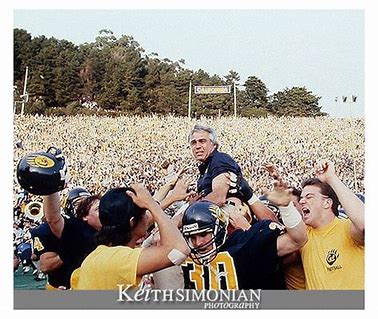
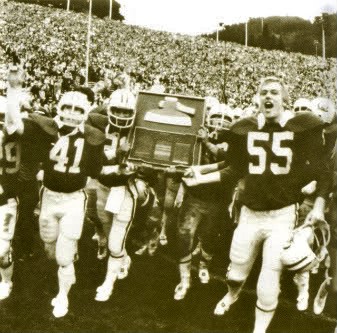
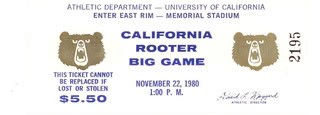
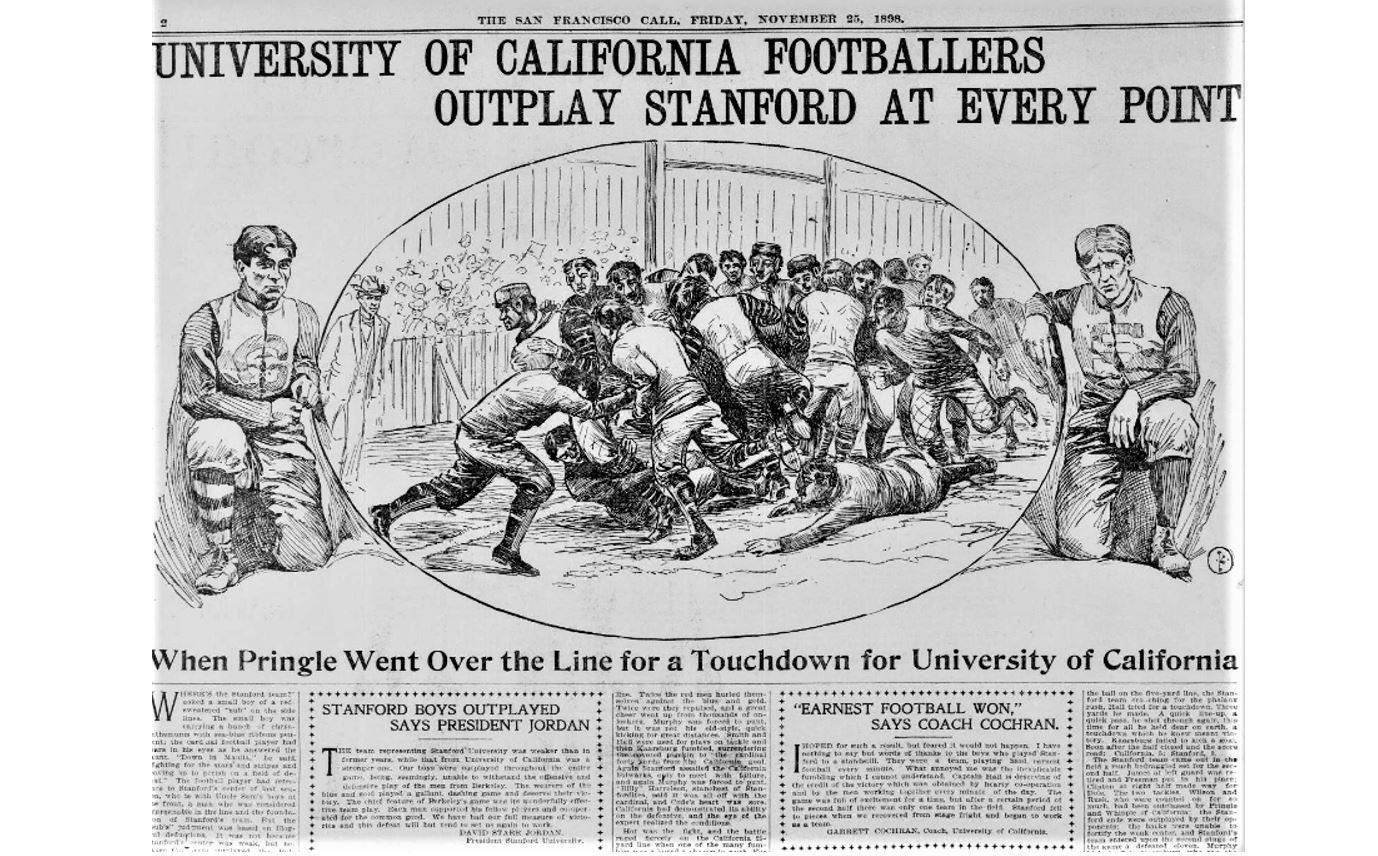
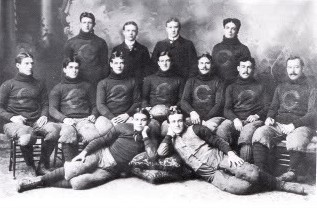
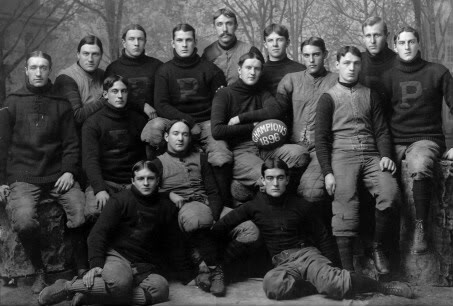
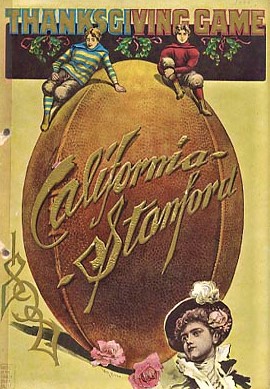
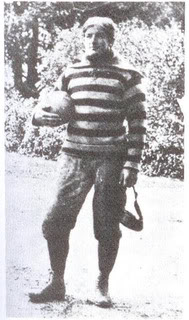

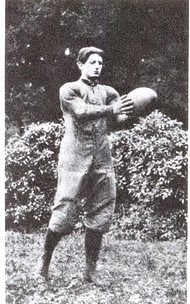
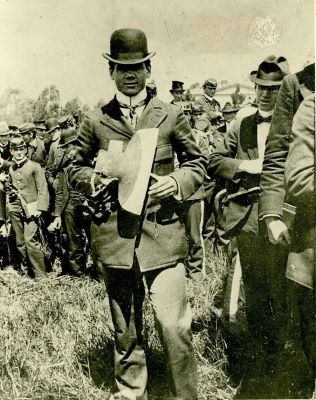
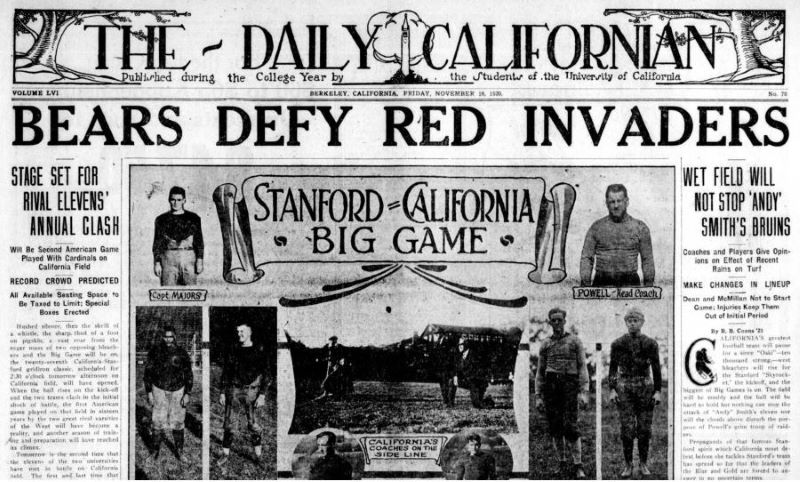
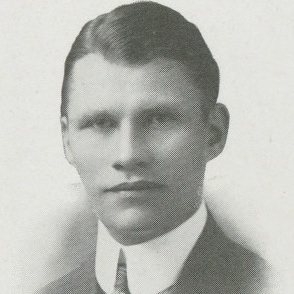


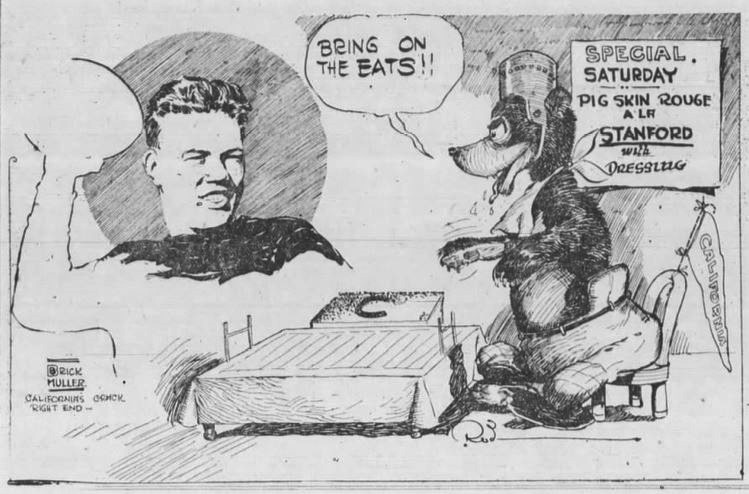

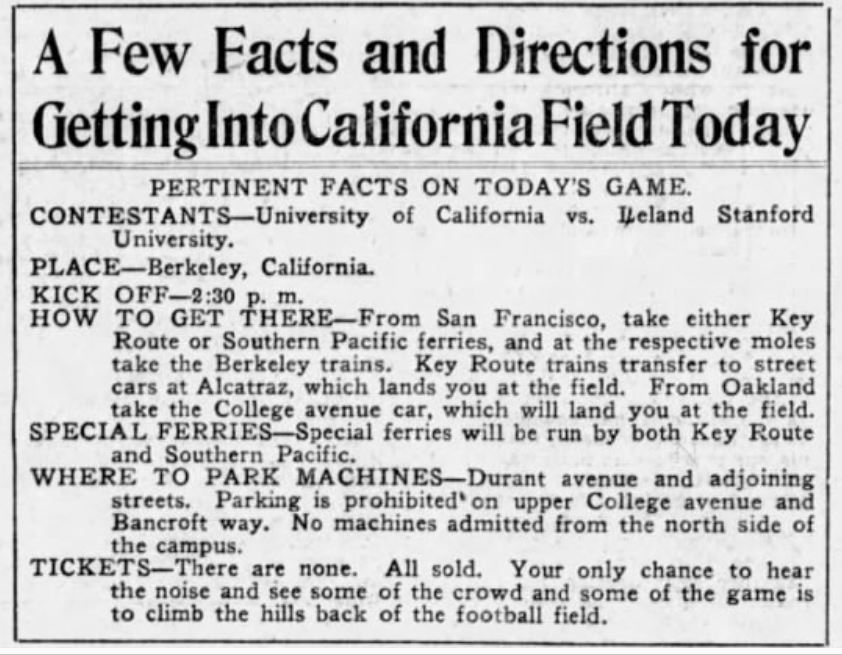
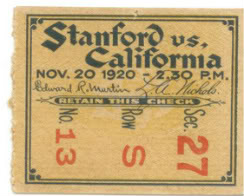
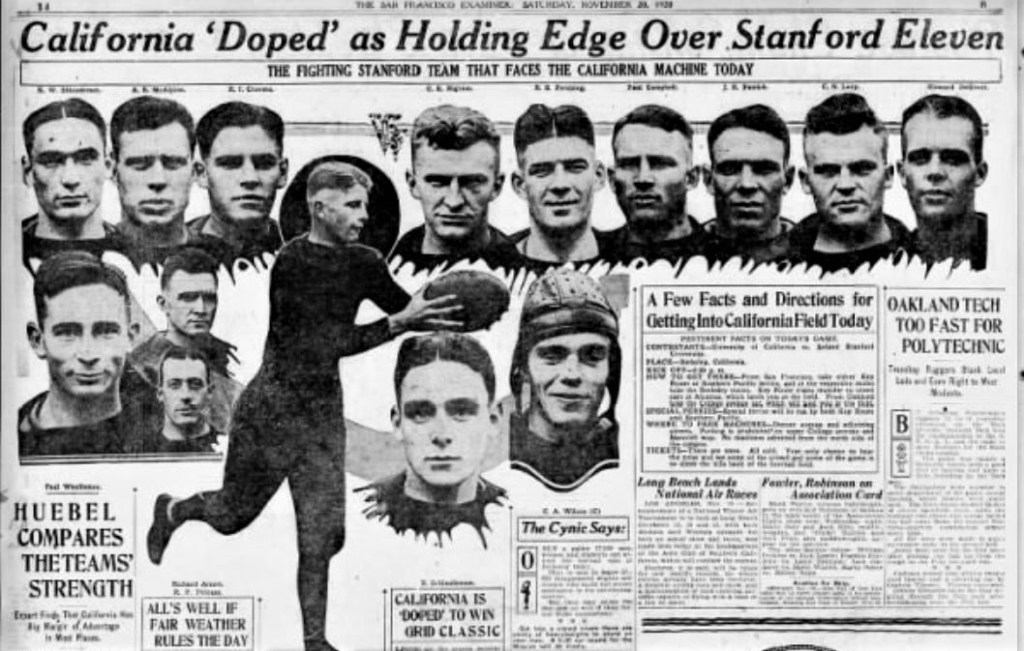
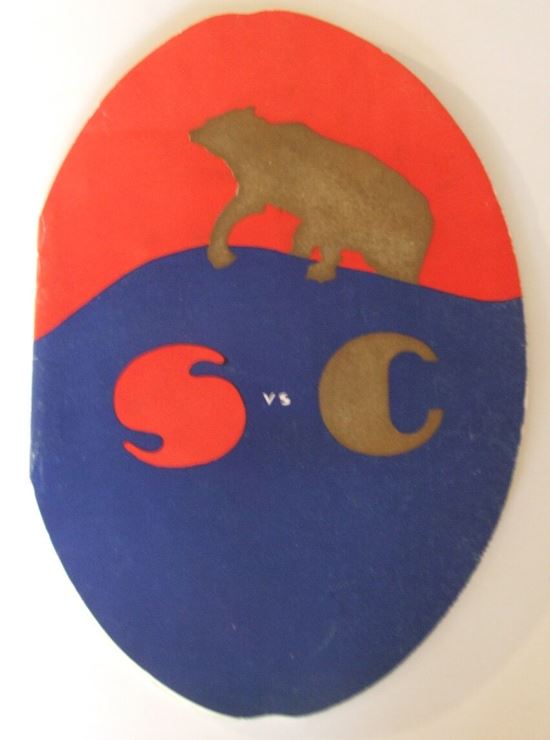

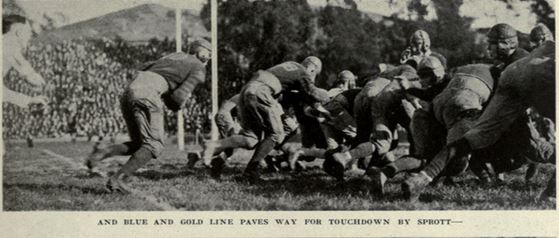

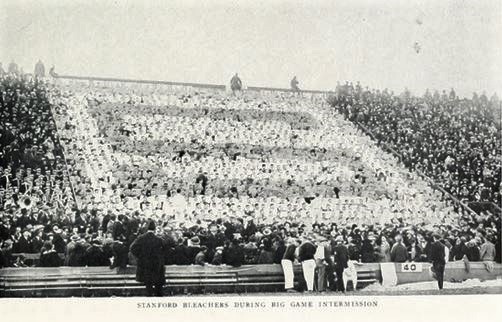
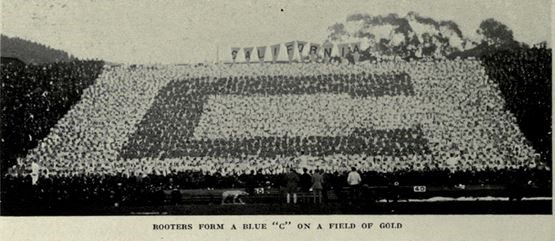

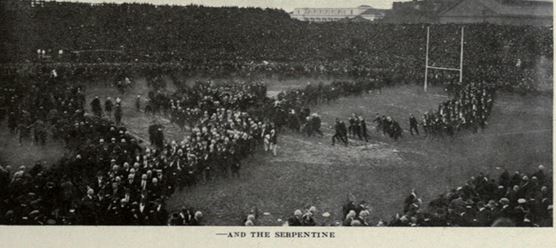
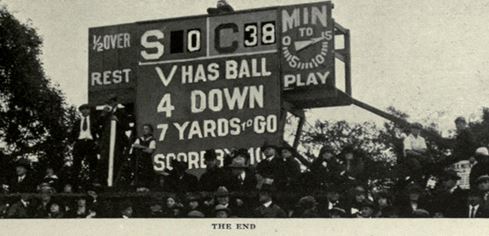
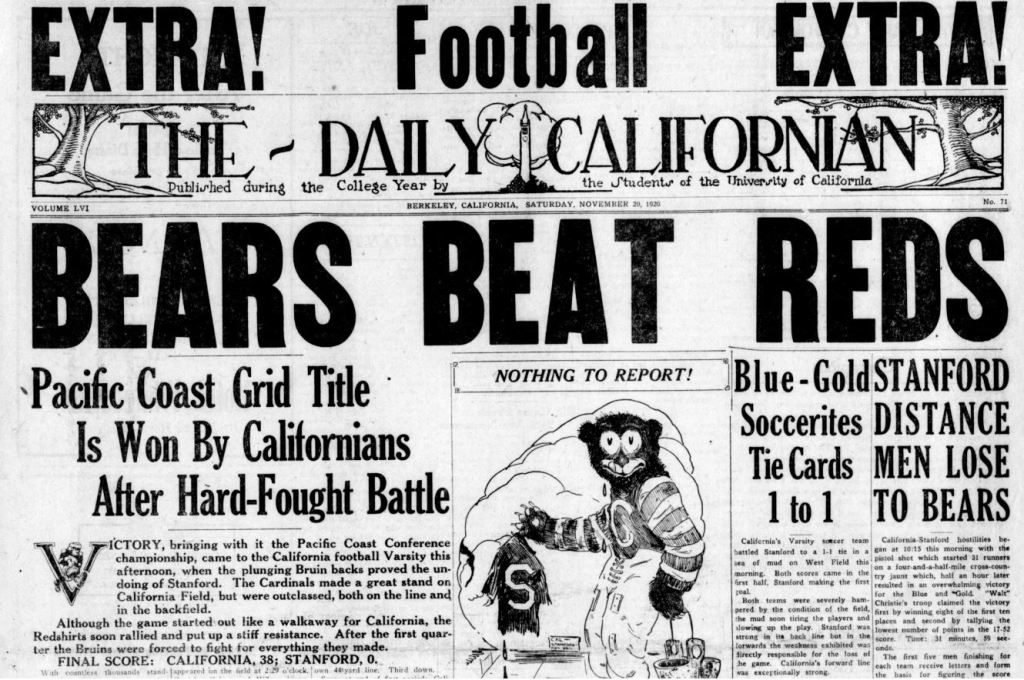
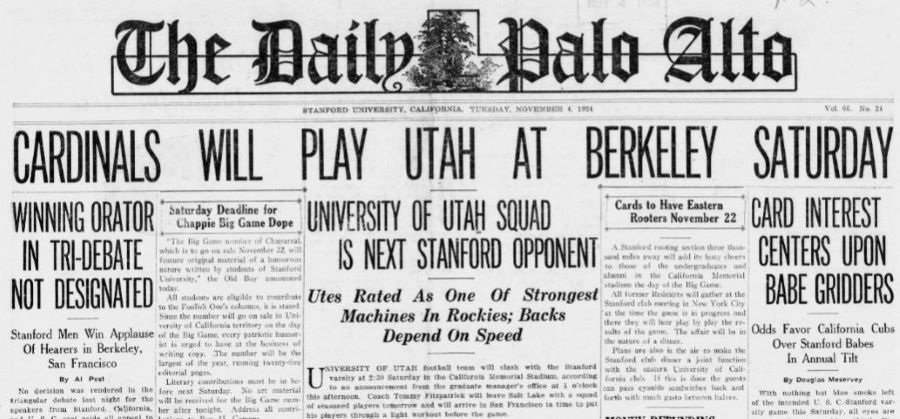


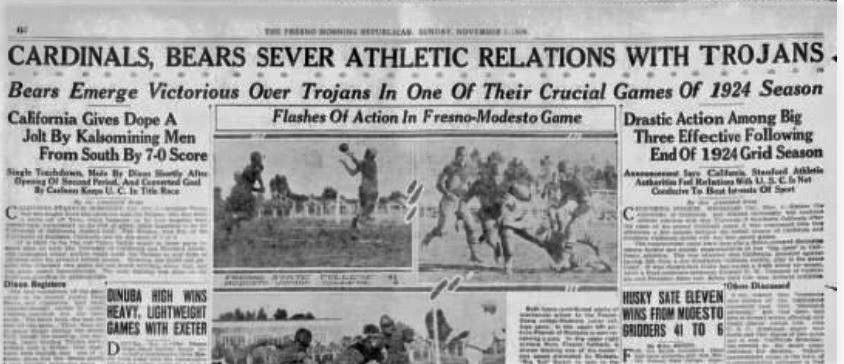
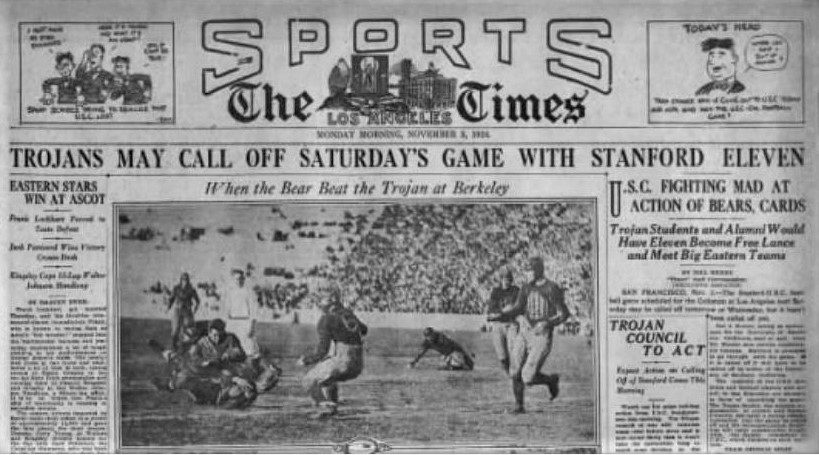
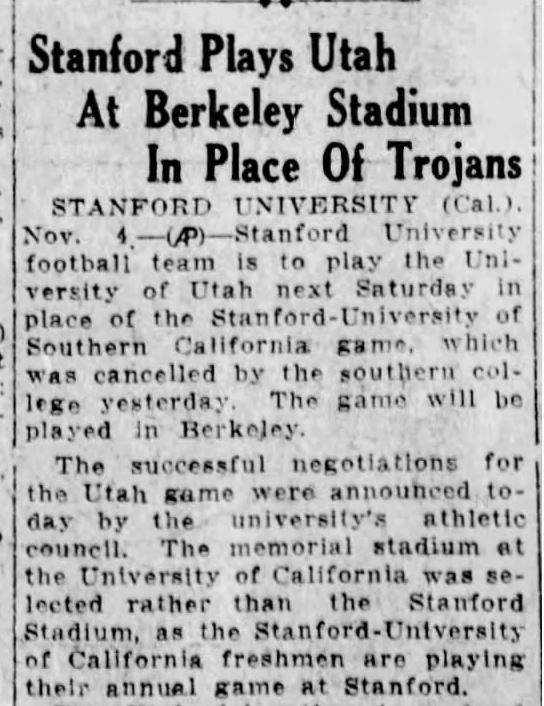
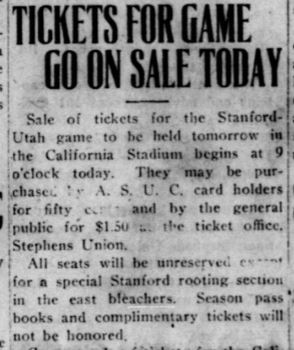
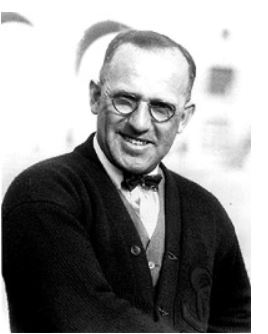

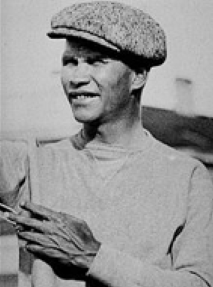
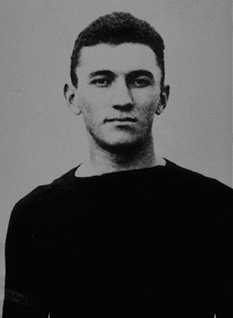

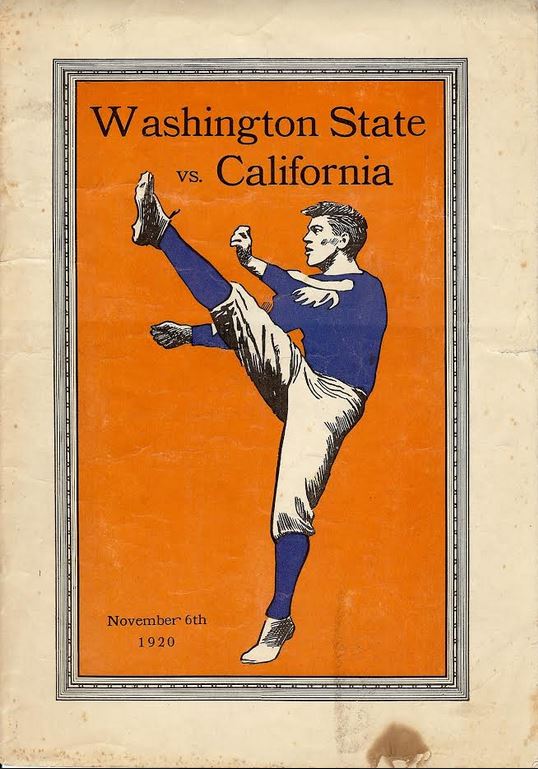
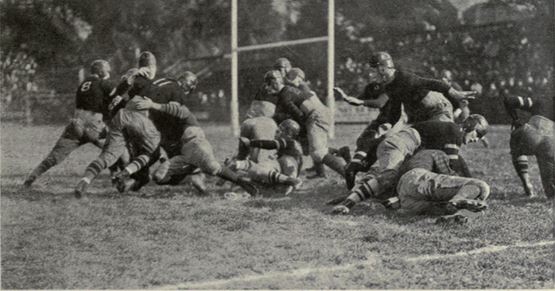
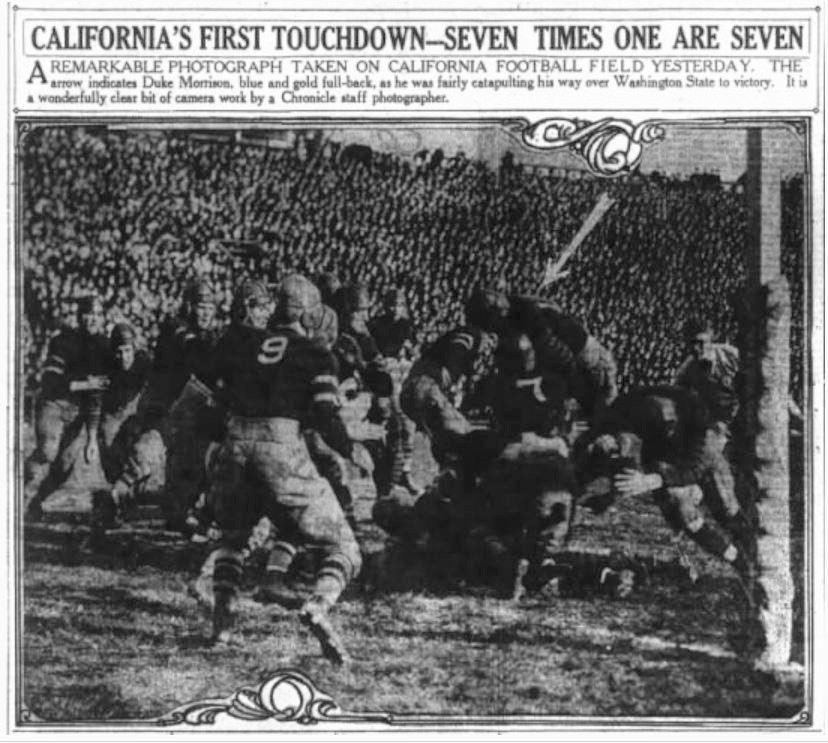
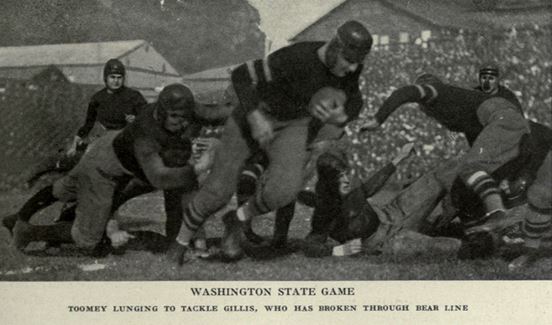

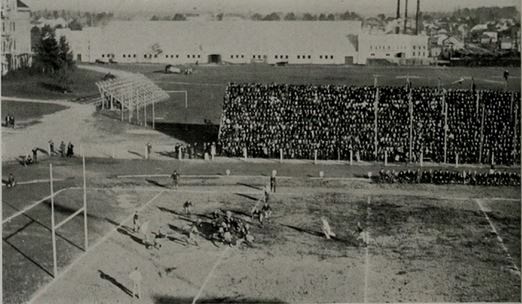
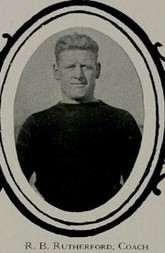
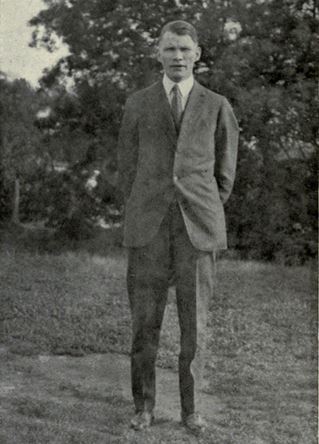

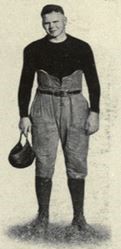
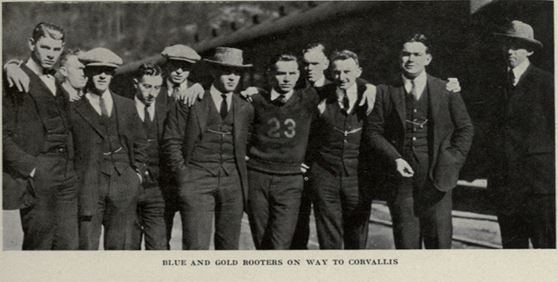

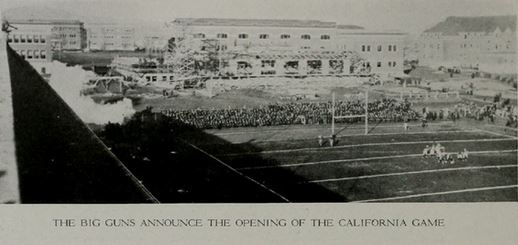
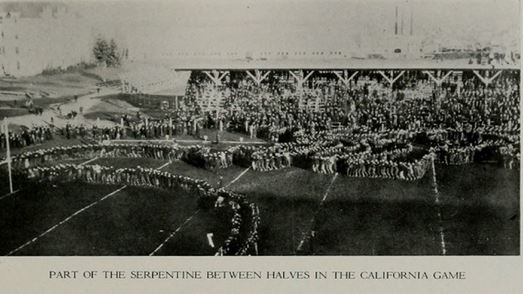
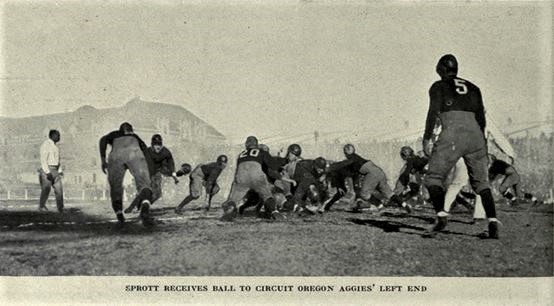
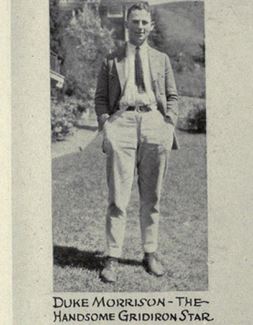
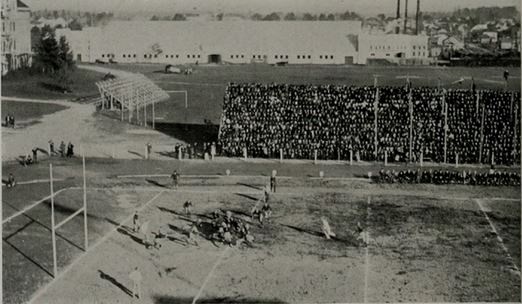
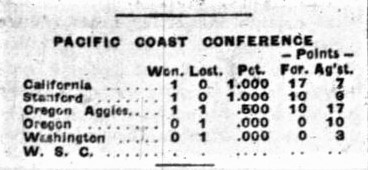

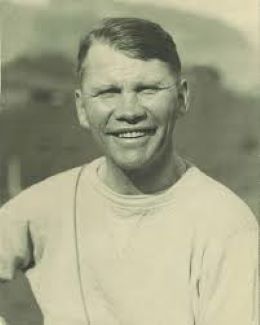

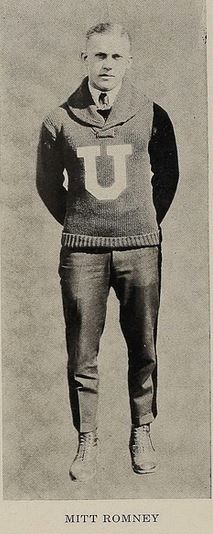
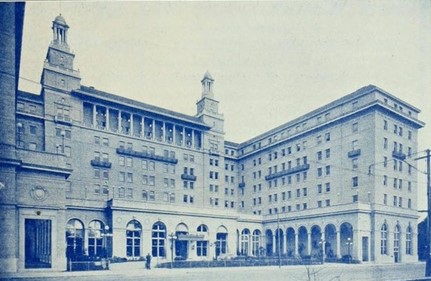
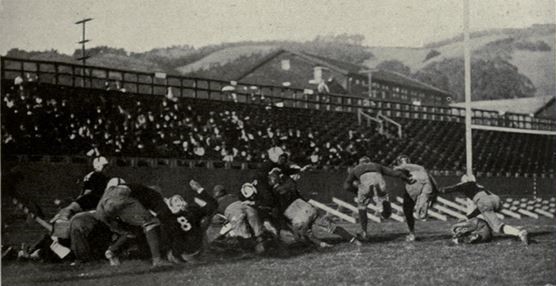
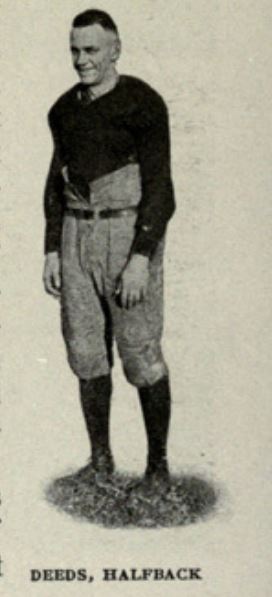
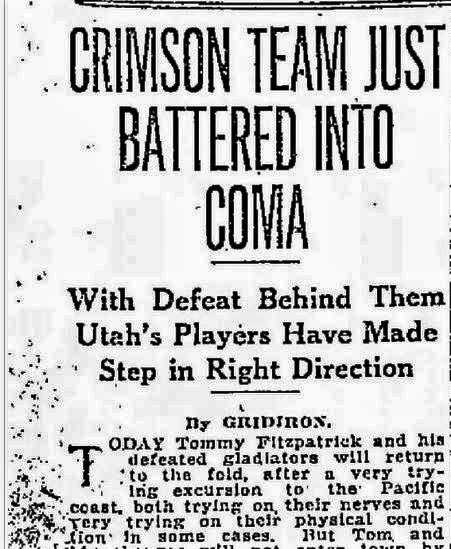
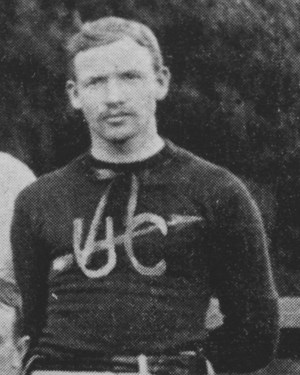
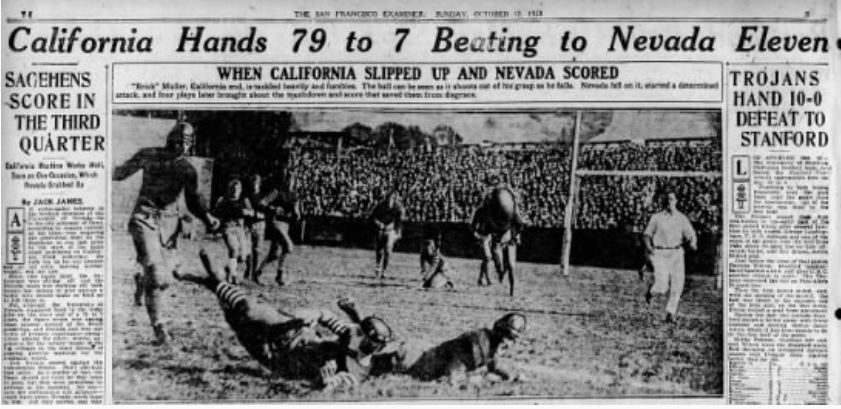
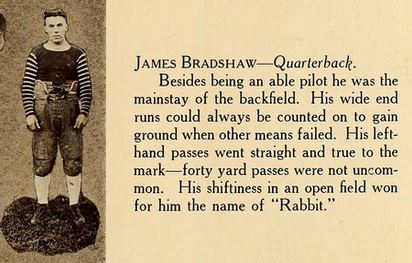
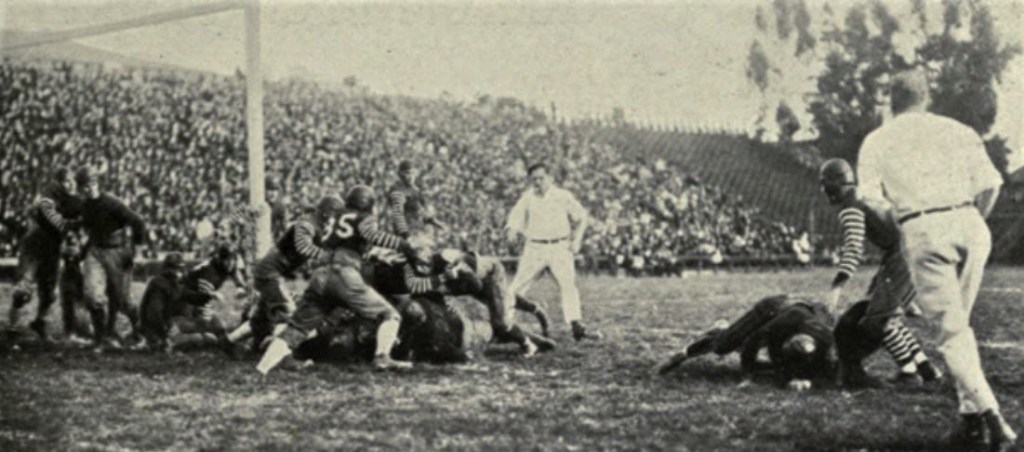
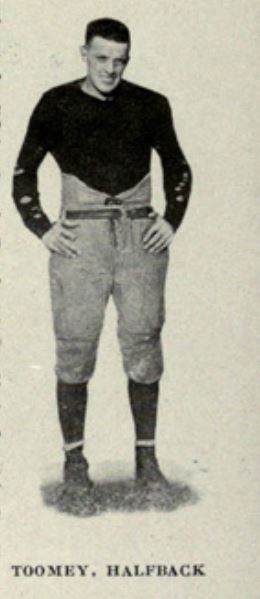
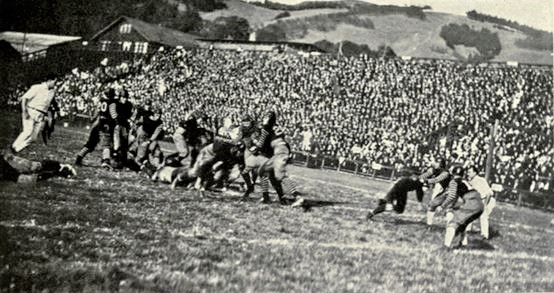
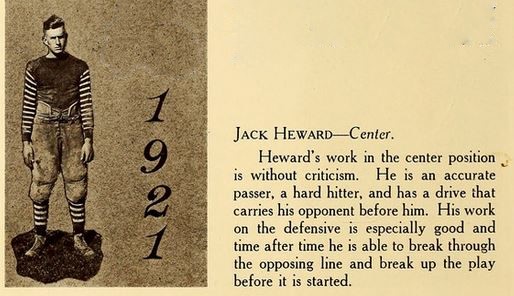
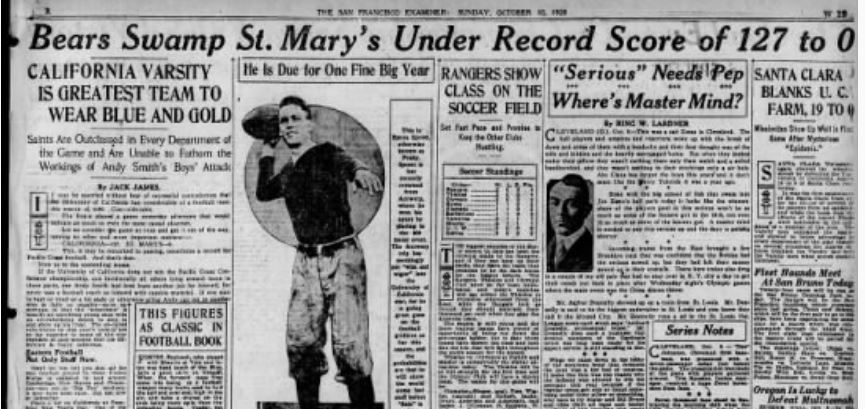
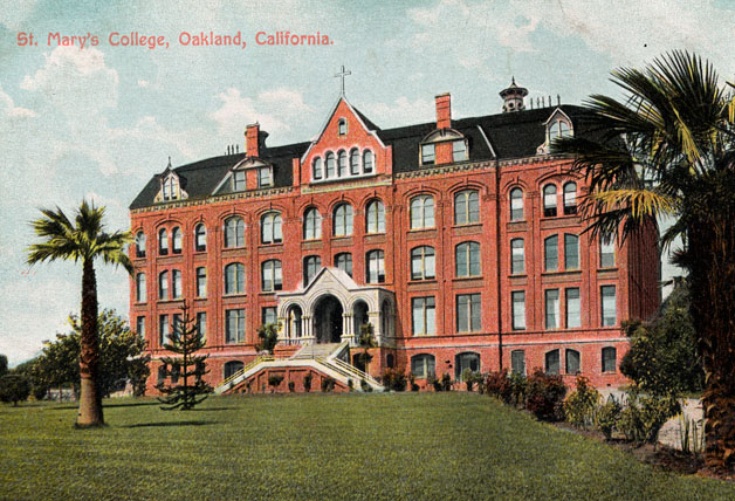
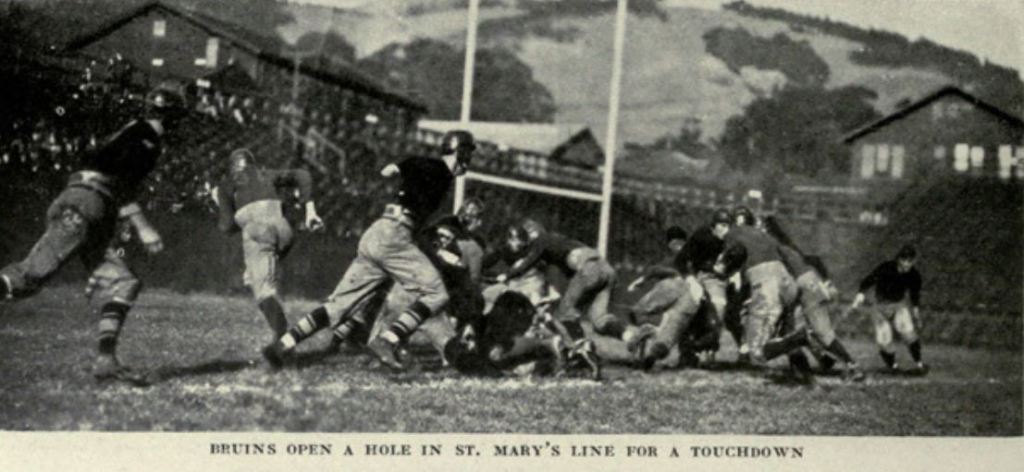
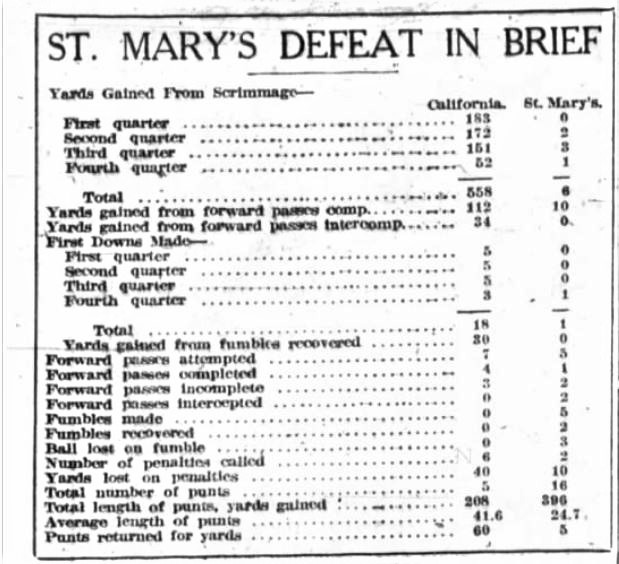

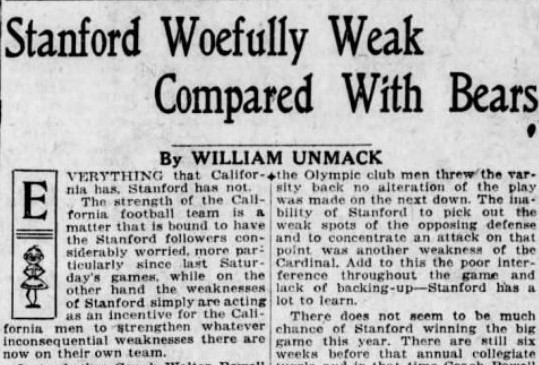
 Cal Bears History